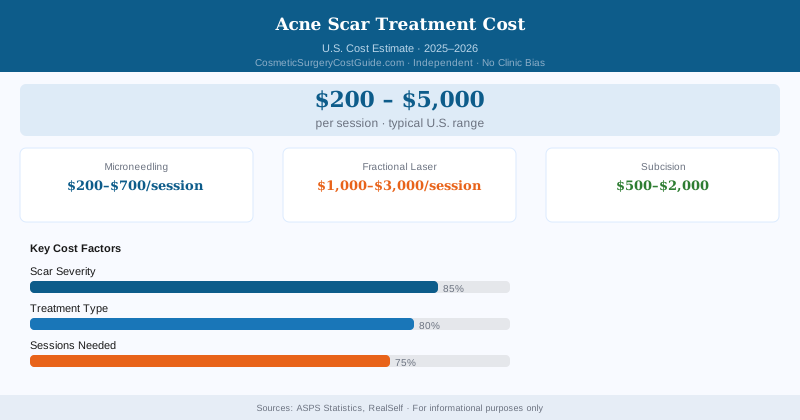
Which acne scar treatment actually works — and what does it cost?
That’s the question most people are really asking when they land on a page like this. And the honest answer is: it depends entirely on what type of scars you have. The biggest mistake isn’t picking a cheap treatment — it’s picking the wrong treatment and spending $2,000–$4,000 finding out it doesn’t work on your scar type. The American Society for Dermatologic Surgery estimates that over 80% of people with acne will develop some degree of scarring, and yet most scar treatment marketing glosses over the single most important factor: scar classification.
So let’s walk through this the right way.
What does acne scar treatment cost?
| Treatment | Cost Per Session | Sessions Needed | Total Cost | Best Scar Types |
|---|---|---|---|---|
| Microneedling | $300–$600 | 4 | $1,200–$2,400 | Rolling, superficial |
| RF Microneedling (Morpheus8) | $900–$1,500 | 3 | $2,700–$4,500 | Rolling, boxcar |
| Fraxel laser (non-ablative) | $1,000–$2,000 | 3–4 | $3,000–$8,000 | All atrophic types |
| Fractional CO2 laser | $1,500–$3,000 | 1–2 | $1,500–$6,000 | All atrophic types |
| Subcision | $300–$600 | 2–4 | $600–$2,400 | Rolling scars |
| TCA CROSS | $200–$500 | 3–5 | $600–$2,500 | Ice pick scars |
| Punch excision | $500–$1,500 | 1–2 | $500–$3,000 | Ice pick, deep boxcar |
| Filler (temporary) | $400–$800 | 1–2 | $400–$1,600 | Individual depressed scars |
| Fat grafting | $2,500–$5,000 | 1 | $2,500–$5,000 | Diffuse atrophic |
Why does the same treatment work for some people and not others?
Most patients with acne scarring have multiple types simultaneously. Identifying your scar types before choosing any treatment is the whole ballgame. Here’s what you’re actually looking at:
Ice pick scars: Narrow, deep pits that go far into the dermis. Think of a tiny hole punched into the skin. These do NOT respond well to surface resurfacing (laser, microneedling) because the scar extends too deep for surface-level collagen stimulation to reach.
- Best treatment: TCA CROSS (chemical reconstruction of skin scars — concentrated TCA applied precisely to the base of the scar) or punch excision
Rolling scars: Broad, shallow depressions with gently sloping edges. The skin looks wavy, undulating. These are caused by fibrous tethers pulling the epidermis downward from beneath.
- Best treatment: Subcision first (releases tethers), then laser or microneedling for surface texture. Fat grafting for comprehensive cases.
Boxcar scars: Wider, flat-bottomed depressions with defined edges. Similar to chicken pox scars.
- Best treatment: Fractional laser, RF microneedling, punch elevation for deeper ones
Many patients undergo extensive laser and microneedling treatment without significant improvement because their scars have active fibrous tethers pulling the skin downward. No amount of surface collagen stimulation can improve a tethered scar — you’re building new collagen on top of a depressed structure that’s being actively pulled down.
Subcision (inserting a needle under the scar to release tethers) should often be done FIRST or alongside any surface treatment. It’s one of the most cost-effective acne scar treatments at $300–$600/session, yet it’s underutilized. If you’ve done multiple laser sessions without improvement on rolling scars, discuss subcision with your provider.
What’s TCA CROSS, and why don’t more people know about it?
TCA CROSS (Chemical Reconstruction of Skin Scars) uses concentrated TCA (60–100%) applied precisely with a toothpick to the base of each ice pick scar. The concentrated acid triggers a controlled wound healing response that fills in the scar from the bottom up.
Cost: $200–$500/session, typically 3–6 sessions needed. That’s dramatically less expensive than laser for ice pick scars — and significantly more effective than any surface treatment for these deep, narrow scars.
If you have ice pick scars and you’re considering laser treatment, specifically ask your provider about TCA CROSS first.
What’s the difference between ablative and non-ablative laser?
Both use light energy to stimulate collagen. The difference is how aggressively they do it.
Fraxel Restore (non-ablative): Creates microscopic treatment zones in the dermis, leaving the surface skin intact. Downtime is 2–3 days. Good for improving texture, tone, and shallow-to-moderate atrophic scars. You’ll typically need 3–5 sessions.
Fractional CO2 (ablative): Creates microscopic ablation channels — it actually removes columns of tissue. More aggressive collagen stimulation, 5–10 days of real downtime. Often achieves in 1–2 sessions what Fraxel Restore takes 3–5 sessions for.
For significant acne scarring, ablative laser usually produces more dramatic results at a lower total session count, even though each session costs more and the downtime is real.
What does a full treatment plan look like?
The best outcomes for acne scarring almost always come from combination approaches. A typical staged protocol looks like this:
- Subcision: Release tethers (sessions 1–3)
- TCA CROSS: Treat ice pick scars (sessions 1–3, concurrent with subcision)
- Fractional laser or RF microneedling: Improve surface texture after subcision (sessions 3–6)
- Filler or fat grafting: Fill any persistent depressed areas that don’t fully respond
This staged approach typically costs $3,000–$8,000 total over 6–12 months. That sounds like a lot, but it’s more effective than spending the same money on a single modality that only addresses part of the problem.
Active acne must be controlled before treating acne scars. Treating scars while actively breaking out risks post-treatment inflammatory hyperpigmentation and creates new scars even as old ones are being treated. Most providers require that acne be well-controlled (often with topicals or isotretinoin) for 3–6 months before proceeding with scar treatment. Isotretinoin specifically: most providers require 6 months off isotretinoin before ablative laser treatment due to impaired wound healing.
I’ve been on Accutane — does that change things?
Yes, and it’s important. Patients who’ve used isotretinoin recently need a waiting period before certain treatments because the drug affects wound healing:
- Ablative laser: 6+ months post-isotretinoin
- Chemical peels: 3–6 months
- Microneedling: 3–6 months (some providers are more conservative)
- Subcision: Most providers allow sooner (1–3 months)
Always disclose your isotretinoin history to any provider before scheduling a skin procedure. Don’t assume they’ll ask.
Bottom Line
For comprehensive acne scar treatment: budget $3,000–$7,000 for a multi-modal approach (subcision + TCA CROSS + fractional laser) over 6–12 months. Individual modalities alone: microneedling course $1,200–$2,400, fractional CO2 $1,500–$3,000. The most important step isn’t picking the most popular treatment — it’s identifying your specific scar types and matching the protocol to those. The AAD recommends seeing a board-certified dermatologist for a formal scar assessment before committing to any treatment plan.