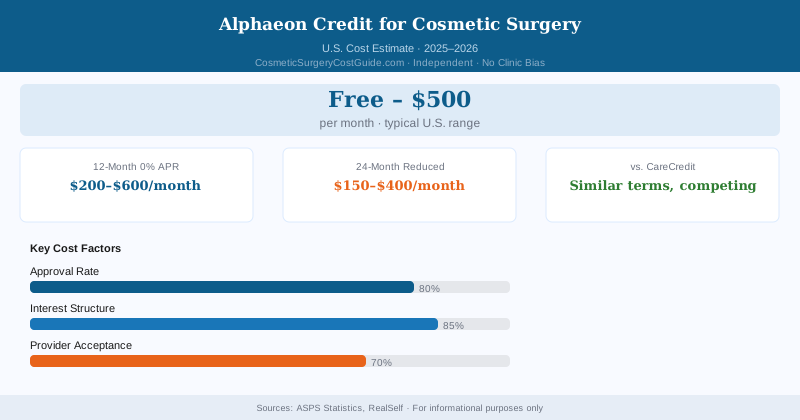
Alphaeon Credit vs. CareCredit: here’s what actually matters.
Both are medical credit cards. Both offer 0% promotional APR. Both will hit you with deferred interest if you don’t pay off the balance in time. So the real question isn’t which one sounds better — it’s which one your surgeon accepts, and whether either one is the right financing tool for what you’re spending.
Alphaeon Credit is issued by Comenity Capital Bank and accepted at thousands of plastic surgery, dermatology, and ophthalmology practices — though its network is smaller than CareCredit’s 225,000+ locations. If your surgeon takes both, here’s how to decide.
Alphaeon Credit at a Glance
| Feature | Alphaeon Credit | CareCredit |
|---|---|---|
| Standard APR | 26.99% | 29.99% |
| Promotional APR | 0% (deferred interest) | 0% (deferred interest) |
| Promotional periods | 6, 12, 18, 24 months | 6, 12, 18, 24 months |
| Long-term fixed APR | ~17.99% | ~17.90% |
| Credit limit | Up to $25,000 | Up to $25,000 |
| Provider network | Smaller | Larger (225,000+) |
| Application credit pull | Hard pull | Hard pull |
| Min credit score | ~620+ | ~620+ |
The only real difference between the two: standard APR
If you pay off your balance before the promotional period ends, Alphaeon and CareCredit are functionally identical. The gap only shows up if you miss that deadline.
Alphaeon’s standard rate: 26.99%. CareCredit’s: 29.99%. That’s a 3-percentage-point difference.
On a $10,000 balance left at standard APR, this works out to:
- Alphaeon: $2,699/year in interest
- CareCredit: $2,999/year in interest
- Annual savings with Alphaeon: $300
Real, but not dramatic. The more important variable for both cards is whether you pay off the promotional balance on time — the deferred interest structure makes both expensive if you don’t.
How the promotional structure works — and where it bites people
Like CareCredit, Alphaeon uses deferred interest promotions. That means all accrued interest — from day one — gets charged to your account if you haven’t paid off the full balance by the end of the promotional period. Not just interest on the remaining balance. All of it.
The math on a $10,000 procedure on an 18-month plan:
- Monthly payment to pay off completely on time: $556
- If $2,500 remains at month 18: approximately $4,500 in deferred interest gets added to your balance
- Result: you owe $7,000 instead of $2,500
Both products have this structure. Neither is “safer” than the other in this regard — the risk is identical and the discipline required is identical.
Some patients hold both cards for flexibility. Reasons this makes sense:
- Different procedures may be done at practices accepting only one card
- You can split a large procedure across two cards to stay within promotional period payoff ability
- Comparing available promotional terms at the time of procedure
Reasons to be cautious:
- Applying for both creates two hard credit inquiries
- Having two high-APR credit cards increases potential financial risk
- Managing payoff schedules across two cards is more complex
For most patients, one card applied for at the time of procedure is the cleaner approach. Having both cards isn’t necessary unless you frequently use different practices.
Where each card has the edge
Alphaeon was built specifically for the aesthetic/elective healthcare market — plastic surgery, cosmetic dermatology, ophthalmology, dental. That focus means most major cosmetic surgery practices accept it. CareCredit, meanwhile, has expanded into broader medical and dental networks — you’ll find it at more locations overall, including optometrists, orthodontists, and general practitioners.
For plastic surgery specifically, most established practices take both cards. If your surgeon only accepts one, that’s your answer.
Beyond the credit card itself, Alphaeon (through its parent Aedit platform) offers virtual consultations connecting patients with aesthetic providers and provider directory features. These extras don’t change the financial math, but they do indicate where Alphaeon’s focus lies.
If you need more than 24 months: neither card is your best option
For amounts that require more than 24 months to repay, the fixed-rate plans for both cards are nearly identical:
- Alphaeon: approximately 17.99% APR
- CareCredit: approximately 17.90% APR
The difference is 0.09%. At $10,000 over 36 months, that’s about $20 total — not meaningful. And at either rate, a personal loan from a bank or credit union is a better deal for anyone with decent credit (personal loan APRs: 6–15% for good-to-excellent credit), without the deferred interest trap.
How to choose: a realistic breakdown
| Situation | Recommended Option |
|---|---|
| Can pay off in 24 months or less | Either card — choose based on practice acceptance |
| Need 36+ months and good credit | Personal loan from bank/credit union |
| Need 36+ months and average credit | CareCredit or Alphaeon fixed plan; compare rates |
| Surgeon only accepts one card | Use whichever is accepted |
| Concerned about deferred interest trap | Consider personal loan for any amount |
Both Alphaeon and CareCredit report to credit bureaus. Late payments or defaults affect your credit score. If you carry a balance after the promotional period ends (even accidentally, by one month), both cards are essentially identical in consequence: the deferred interest is charged. The credit issuer doesn’t waive it for first-time mistakes or good-faith errors. Set automatic payments and monitor your balance — the end of the promotional period is not forgiving.
Bottom Line
Alphaeon and CareCredit are nearly identical products. Alphaeon’s standard APR is marginally lower (26.99% vs. 29.99%), which only matters if you miss the promotional payoff deadline. Both use deferred interest structures that get expensive fast if you don’t pay the balance in full. At practices accepting both, go with whichever offers a longer promotional period for your specific procedure. If you need more than 24 months to pay it off and your credit is decent, a personal loan from a bank or credit union beats both cards on rate and avoids the deferred interest structure entirely.