Nobody goes into a rhinoplasty consultation thinking about anesthesia. They’re thinking about their nose. The anesthesia part feels like a logistical detail — the surgeon’s problem to manage.
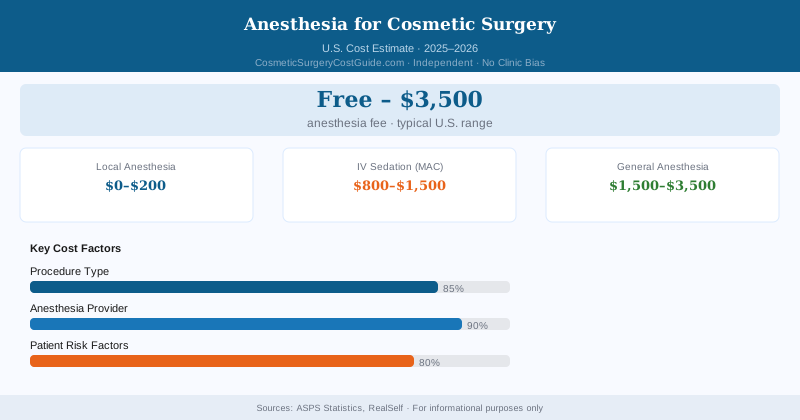
It isn’t. Anesthesia type affects your safety profile, your recovery timeline, and a real chunk of your total cost. The ASPS reports that anesthesia accounts for $800–$3,500 of total cosmetic surgery costs depending on type and duration. That’s before we get to the risk conversation, which is even more important than the money.
Local Anesthesia: The Safest Option
Local anesthesia means a numbing injection — lidocaine, bupivacaine, or a similar agent — directly at the treatment site. You’re fully awake. You feel pressure and movement but not pain. No IV, no recovery room, no fasting requirements.
Local is used for minor procedures: small excisions, mole removal, minor skin procedures, lip augmentation injections. The risk profile is essentially limited to rare lidocaine toxicity (almost never seen at normal doses) and normal post-procedure soreness.
Cost: $0–$200, often bundled into the procedure fee.
Tumescent Local Anesthesia
A specialized variation used primarily in liposuction, tumescent anesthesia involves infusing large volumes of a diluted lidocaine and epinephrine solution directly into the treatment area. The epinephrine constricts blood vessels, dramatically reducing blood loss. The patient stays awake throughout.
Research published in Dermatologic Surgery established tumescent liposuction’s safety record — when performed under tumescent local anesthesia only, serious complication rates are extremely low. Many liposuction providers now offer this as a safer alternative to general anesthesia for appropriate candidates.
Cost: $200–$600, typically bundled into the liposuction fee.
IV Sedation / Twilight Anesthesia
“Twilight” is the colloquial term, though the more accurate description is conscious sedation or monitored anesthesia care (MAC). An IV delivers sedative medications — often propofol and/or midazolam — that leave you deeply relaxed, often with limited memory of the procedure, while you continue breathing on your own. Local anesthesia is usually administered alongside it for actual pain management.
This is the most commonly used anesthesia for mid-level cosmetic procedures: rhinoplasty, blepharoplasty, breast augmentation, otoplasty, and many facial procedures. You’re not fully unconscious, there’s no breathing tube, and recovery is faster than general anesthesia.
A CRNA (Certified Registered Nurse Anesthetist) or anesthesiologist typically administers and monitors IV sedation. The key word is “typically” — see the warning below.
Cost: $800–$1,500, usually billed separately from the surgical fee.
General Anesthesia
General anesthesia renders you fully unconscious and unable to breathe independently. A breathing tube (endotracheal tube) is placed to manage your airway. An anesthesiologist must be present and directing your care throughout.
General anesthesia is used for major procedures: abdominoplasty (tummy tuck), body lifts, extended facelifts, combined procedures. Recovery takes longer than IV sedation — the lingering effects of anesthetic agents, plus the physiological stress of intubation, mean more time in the recovery room and more post-operative fatigue.
Cost: $1,500–$3,500, billed separately from the surgical fee.
| Anesthesia Type | Consciousness | Breathing | Typical Procedures | Typical Cost | Recovery Time |
|---|---|---|---|---|---|
| Local only | Fully awake | Independent | Minor excisions, injections | $0–$200 | Minimal |
| Tumescent local | Fully awake | Independent | Liposuction (appropriate candidates) | $200–$600 | 1–2 days |
| IV sedation / MAC | Drowsy/amnestic | Independent | Rhinoplasty, breast aug, blepharoplasty | $800–$1,500 | 2–4 hours |
| General anesthesia | Fully unconscious | Intubated | Abdominoplasty, body lift, major combined | $1,500–$3,500 | 4–8 hours |
Who Should Administer Your Anesthesia
This is not a minor detail — it’s one of the most important safety questions you can ask.
An anesthesiologist holds an MD or DO degree plus a four-year anesthesiology residency. A CRNA holds a nursing degree plus a two-to-three-year nurse anesthesia program — highly trained professionals who handle the majority of anesthesia cases in the US safely. Both are appropriate providers for cosmetic procedures.
What isn’t appropriate is a surgeon administering anesthesia to their own patient.
If your surgeon plans to administer anesthesia themselves while also performing your procedure, find another surgeon. Safely managing anesthesia requires continuous monitoring and the ability to respond to changes without interruption. A surgeon cannot simultaneously focus on the operative field and monitor your airway, vital signs, and anesthetic depth. This is a fundamental patient safety issue — not a preference or a convenience question.
Ask directly at your consultation: “Who administers anesthesia, and will they be present for the entire procedure?”
Risk Factors That Elevate Anesthesia Risk
Most healthy adults tolerate all anesthesia types well. Certain factors increase risk and should be disclosed to your surgical team well before surgery day:
BMI above 30–35: Increases risk of airway complications under general anesthesia, aspiration risk, and post-operative breathing issues. Many surgeons require physician clearance before proceeding.
Obstructive sleep apnea (OSA): Significantly elevates airway risk under sedation and general anesthesia. Patients with OSA should have it formally evaluated and may need to bring their CPAP machine to surgery.
Active smoking: Nicotine impairs oxygen delivery to tissues. Most anesthesiologists recommend at least two weeks of smoking cessation before general anesthesia; plastic surgeons often require six weeks before elective procedures.
Certain medications: Blood thinners, herbal supplements (fish oil, vitamin E, ginkgo, St. John’s Wort), and some antidepressants affect bleeding and anesthetic drug interactions. Disclose everything, including things that feel “natural.”
Prior adverse anesthesia reactions: Family history of malignant hyperthermia — a rare but life-threatening reaction to certain anesthetic agents — must be disclosed. It’s screened for specifically once identified.
At your consultation, ask:
- What type of anesthesia do you recommend for this procedure, and why?
- Who administers and monitors anesthesia — is it an MD anesthesiologist or CRNA?
- Will the anesthesia provider be present for the entire procedure?
- Where is the surgery performed — is it an accredited facility with emergency equipment?
- What’s your protocol if I have an adverse anesthesia reaction?
- What do I need to do before surgery to prepare (fasting, medication holds, smoking cessation)?
Anesthesia deserves the same attention you give to reviewing the surgeon’s before-and-after photos. It’s the part of the procedure most patients think about least — and the part that most directly affects your safety on the day itself.