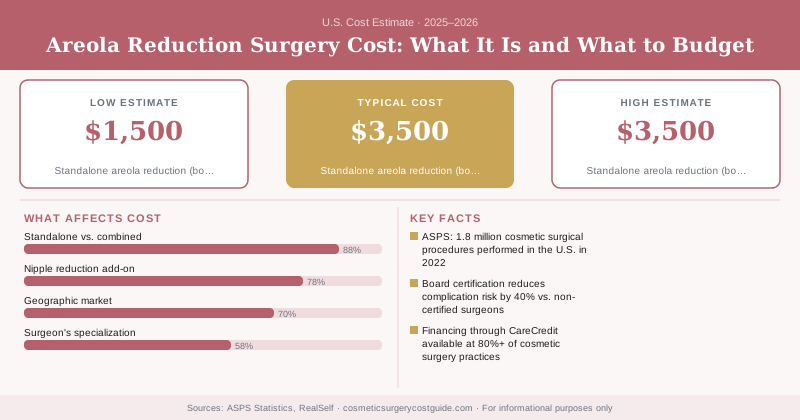
Most patients assume areola reduction is a major surgery with a steep price tag. It’s not. Standalone areola reduction costs $1,500–$4,000. When added to breast augmentation, a breast lift, or breast reduction you’re already having, the incremental cost drops to $400–$1,500 — because the operating room, anesthesia, and sterile setup are already in place.
It’s a short procedure — 45 to 90 minutes under local anesthesia in most standalone cases — with results that are permanent. The incision line runs along the perimeter of the areola, where the color transition naturally conceals it. For women who’ve experienced areola enlargement after pregnancy, breastfeeding, or significant weight changes, or who simply have naturally large areolae they’ve been self-conscious about, it’s one of the most cost-efficient corrective procedures available.
Cost breakdown
| Scenario | Typical Total Cost |
|---|---|
| Standalone (both areolae) | $1,500–$4,000 |
| Added to breast lift (mastopexy) | $400–$1,200 incremental |
| Added to breast augmentation | $400–$1,000 incremental |
| Added to breast reduction | Often included — no add-on fee |
| Combined with nipple reduction | $2,500–$5,000 total |
Standalone procedures fold in the surgeon fee ($1,000–$3,000), facility or procedure room fee, and local anesthesia. Combined procedures are cheaper per line item because you’re sharing the general anesthesia and OR time you’re already paying for.
Geographic variation is real: practices in Los Angeles and New York charge 30–50% more than comparable board-certified surgeons in the Midwest or South. For a $2,000 procedure in Nashville, expect $2,800–$3,200 for equivalent work in Miami or San Francisco.
What the surgery involves
The technique is called a periareolar or “donut mastopexy” approach. Your surgeon marks two concentric circles on the areola: the inner circle defines the desired final diameter, the outer circle marks the current edge. The ring of pigmented skin between those two circles is excised. The outer breast skin is then sutured to the new areola edge.
Most surgeons place a permanent purse-string suture around the perimeter during closure — this is called “blocking” the scar, and it prevents the sutured edge from spreading during healing. Without it, the circular scar has a tendency to widen.
The procedure takes 45–90 minutes. In standalone cases, you’re awake with local anesthesia and go home the same day. Recovery involves bandages for 3–7 days, a soft bra without underwire for 4–6 weeks, and no strenuous exercise for 4 weeks.
The permanent scar — an honest conversation
The incision runs entirely around the areola. That means the scar is circular and sits exactly at the areola-skin junction. The good news: that color transition is one of the best natural camouflage lines on the body. On most patients, the scar heals flat and becomes nearly invisible within 12–18 months.
The risk: on patients prone to hypertrophic or keloid scarring, the circular scar can be visible, raised, or hyperpigmented. According to the American Society of Plastic Surgeons, scar-related dissatisfaction is the most commonly reported source of post-procedure regret for areola reduction — making scar history one of the most important topics to cover before surgery.
Think about how previous incisions have healed on you — C-sections, laparoscopic ports, or even childhood wounds. If scars tend to stay flat and fade within a year, areola reduction scarring will likely heal well at the color junction. If you’ve had raised, itchy, or widened scars, tell your surgeon before committing. They can discuss preventive options: silicone sheeting post-healing, steroid injections, or laser treatment to manage the scar’s appearance if it becomes prominent.
What affects your cost
Standalone vs. combined: This is the single biggest cost driver. If you’re already planning breast augmentation or a breast lift, adding areola reduction is an easy cost-effective decision.
Nipple reduction add-on: Some women combine areola reduction with nipple projection reduction. Combined procedures run $2,500–$5,000 total depending on technique complexity.
Surgeon’s specialty and volume: Breast-specialist plastic surgeons charge more — and have more experience with the periareolar incision’s specific pitfalls. Volume on this technique matters for scar outcomes.
ASPS 2023 annual statistics report shows that periareolar procedures including areola reduction remain consistently popular, with strong patient satisfaction rates tied directly to surgeon selection and scar management.
Combining with breast reduction: when insurance enters the picture
Standalone cosmetic areola reduction is never covered by insurance. But there’s a meaningful exception: if you’re pursuing medically necessary breast reduction and areola reduction is performed as part of that procedure, it may be covered under your health plan. The Women’s Health and Cancer Rights Act also requires coverage for areola reconstruction following mastectomy.
If your breast reduction is being billed as medically necessary (documented macromastia causing physical symptoms), ask your surgeon’s billing team whether the areola component is included in the coverage or coded separately.
Periareolar incisions — including those used in areola reduction — carry a small risk of reduced nipple sensation. The circular nerve supply to the nipple runs through the tissue at the incision line. The risk is low for standalone areola reduction but increases when multiple periareolar incisions are combined (for example, areola reduction plus a periareolar breast lift). If you’re combining both, ask your surgeon specifically how they plan to protect sensory nerve pathways — it’s a technical question with a technical answer you’re entitled to hear.
Bottom line
Standalone areola reduction costs $1,500–$4,000. Combined with breast surgery you’re already having, it’s one of the most cost-effective additions in cosmetic surgery — $400–$1,200 incremental for a permanent result built into the same recovery period. The scar is real and runs the full circumference of the areola, but heals excellently in patients with favorable scar genetics. Consult a board-certified plastic surgeon who specializes in breast surgery, review their before-and-after areola cases specifically, and be direct about your personal scar history before you book.