Picture this: you’ve lost 70 pounds. You worked for it — diet, exercise, maybe a couple of years of real commitment. The scale reflects it. Your health is better. But your arms tell a different story. The skin that stretched over years of carrying extra weight doesn’t bounce back. You avoid sleeveless tops. You cover up at the beach. And every tricep workout you do just sits underneath a curtain of loose skin that doesn’t respond to anything.
That’s the patient who ends up in a plastic surgeon’s office asking about brachioplasty. Arm lift surgery — not fat removal, but actual skin excision — is the only thing that fixes it. No cream, no device, no exercise program changes permanently inelastic skin.
The trade-off is a scar running along the inner arm. For patients dealing with chronic skin chafing, rashes under the skin folds, or significant aesthetic distress, that scar is typically a worthwhile exchange. For patients with mild laxity, less invasive options may apply.
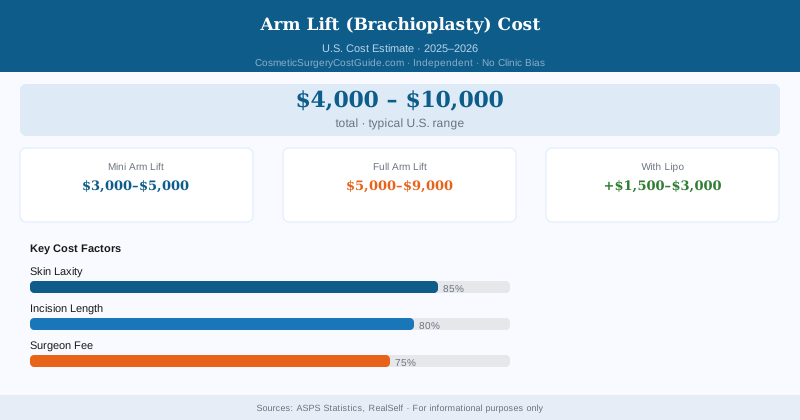
ASPS 2024 data puts the average surgeon fee for arm lift at $4,861. All-in costs run $6,000–$10,000.
Arm Lift Cost Breakdown
| Cost Component | Typical Range |
|---|---|
| Surgeon’s fee | $3,500–$7,000 |
| Anesthesia | $900–$1,500 |
| Facility fee | $800–$1,500 |
| Compression garment | Often included |
| Follow-up appointments | Usually included |
| Total all-in | $5,500–$10,000 |
Types of arm lift procedures
Not every arm lift is the same. The type you need depends on where the excess skin is and how much there is:
Limited/minimal incision brachioplasty: A shorter scar confined to the armpit area. Works for patients with mild skin laxity in the upper arm only, near the axilla. Less dramatic results but more hidden scar.
Standard brachioplasty: Scar runs from the armpit to the elbow along the inside of the arm. Addresses moderate to significant excess skin. This is the most common type.
Extended brachioplasty: Extends the incision into the lateral chest/bra area. Needed for patients with excess skin extending onto the chest wall — common after massive weight loss.
Brachioplasty + liposuction: Adding liposuction helps remove any residual fat deposits while the skin is being excised. Most surgeons perform some concurrent liposuction as part of the procedure.
The inner arm scar from brachioplasty is permanent, though it softens and fades over 12–18 months. In lighter-skinned patients, a mature scar may become nearly imperceptible when the arm is at rest. In darker skin tones, scars may remain more visible. Most patients — especially those who’ve dealt with chafing, skin rashes, or significant aesthetic distress — consider the scar a worthwhile trade. Ask your surgeon to show you photos of healed scars from patients with similar skin tone to yours.
Arm lift vs. arm liposuction
If excess skin isn’t really the issue — just excess fat with reasonably elastic skin — arm liposuction alone can produce excellent results without any significant scarring. It’s appropriate for:
- Younger patients (typically under 40) with good skin elasticity
- Patients whose main concern is fat volume, not loose skin
- Patients who wouldn’t trade a visible scar for the improvement
Arm liposuction costs $2,500–$5,000 all-in — significantly less than a full brachioplasty. The skin needs enough elasticity to contract after fat removal; otherwise you’ll end up with looser skin than before. A consultation with a board-certified plastic surgeon will tell you whether liposuction alone or a combined approach is appropriate for your anatomy.
Who gets the best results
Ideal arm lift candidates:
- Have reached a stable weight — not still losing or gaining
- Have excess skin from weight loss, aging, or genetics (not just fat)
- Don’t smoke (smoking significantly increases scar complications)
- Understand and accept the scar trade-off
- Have realistic expectations about recovery
Patients who recently had bariatric surgery and are still losing weight should wait until weight has been stable for 6–12 months before proceeding. Operating on a body that’s still changing produces results that may need revision — you don’t want to pay for this twice.
Arm lift is among the procedures where the scar complication rate is highest if the patient smokes. Nicotine constricts blood vessels, impairing the healing of the lengthy arm incision. Surgeons typically require cessation of smoking for 4–6 weeks before and after surgery. This is not a negotiable recommendation — wound healing complications (separation, infection, hypertrophic scarring) are meaningfully more common in smokers.
Combining arm lift with other procedures
Arm lift is frequently combined with:
- Body lift after weight loss: Arm, thigh, and torso procedures are often staged or combined for patients after massive weight loss
- Breast lift or reduction: The lateral chest extension from an extended brachioplasty often connects naturally with breast procedures
- Liposuction of other areas: Combined during the same session to spread anesthesia and facility costs across multiple areas
Adding a single-area liposuction to an arm lift typically adds $1,500–$2,500 — much less than scheduling it as a separate procedure.
Recovery timeline
- Arm movement restricted for 2 weeks
- Compression garment worn 4–6 weeks
- No strenuous arm exercise for 4–6 weeks
- Desk work possible in about 1 week
- Physical labor: 3–4 weeks out
- Final results at 6–12 months (scar maturation takes up to a year)
Bottom Line
Budget $6,500–$9,000 all-in for a standard brachioplasty with a board-certified plastic surgeon. If liposuction alone is appropriate for your anatomy, $3,000–$4,500 covers most markets. According to ASPS, arm lift was among the top 10 body contouring procedures in 2023 — demand has grown alongside the rise of weight-loss surgery. For patients dealing with functional skin issues or real aesthetic distress from excess arm skin, the procedure consistently delivers meaningful quality-of-life improvement. Just go in with clear, honest expectations about the scar.