If you’re reading this, you’re probably trying to figure out whether the cheaper surgeon is a reasonable choice — or whether you’d be making a serious mistake.
You’ve gotten multiple quotes. One stands out as significantly lower. The practice looks professional. The website says “board certified.” You’re wondering if the extra $3,000 or $5,000 is really buying you anything meaningful, or if it’s just brand premium.
Here’s an honest answer.
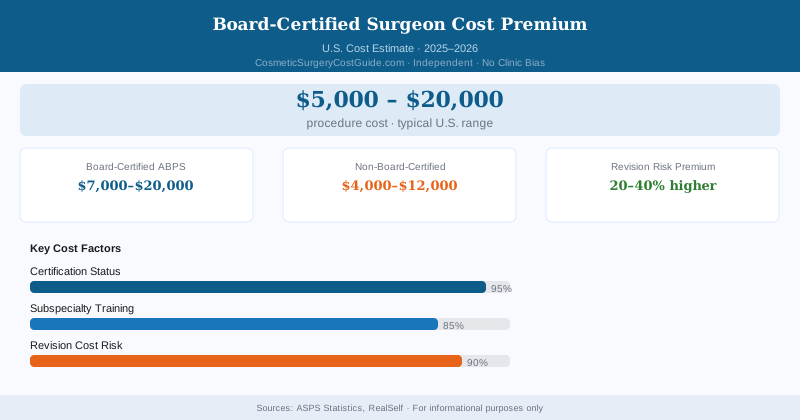
The price difference is real. A non-board-certified surgeon typically quotes 20–40% less for identical-sounding procedures. On a rhinoplasty, that’s a $4,800 quote vs. $9,200. On a facelift, it’s $10,000 vs. $18,000. But “board certified” appears on more than 150 different medical board websites — including some that function primarily as marketing organizations with minimal training requirements. The phrase itself means almost nothing without knowing which board.
What “board certified” actually means in plastic surgery
There are two relevant certifications in cosmetic surgery, and they’re not equivalent:
American Board of Plastic Surgery (ABPS) — The gold standard. Requires completion of a full plastic surgery residency (5–7 years post-medical school), a fellowship examination, an oral examination, and ongoing maintenance of certification. ABPS surgeons are trained in both reconstructive and cosmetic surgery.
American Board of Cosmetic Surgery (ABCS) — A newer, separate board. Surgeons may have completed different residency training (dermatology, general surgery, ENT) and then completed a cosmetic surgery fellowship. It’s technically board certification, but it’s a different and shorter training path than ABPS.
ABCS surgeons aren’t inherently dangerous — many perform successful procedures. But they’re not the same credential as ABPS, and the cosmetic surgery marketing industry actively blurs this distinction.
| Credential | Training Path | Cosmetic Surgery Scope |
|---|---|---|
| ABPS (American Board of Plastic Surgery) | 5–7 year residency + exam | Full cosmetic + reconstructive |
| ABCS (American Board of Cosmetic Surgery) | Varied residency + fellowship | Cosmetic focus |
| “Board certified” (no plastic/cosmetic) | General surgery, dermatology, ENT | Limited cosmetic scope |
| No relevant board certification | Variable | High risk — avoid |
The price gap in practice
Non-ABPS-certified surgeons typically charge 20–40% less for identical-sounding procedures. The upfront dollar gap is significant:
- Rhinoplasty: $9,200 (ABPS) vs. $5,500–$6,500 (non-ABPS) — saves $2,700–$3,700 upfront
- Facelift: $18,000 all-in (ABPS) vs. $10,000–$12,000 (non-ABPS) — saves $6,000–$8,000 upfront
- Breast augmentation: $8,500 all-in (ABPS) vs. $5,500–$6,500 (non-ABPS) — saves $2,000–$3,000 upfront
The savings are real. The question is whether they stay real after the procedure.
Where the savings get spent
Revision surgery rates aren’t tracked systematically across certification categories in published studies — surgeons don’t report their own revision rates to a national database. But what is documented:
- ASPS members report average revision rates of 5–10% for primary rhinoplasty; rates from non-specialist providers can run higher in anecdotal surgical series
- Revision rhinoplasty costs $5,000–$35,000 depending on what went wrong
- Capsular contracture revision after breast augmentation: $5,000–$10,000
- Facelift revision for asymmetry or visible scarring: $8,000–$20,000
One revision absorbs the entire initial savings — and often costs more. That’s not a theoretical risk; it’s the math on a fairly common outcome.
Go directly to the American Board of Plastic Surgery at abplsurg.org (not abms.org, which tracks all boards). Search your surgeon by name. Certification status and whether it’s currently active are both displayed.
Do not rely on the surgeon’s own website claiming “board certified” — this phrase is legally permitted for any board, including self-appointed ones. The ABPS search takes 30 seconds and provides definitive verification.
Also check your state medical board for any disciplinary actions, license suspensions, or malpractice settlements.
The “MD” title that doesn’t mean what you think it does
Some practitioners performing cosmetic procedures are MDs — but in entirely different specialty areas:
- Dermatologists performing surgical procedures beyond their training
- OB/GYNs or emergency physicians who’ve taken weekend cosmetic surgery courses
- General practitioners advertising Botox, filler, and minor surgical services
Botox and filler in the hands of a skilled dermatologist or trained PA is often genuinely fine — these are lower-risk procedures with a real skill component that doesn’t require a surgery residency. But surgical procedures — rhinoplasty, blepharoplasty, liposuction, facelifts — performed by providers without surgical residency training are a different story.
The words “trained,” “certified,” “expert,” and “specialist” have no regulated meaning in advertising. Any practice can use any of them.
When the price gap is reasonable to accept
Non-ABPS surgeons aren’t uniformly a poor choice. Here’s where the math sometimes makes sense:
- Injectable treatments (Botox, fillers) performed by trained dermatologists or supervised PAs — lower risk procedures where the credential difference matters less
- Minor skin procedures (skin tag removal, simple mole excision) in dermatology offices
- Procedures where an ABCS surgeon has extensive documented experience and a strong portfolio you can actually review
Even in these cases: verify adequate surgical training for the specific procedure, facility accreditation, and a track record of results you can evaluate — not just a website that looks polished.
The phrase “board certified” appears on the websites of providers certified by more than 150 different medical boards, including some that function primarily as marketing organizations with minimal training requirements. Never interpret “board certified” as meaningful without verifying specifically which board. For cosmetic surgery procedures, ABPS certification from abplsurg.org is the standard worth confirming.
The smarter way to compare costs
When you’re shopping quotes, compare ABPS surgeon to ABPS surgeon. That comparison is legitimate and useful — it finds real geographic and market-level variation in fee levels. Comparing an ABPS surgeon to a non-credentialed provider is comparing two different things that happen to share a procedure name.
Here’s the part most people overlook: ABPS surgeons in mid-sized cities charge 25–40% less than equivalent ABPS surgeons in New York, Los Angeles, or Miami. That geographic variation produces the same absolute dollar savings as choosing a less-qualified provider — without the credential gap. If cost is a real constraint, finding a well-reviewed ABPS surgeon in a nearby mid-sized market is a better move than choosing a lower-credentialed surgeon in your city.
Bottom Line
The 20–40% price gap between ABPS-certified and non-certified surgeons reflects a real difference in training, not just premium branding. For surgical cosmetic procedures, a single revision typically wipes out the entire upfront savings. Verify ABPS certification directly at abplsurg.org — it takes 30 seconds. Then find competitive pricing within the qualified pool. Geographic variation among credentialed surgeons delivers the same savings without the credential risk.