You’ve spent two hours reading surgeon profiles and every single one says “board certified.” Every. Single. One. Which is exactly the problem — because not all boards are created equal, and most practice websites have zero interest in clarifying that distinction for you.
Here’s what that phrase actually means, how to verify it in under five minutes, and what happens when you don’t.
What ABPS Certification Actually Requires
The American Board of Plastic Surgery (ABPS) is the only board recognized by the American Board of Medical Specialties (ABMS) that certifies plastic surgeons. Getting there is not quick.
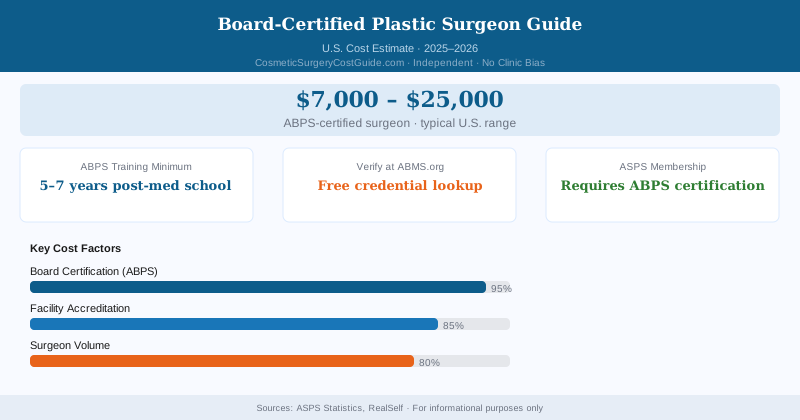
The full sequence: four years of medical school, a three-year general surgery residency, a two-year plastic surgery residency, then two years of independent practice — followed by both written and oral examinations. Surgeons must also submit a case list from their certification period for review.
That’s a minimum of six years of post-medical-school training before a single exam is taken.
After initial certification, ABPS surgeons maintain their status through continuing education and periodic recertification. Fellowship training — subspecialty programs in craniofacial surgery, hand surgery, or microsurgery — adds another one to two years on top. According to the ABMS, only about 7,000 surgeons in the US hold active ABPS certification — so when a surgeon has it, it’s a genuinely meaningful credential.
The Board That Isn’t Equivalent
Here’s what many patients don’t know until after they’ve already booked.
A surgeon who is board certified by the American Board of Cosmetic Surgery has not completed the same training as a surgeon certified by the American Board of Plastic Surgery — these are different certifications with very different requirements. The American Board of Cosmetic Surgery is not recognized by the American Board of Medical Specialties (ABMS).
The American Board of Cosmetic Surgery (ABCS) was founded in 1979 and is not an ABMS member board. Surgeons certified by ABCS may come from various surgical specialties — oral surgery, otolaryngology, general surgery — and the training pathway and minimum requirements differ significantly from ABPS.
This doesn’t mean every ABCS surgeon is unqualified. Some have extensive hands-on experience with specific procedures. But when a surgeon advertises “board certified” without specifying which board, that omission is doing work. An ABPS-certified surgeon is proud to say so, precisely.
Plastic Surgeon vs. Cosmetic Surgeon: The Distinction American Patients Often Miss
In the US, any physician with an MD or DO can legally call themselves a “cosmetic surgeon” and perform cosmetic procedures. There’s no specialty-specific licensing requirement for the title. A dermatologist, a family medicine doctor, even a gynecologist can open a cosmetic surgery practice.
“Plastic surgeon” is a protected term in most states — it requires residency training in plastic surgery. “Cosmetic surgeon” is not protected the same way.
This is why evaluating credentials matters more than job titles on a website.
How to Verify a Surgeon’s Credentials
Three searches, five minutes, and you’ll know more than most patients ever bother to find out.
ABMS.org: The official verification site for ABMS member board certifications. Search by name and state to confirm ABPS certification status and whether it’s current.
ASPS.org member search: The American Society of Plastic Surgeons requires ABPS certification for membership. If a surgeon is an ASPS member, you know they’re ABPS certified — the society does the vetting for you.
State medical board license check: Every state has a public license lookup. This shows disciplinary actions, license suspensions, or malpractice settlements. The depth of information varies by state, but it’s publicly available.
| Certification Body | ABMS Recognized | Training Minimum (post-med school) | Verifiable At |
|---|---|---|---|
| American Board of Plastic Surgery (ABPS) | Yes | 5–7 years | ABMS.org, ASPS.org |
| American Board of Cosmetic Surgery (ABCS) | No | Varies by specialty background | ABCS website only |
| American Board of Facial Plastic Surgery | No | ENT residency + 1yr fellowship | ABFPRS.org |
| American Board of Dermatology | Yes (for dermatology) | 3yr derm residency | ABMS.org |
What Fellowship Training Means
After completing a plastic surgery residency, some surgeons pursue fellowship training — one to two additional years focused on a subspecialty. Craniofacial surgery fellows work on complex congenital and traumatic facial deformities. Hand surgery fellows specialize in microsurgical nerve and tendon reconstruction. Microsurgery fellows train in tissue transfer techniques used in breast reconstruction.
For most cosmetic procedures, fellowship training isn’t required, and plenty of excellent surgeons don’t have one. But for complex facial procedures, rhinoplasty revisions, or breast reconstruction, a surgeon with subspecialty fellowship training brings a deeper technical foundation that genuinely matters.
Red Flags That Should Stop You Cold
Some of these seem obvious after the fact. Here’s what to watch for in real time.
“Board certified” without specifying the board — Ask directly: which board? An ABPS-certified surgeon will answer you immediately and without defensiveness.
Pressure to book the same day — Reputable surgeons expect you to take time. Same-day booking pressure is a sales tactic, not a medical standard.
No before-and-after photos of actual patients — Stock photos or heavily filtered images don’t show you what this surgeon’s work looks like. Every experienced cosmetic surgeon has a patient photo portfolio.
Operating in a non-accredited facility — Ask where the procedure will be performed and whether the facility is accredited by AAAHC or The Joint Commission. These accreditations mean the facility has met real safety standards for equipment, emergency protocols, and staff credentials.
Significantly below-market pricing — In cosmetic surgery, pricing outliers on the low end are a signal to investigate, not celebrate.
How to Structure Your Credential Research
Before your consultation, spend 20 minutes on this sequence. Search ABMS.org to confirm ABPS certification is current. Check the state medical board for any disciplinary history. Look at the ASPS member directory. Then review the surgeon’s actual before-and-after gallery — not testimonials, the actual photos.
At the consultation, ask directly: “Are you certified by the American Board of Plastic Surgery?” Then ask where the procedure will be performed and whether the facility is accredited. These aren’t rude questions. Any surgeon worth operating with will answer them without hesitation.
The whole credential research process takes less time than choosing a hotel for a weekend trip. For a surgical procedure, it’s the most important 20 minutes you’ll spend in the entire process.