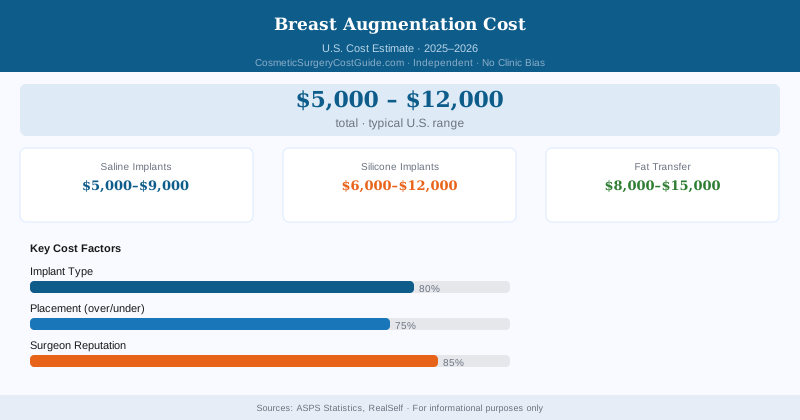
Saline vs. silicone vs. gummy bear: here’s what actually separates them — and why the cost difference exists.
Estimates include surgeon fee, anesthesia, and facility costs. Revision surgery, pre-op labs, and compression garments add cost. Get 2–3 in-person consultations for accurate quotes.
Breast augmentation has been the most-performed cosmetic surgery in the US for over a decade. ASPS reported approximately 313,000 procedures in 2023. The demand isn’t the confusing part — it’s the pricing and the implant decision that trips most people up. You’ll get quotes ranging from $5,500 to $13,000 for what sounds like the same procedure, and the difference comes down mostly to which implant type you choose, where you have it done, and who does it.
ASPS 2024 data puts the average surgeon fee at $4,516. All-in costs with anesthesia and facility run $5,500–$12,000 at board-certified practices. Here’s how to make sense of the spread.
Cost by Implant Type
| Implant Type | Implant Cost (pair) | Surgeon Fee | All-In Total |
|---|---|---|---|
| Saline implants | $800–$1,200 | $3,500–$6,000 | $5,500–$9,000 |
| Silicone gel implants | $1,500–$2,500 | $4,000–$7,000 | $6,500–$11,000 |
| Gummy bear (cohesive gel) | $2,000–$3,500 | $4,500–$8,000 | $7,500–$13,000 |
| Fat transfer augmentation | N/A | $5,000–$9,000 | $7,500–$13,000 |
Saline vs. silicone vs. gummy bear: what actually separates them
Saline implants: A silicone shell filled with sterile salt water. They’re less expensive because they’re filled after insertion — that means a smaller incision. The trade-off: they feel firmer than natural tissue, and rippling can sometimes be felt or seen, especially in thin patients with little natural breast tissue. If they rupture, the saline is absorbed harmlessly and the implant deflates visibly — you’ll know immediately.
Silicone gel implants: The most popular choice in the US. Pre-filled with silicone gel that mimics the feel of natural breast tissue better than saline. Requires a slightly larger incision. If they rupture (what’s called a “silent rupture”), there’s no immediate deflation — the gel stays in or near the implant shell. That’s why the FDA recommends MRI screening every 2–3 years after year 5.
Cohesive/gummy bear implants: A form of silicone gel that’s highly cohesive — it holds its shape even if you cut it. Generally teardrop-shaped rather than round. More expensive, require more precise placement (if they rotate, the shape is off and requires correction), but many surgeons and patients prefer the result in the right candidate.
This decision should be made in consultation with your surgeon based on your body, your goals, and your tissue coverage. Some general patterns:
- Thin patients with minimal natural tissue: Silicone gel typically looks and feels more natural
- Patients concerned about rupture detection: Saline deflates visibly; silicone does not
- Patients wanting the most natural result: Gummy bear implants in anatomical shape may provide the most natural profile
- Budget-limited patients: Saline is the most affordable option
There is no universally “best” implant — the right choice depends on your individual anatomy and priorities.
Additional cost components
Beyond the implant, here’s what else makes up the total:
Anesthesia: Breast augmentation is performed under general anesthesia or IV sedation. Anesthesia costs $900–$1,800 depending on the type and how long the surgery takes.
Facility fee: Outpatient surgery center fees run $800–$1,800. Hospital OR fees can be 30–50% higher. Most breast augmentations are safely done at accredited outpatient centers — you don’t need a hospital for this procedure.
Pre-op testing: EKG, blood work, and possibly a mammogram (usually recommended for patients over 40 or with a family history of breast cancer): $200–$600.
Post-op garments: Surgical bras worn 4–6 weeks. Often included in the surgical fee, but worth confirming.
Implant placement: under or over the muscle?
Submuscular placement (under the pectoral muscle) gives more tissue coverage and typically produces more natural results, especially in thin patients with less natural tissue. It’s the more common recommendation.
Subglandular placement (over the muscle, under the breast tissue) means a faster recovery and is appropriate for patients with adequate natural breast tissue — and for athletic patients who want to avoid “animation deformity,” where the implant shifts or distorts when the chest muscle contracts during exercise.
Placement choice affects the surgeon’s fee by $500–$1,500. Submuscular surgery is more technically demanding and takes longer, which is why it costs more.
Implant replacement and long-term costs
Implants aren’t lifetime devices. They don’t require scheduled replacement, but plan for eventual revision. ASPS data suggests that by 10 years, approximately 20–25% of patients have had at least one revision procedure. By 20 years, that number climbs above 50%.
Implant exchange or removal and replacement: $4,000–$9,000 all-in, depending on what’s involved — simple exchange, pocket revision, capsular contracture treatment, or a combination. That’s not a scare tactic; it’s just honest financial planning for anyone making this decision.
Breast implant illness (BII) is a term patients use to describe a constellation of symptoms — fatigue, brain fog, joint pain — that some patients attribute to their implants. The FDA and major medical societies recognize that some patients report symptoms that resolve after implant removal, though a specific causal mechanism has not been definitively established. If you’re considering breast augmentation, understand that explantation remains an option if you develop concerns, and research the BIA-ALCL (implant-associated lymphoma) risk — extremely rare, but associated specifically with textured shell implants.
Geographic price differences
California, New York, and Florida typically run 30–50% above the national average. The Southeast, Midwest, and Mountain West markets are generally competitive. Getting quotes from two or three board-certified surgeons in your area gives you a reliable baseline for your market — and a sense of whether a quote you’ve received is in range or out of it.
Bottom Line
All-in breast augmentation with silicone implants and a board-certified plastic surgeon: budget $7,000–$10,000 in most US markets. Saline saves $1,000–$2,000 upfront. Gummy bear/anatomical implants add $1,500–$3,000. Get at least two consultations, confirm ABPS board certification, and ask your surgeon specifically what they’d recommend for your anatomy — not just what you’ve already decided you want. That conversation is the most useful thing you can do before signing anything.
Frequently Asked Questions
Breast augmentation costs $4,000–$10,000 total. ASPS 2023 data shows average surgeon fees of $4,516 for implant augmentation; add facility and anesthesia for $7,000–$10,000 all-in. Silicone implants cost $1,000–$2,000 more than saline. Fat transfer augmentation (no implants) runs $6,000–$12,000 and requires enough donor fat.
Modern implants don't have a fixed expiration date, but the FDA recommends MRI screening at 5–6 years post-op and every 2–3 years after to check for silent rupture in silicone implants. Many women have their implants for 20+ years without replacement. Capsular contracture, rupture, or desired size change are the most common reasons for revision surgery.
Silicone implants feel more natural and are less likely to show rippling. Saline implants require a smaller incision and a rupture is immediately visible. Silicone costs $1,000–$2,000 more and requires periodic MRI monitoring. FDA approves silicone for patients 22+ and saline for 18+. Most US patients (roughly 80%) choose silicone, per ASPS data.