Roughly 1 in 5 breast augmentation patients will need some form of revision within 10 years — that’s not a worst-case estimate, it’s what ASPS outcome data actually shows. By year 20, the majority of patients have had at least one revision procedure. Implants are medical devices in a body that keeps changing, and revision is part of the realistic long-term picture for most patients.
This doesn’t mean your original surgery failed. Weight fluctuations, aging, pregnancy, taste changes, and the natural evolution of what you want aesthetically all factor in. So do complications.
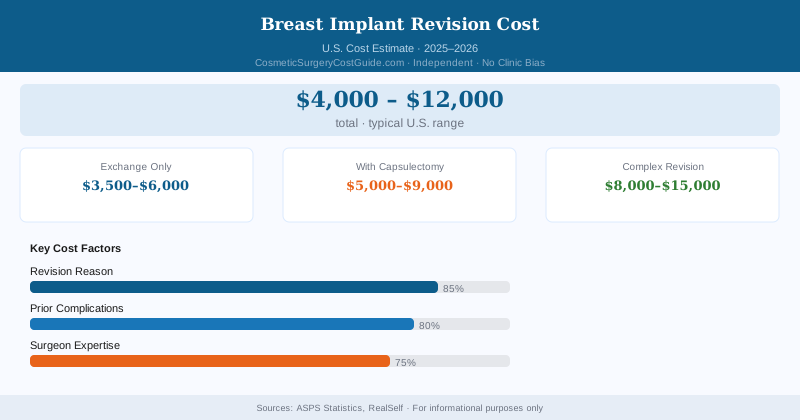
ASPS data shows revision surgeon fees averaging $4,500–$8,000. All-in costs run $6,000–$15,000+ depending on complexity.
Revision Cost by Reason
| Revision Type | Surgeon Fee | All-In Cost |
|---|---|---|
| Size change only (exchange) | $3,500–$6,000 | $5,500–$9,000 |
| Capsular contracture correction | $4,500–$8,000 | $7,000–$12,000 |
| Implant malposition correction | $4,000–$7,000 | $6,500–$11,000 |
| Symmastia repair (“uniboob”) | $5,000–$9,000 | $8,000–$14,000 |
| Double bubble correction | $4,500–$8,000 | $7,000–$12,000 |
| Saline rupture replacement | $4,000–$6,500 | $6,000–$10,000 |
| Silent silicone rupture replacement | $4,500–$7,000 | $7,000–$11,000 |
| Pocket conversion (sub-glandular to sub-muscular) | $5,000–$9,000 | $8,000–$14,000 |
Capsular Contracture: The Most Common Complication
Every implant develops a capsule — a layer of scar tissue around it. In most patients, this capsule stays thin and soft and you’d never know it’s there. Capsular contracture is when the capsule hardens and squeezes the implant, causing firmness, distortion, and sometimes real pain.
Surgeons grade it from I to IV:
- Grade I: Breast looks and feels normal
- Grade II: Breast feels firmer than normal but looks normal
- Grade III: Firm and looks abnormal — breast appears distorted
- Grade IV: Hard, painful, and significantly distorted
Grade III and IV contractures typically require surgical correction: capsulectomy (complete removal of the capsule) plus implant replacement. A thorough capsulectomy with pocket modification significantly reduces recurrence versus simply swapping the implant.
The cause isn’t fully understood, but subclinical bacterial contamination at the time of primary surgery is thought to be a major factor. High-volume, experienced practices tend to have lower capsular contracture rates — another reason why surgeon selection matters from the start.
Insurance almost never covers cosmetic breast implant revision. However, two exceptions exist:
- Silicone implant rupture: Allergan and Mentor have warranty programs that provide some financial assistance for rupture-related revisions in qualifying patients.
- Implants placed for reconstruction: Revisions to post-mastectomy implants may be covered under your health insurance, since the original placement was medically indicated.
For all cosmetic revisions — size change, contracture, malposition — plan on paying out of pocket. The manufacturer warranty (most implants come with a 10-year warranty against rupture) may provide the implant itself at no cost, but surgical fees and facility costs are your responsibility.
Simple Size Change: The Most Common Revision
Wanting different-sized implants — usually larger, occasionally smaller — is the single most common reason for revision. The procedure involves removing the existing implants and inserting new ones.
If the pocket (the space created for the implant) is the right size for the new implants, it’s relatively straightforward. If you’re going significantly larger, pocket modification may be needed. If you’re downsizing, the pocket typically needs to be reduced so the smaller implant doesn’t sit incorrectly in an oversized space.
Implant Malposition Corrections
Implant malposition — where the implant moves or sits in the wrong position — takes several forms:
Bottoming out: Implant migrates too low, with the nipple appearing too high on the breast. Requires repositioning the inframammary fold or suturing to prevent further migration.
Lateral displacement: Implant shifts toward the armpit when lying flat, causing a gap between the breasts in certain positions. The pocket is narrowed on the inner side.
Symmastia (“uniboob”): Implants migrate toward each other, eliminating cleavage definition and creating a connected appearance in the middle. Technically challenging to fix — the internal pocket reconstruction requires meticulous suturing and significant experience.
Breast implant revisions for complications are significantly more complex than primary augmentation. A surgeon who’s excellent at primary breast augmentation may not have the same expertise in complex revision cases. When seeking revision for complications like symmastia, capsular contracture, or double bubble, specifically seek surgeons with documented revision expertise — not just high volumes of primary augmentations. Ask specifically: “How many revision cases like mine do you perform per year?”
Implant Manufacturer Warranties
Most major implant manufacturers (Allergan/AbbVie, Mentor, Sientra) offer warranty programs:
- Rupture replacement: Most warranties provide free implant replacement for rupture. Check your original paperwork for your specific terms.
- Financial assistance programs: Some manufacturers offer $1,000–$3,500 toward surgical costs if you need a revision for covered reasons within a specified timeframe.
Finding your original implant sticker (placed in your surgical record at the time of your primary surgery) gives you the manufacturer, model, and lot number needed to file a warranty claim. Don’t skip this step — it could knock thousands off your out-of-pocket cost.
Bottom Line
Budget $6,000–$12,000 for most breast implant revisions with a board-certified plastic surgeon. Complex corrections (symmastia, repeated capsular contracture) can run $10,000–$15,000. Start by contacting your implant manufacturer to understand your warranty terms — you may be entitled to a free replacement implant, which reduces your out-of-pocket significantly. Then get at least two revision consultations, specifically seeking surgeons experienced in the type of problem you’re having.