If you’re reading this, you’re probably already past the “is this something I want?” stage and into “what does this actually cost and what should I know before I commit?” Good place to be. Let’s cut straight to it.
A breast lift — mastopexy in surgical terms — repositions the nipple-areola complex, removes excess skin, and reshapes the breast to a higher position. What it doesn’t do: add volume. If you want both lift and more fullness, you’ll need implants alongside the lift.
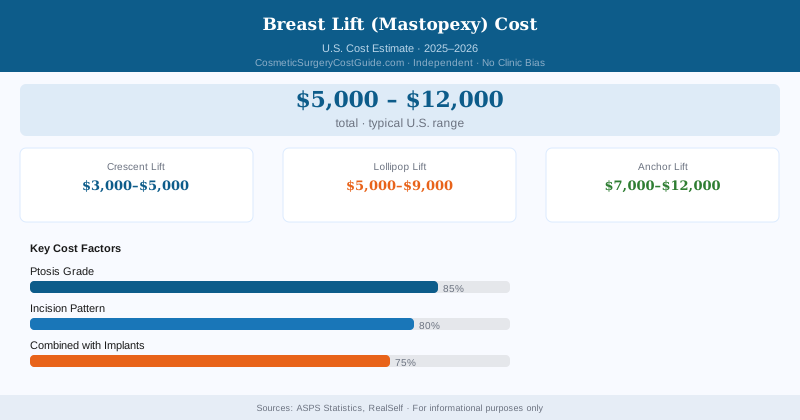
The ASPS 2024 average surgeon fee for mastopexy is $5,012. All-in costs with anesthesia and facility run $7,000–$12,000 depending on technique and market.
Breast Lift Cost by Technique
| Technique | Incision Pattern | Surgeon Fee | All-In Cost |
|---|---|---|---|
| Crescent lift | Half-circle above nipple | $2,500–$4,500 | $4,000–$6,500 |
| Periareolar (donut/Benelli) | Circle around areola | $3,000–$5,000 | $4,500–$7,500 |
| Vertical (lollipop) lift | Circle + vertical line | $4,000–$6,500 | $6,000–$10,000 |
| Anchor (full mastopexy) | Circle + vertical + horizontal | $5,000–$8,000 | $7,500–$13,000 |
How to Know Which Lift You Need
The technique isn’t really a choice — it’s determined by how much ptosis (sagging) you have. Your surgeon’s job is to match the technique to your anatomy.
Crescent and periareolar lifts: These work only for mild ptosis, when the nipple sits near or at the breast crease. They produce modest repositioning with less scarring. If your sagging is moderate to significant and a surgeon recommends one of these to “spare you scars,” push back and ask why.
Vertical (lollipop) lift: This is the workhorse of breast lifting. It handles moderate ptosis with meaningful nipple repositioning and solid breast reshaping — without the horizontal scar that the anchor technique adds. Most surgeons prefer it when they can get away with it.
Anchor (Wise pattern) lift: You need this when ptosis is significant — nipple well below the breast crease, or when there’s a lot of excess skin to remove. It creates the most comprehensive correction but does leave a longer scar pattern.
Your degree of ptosis determines your technique, which in turn determines cost and scar pattern. Don’t let anyone talk you into a smaller technique to save money or scars if your anatomy actually warrants more correction — inadequate technique leads to recurrent sagging much sooner.
Many patients ask: “Can I get just a lift and add volume later?” The answer is yes, but staging the procedures adds cost (you pay facility and anesthesia twice) and complexity. Combining augmentation and mastopexy in a single session saves money and recovery time — but it’s technically more demanding for the surgeon, since they’re reshaping the breast while also accommodating an implant.
A combined breast augmentation + lift typically costs $10,000–$18,000 all-in, compared to $7,500–$12,000 for lift alone. The incremental cost of adding an augmentation to a lift is about $2,500–$5,000 — a meaningful savings over scheduling separately.
Does a Breast Lift Include a Reduction?
Sometimes — particularly for patients with very large, heavy breasts. Surgeons can remove breast tissue during a lift (reducing the size) while also repositioning the nipple. This is technically both a mastopexy and reduction in one procedure.
If the breast size reduction is significant enough to qualify as medically necessary, insurance may cover it. Worth discussing with your surgeon before you commit to paying privately.
What Affects the Price
Degree of ptosis: More extensive surgery (anchor technique) takes longer and costs more than a minimal lift.
Combination with augmentation: Adding implants adds $2,500–$5,000 in implant and surgical time cost, but saves compared to separate procedures.
Geographic location: Coastal markets charge 25–45% more than Midwest and Southern averages.
Surgeon experience: Mastopexy is among the more technically complex breast procedures. The scar pattern, nipple position, and breast shape are all a direct result of the surgeon’s judgment and technique. High-volume breast surgery specialists charge more and generally produce more consistently excellent results.
Recovery
- Surgical bra worn continuously for 4–6 weeks (usually included)
- No underwire bras for 6–8 weeks
- Return to desk work: 1–2 weeks
- No strenuous upper body exercise: 6 weeks
- Scars fade significantly over 12–18 months
Breast lift results are not permanent. The effects of gravity, aging, weight fluctuations, and future pregnancies will continue. Patients who gain and lose significant weight after surgery tend to see faster return of laxity. The best long-term results come from patients who maintain a stable weight. Lifestyle factors matter as much as surgical technique for longevity of results.
Bottom Line
For a vertical (lollipop) breast lift, which addresses most patients’ degree of ptosis: budget $7,000–$10,500 all-in. Significant sagging requiring an anchor technique: $8,500–$13,000. If you’re also wanting more fullness, budget an additional $2,500–$5,000 for simultaneous augmentation. Consult at least two board-certified plastic surgeons to get independent assessments of which technique your anatomy requires.