Here’s a misconception that costs women money every year: “My insurance covers mastectomy, but reconstruction is cosmetic — I’ll have to pay for that myself.”
That’s wrong. Federal law says otherwise.
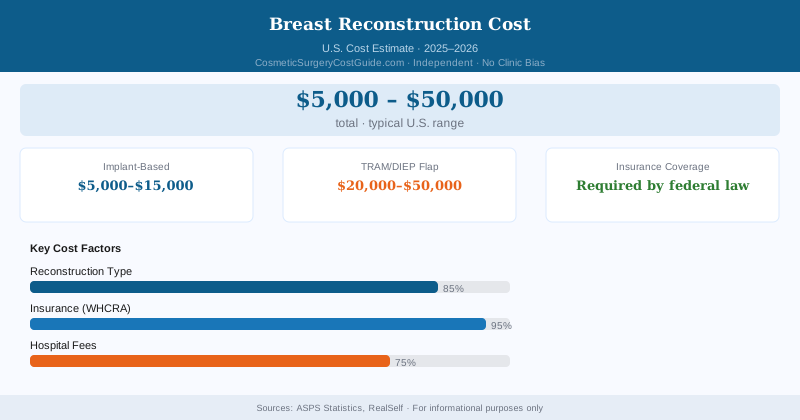
The Women’s Health and Cancer Rights Act (WHCRA) of 1998 requires any insurer that covers mastectomy to also cover reconstruction — including surgery on the contralateral (opposite) breast to achieve symmetry. This is a federal mandate, not an insurer’s discretion. The American Cancer Society and ASPS both confirm that this protection applies to virtually all private health plans and Medicare.
What “covered” doesn’t mean is free. You’ll still pay your deductible, copay, and coinsurance. Depending on your plan and the complexity of reconstruction, that’s typically $2,000–$10,000 out of pocket — a significant savings compared to paying the full $15,000–$60,000 procedure cost privately.
Insurance-Covered vs. Private Pay Costs
| Reconstruction Type | Total Procedure Cost | Typical Insurance Out-of-Pocket |
|---|---|---|
| Tissue expander + implant (2-stage) | $15,000–$30,000 | $2,000–$8,000 |
| Direct-to-implant (1-stage) | $12,000–$25,000 | $1,500–$6,000 |
| TRAM flap (own tissue) | $25,000–$50,000 | $3,000–$12,000 |
| DIEP flap (microsurgical) | $30,000–$60,000 | $4,000–$15,000 |
| Latissimus dorsi flap | $20,000–$35,000 | $2,500–$9,000 |
| Nipple-areola reconstruction | $2,000–$6,000 | $500–$2,000 |
Out-of-pocket estimates assume meeting your deductible and typical cost-sharing. High-deductible plans will have higher out-of-pocket costs.
Types of Breast Reconstruction
Implant-based reconstruction (most common): A tissue expander is placed at mastectomy and gradually expanded over weeks to months to stretch the remaining tissue. Then the expander is exchanged for a permanent implant in a second surgery. Widely available at most cancer centers; requires multiple surgeries but is less complex than flap procedures.
Direct-to-implant: If enough skin and tissue are preserved during mastectomy, a permanent implant can sometimes be placed immediately — skipping the tissue expander stage. Not appropriate for all patients; depends on mastectomy type and skin quality.
TRAM flap: Uses muscle and tissue from the abdomen to create a new breast mound. The abdominal incision means some patients experience mild core weakness afterward, though refined techniques minimize this. Produces a natural result using your own tissue.
DIEP flap: The most sophisticated reconstruction technique — a microsurgical procedure that transfers abdominal skin and fat (but not the underlying muscle) to the chest. Requires specialized microsurgery expertise; only available at select centers. Results are natural, long-lasting, and don’t sacrifice abdominal muscle.
Latissimus dorsi flap: Uses tissue from the back. Often combined with an implant to create adequate volume. Less common than the TRAM/DIEP approach.
The fundamental trade-off: implant reconstruction is less complex, shorter surgery time, and available at more centers — but involves an artificial device that may require revision over time. Own-tissue (autologous) reconstruction uses your own body tissue, produces a more natural long-term result that ages with you, but involves longer, more complex surgery, longer recovery, and is available only at centers with microsurgical expertise.
Many factors influence the choice: your body type, the mastectomy type, cancer treatment plan (radiation significantly affects reconstruction), and patient preferences. A multi-disciplinary discussion with your breast surgeon and reconstructive surgeon before mastectomy gives you the best information for this decision.
Timing: Immediate vs. Delayed Reconstruction
Immediate reconstruction: Reconstruction begins at the time of mastectomy. Psychological benefits of not waking up without a breast mound are significant; may also result in better cosmetic outcomes in some cases.
Delayed reconstruction: Mastectomy first, reconstruction later (weeks to years). May be recommended when radiation is planned post-mastectomy — radiation significantly affects the reconstructed breast and is one of the most important timing considerations in planning reconstruction.
Delayed-immediate: A tissue expander is placed at mastectomy; definitive reconstruction is delayed until the pathology and radiation decision are confirmed.
What WHCRA Actually Requires
Under the WHCRA, your insurer must cover:
- Reconstruction of the breast on which mastectomy was performed
- Surgery on the other breast to achieve a symmetrical appearance
- Prostheses (external breast forms) if reconstruction isn’t performed
- Treatment of complications from mastectomy, including lymphedema
What WHCRA doesn’t guarantee: the specific type of reconstruction you want, or that your preferred surgeon is in-network. Out-of-network reconstructive surgeons can generate significant surprise bills even with coverage.
Always confirm your reconstructive surgeon is in-network with your insurance before proceeding. Facility in-network status matters too — a reconstruction performed at an in-network hospital with an out-of-network surgeon can leave you with substantial bills. Get explicit written confirmation of network status from your insurer, not just from the provider’s office.
Nipple and Areola Reconstruction
After the breast mound is created, nipple and areola reconstruction typically occur in a third (or second, in direct-to-implant cases) procedure:
- 3D nipple tattooing: $300–$800 (creates a lifelike tattoo of the nipple/areola; no projection)
- Surgical nipple reconstruction + areola tattooing: $2,000–$5,000 all-in (creates physical projection plus tattoo)
Both are covered by insurance under WHCRA.
Bottom Line
Breast reconstruction is federally mandated to be covered by any insurer that covers mastectomy. Your out-of-pocket exposure depends on your deductible, copay structure, and whether your surgeon is in-network — factors that can vary from under $2,000 to over $10,000. Coordinate your reconstruction team before mastectomy whenever possible, and verify insurance coverage in writing before any procedure.