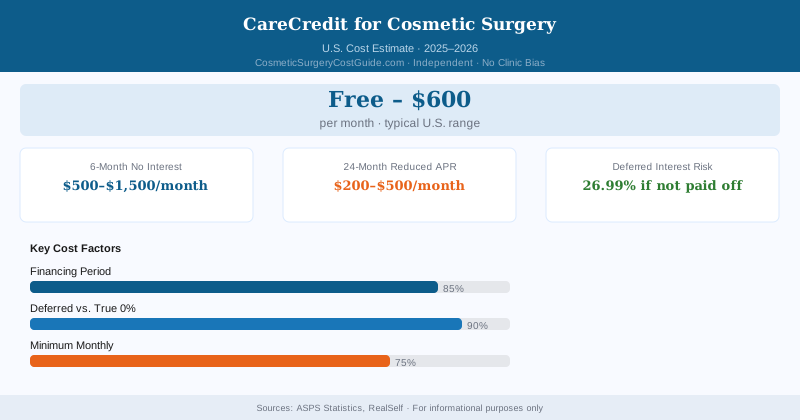
The brochure in your surgeon’s waiting room makes it sound simple: 0% APR for 18 months, apply online, instant decision. What it doesn’t explain clearly is the deferred interest clause — the part that catches thousands of patients every year and turns a $10,000 surgery into a $14,000+ bill.
Start there. Understand the trap first, then decide if CareCredit still makes sense for you.
The Deferred Interest Trap: What You Must Understand
CareCredit’s promotional financing is deferred interest, not true 0% financing. Here’s what that distinction actually means:
True 0% interest financing: You pay no interest during the promotional period AND the interest doesn’t accrue. If you pay off 80% of the balance, you owe 80%.
Deferred interest: Interest accrues at the full rate (29.99% APR) during the promotional period but is deferred (not charged) if you pay the full balance by the end of the promotional period. If you don’t pay the full balance, ALL the accrued interest from day one is charged to your account.
Example: $10,000 procedure on 18-month 0% deferred interest promo.
- You make $400/month payments for 18 months: $7,200 total paid
- At 18 months, remaining balance: $2,800
- Deferred interest on $10,000 at 29.99% for 18 months: approximately $4,500
- Your new balance: $2,800 + $4,500 = $7,300 charged, not $2,800
That’s the trap. And it’s not a rare edge case — it’s what happens to any patient who doesn’t pay off the full balance before the promotional period ends.
CareCredit Promotional Periods and True Costs
| Promotional Period | Standard APR After Promo | Monthly Payment (on $10,000) | Interest If Not Paid Off |
|---|---|---|---|
| 6 months (0% APR) | 29.99% | $1,667/month | Deferred interest owed |
| 12 months (0% APR) | 29.99% | $834/month | Deferred interest owed |
| 18 months (0% APR) | 29.99% | $556/month | Deferred interest owed |
| 24 months (0% APR) | 29.99% | $417/month | Deferred interest owed |
| 36 months (reduced APR ~17.90%) | 17.90% | $360/month | Standard interest |
| 48 months (reduced APR ~17.90%) | 17.90% | $295/month | Standard interest |
CareCredit is genuinely useful when used correctly:
Calculate the monthly payment to pay off the FULL balance within the promotional period before you sign. For an 18-month promo on $10,000, you must pay $556/month to pay it off in time.
Set up automatic payments for this amount so you don’t miss payments.
Don’t use the card for anything else during this period. New purchases restart deferred interest clocks and complicate the payoff math.
Pay it off 1 month early to be safe. If month 18’s payment posts late, you may still be assessed the deferred interest.
If your budget can support paying off the balance within the promotional period, CareCredit’s promotional financing is a genuinely good deal. If you’re not confident you can pay it off in time, a different financing option may be safer.
CareCredit’s Reduced APR Long-Term Plans
For balances that need more than 24 months to repay, CareCredit offers reduced fixed-interest plans (currently ~17.90% APR) without deferred interest. These work like traditional installment loans — no surprise charges:
- $10,000 at 17.90% for 36 months: approximately $360/month; total paid: $12,960 ($2,960 in interest)
- $10,000 at 17.90% for 48 months: approximately $295/month; total paid: $14,160 ($4,160 in interest)
These are straightforward — you pay interest from month one, there’s no deferred interest bomb. The rate (17.90%) is higher than typical personal loans for good-credit borrowers but lower than standard credit card rates.
How to Apply for CareCredit
Application process:
- Apply online at carecredit.com or in your surgeon’s office
- Instant credit decision in most cases
- Minimum credit score: approximately 620–640 (soft pull to check eligibility; hard pull if you apply)
- Credit limit: varies by creditworthiness; typically $500–$25,000
For large procedures, your credit limit may not cover the full cost. You can use CareCredit for a portion and pay the remainder out of pocket or through other means.
CareCredit has one of the highest standard APRs among major credit cards (29.99%). If you miss a payment, lose a promotional period for any reason, or fail to pay the full balance by the promotional end date, the deferred interest cost is severe. Read the terms of your specific promotional offer carefully — the rules governing deferred interest are in the fine print, and the consequences are significant enough that understanding them before signing is mandatory.
CareCredit vs. Personal Loan: Which Is Better?
For patients with good to excellent credit, a personal loan from a bank or credit union may offer better terms than CareCredit’s long-term plans:
| Option | APR | Best For |
|---|---|---|
| CareCredit 0% promo | 0% (if paid off on time) | Patients who can pay off within promo period |
| CareCredit 36-month plan | 17.90% | Patients needing long-term financing who want convenience |
| Personal loan (good credit) | 8–15% | Patients who need 2–5 years and want lower interest |
| Personal loan (excellent credit) | 5–10% | Most cost-effective long-term option |
| Credit union loan | 6–12% | Often best rates for members |
For amounts over $5,000 that you can’t pay off within 24 months, shopping personal loan rates before defaulting to CareCredit’s 17.90% plan can save significant money.
Bottom Line
CareCredit is the most accessible medical financing option for most cosmetic surgery patients. The promotional 0% periods are genuinely valuable if you use them correctly — calculate the monthly payment needed to pay off the full balance before the promotional period ends, and commit to it. For amounts that require longer than 24 months, compare personal loan rates from banks and credit unions against CareCredit’s 17.90% plans. The right answer depends on your credit score and discipline with payment schedules.