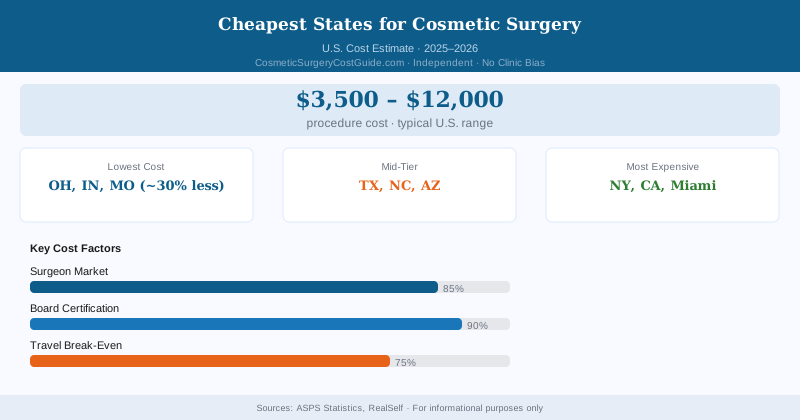
The same rhinoplasty that runs $14,000 all-in in Los Angeles runs $7,500–$9,000 in Kansas City or Nashville — with equivalent surgeon credentials and equivalent outcomes. That’s not a rumor. ASPS fee data and regional market surveys consistently show a 25–40% gap between coastal premium markets and mid-size Midwest and Southern cities.
That gap is real, it’s exploitable, and here’s how to use it without compromising on the credentials that actually matter.
The Lowest-Cost Markets for Cosmetic Surgery
These markets consistently price 25–40% below the national high-cost markets (New York, Los Angeles, Miami, San Francisco, Chicago):
| State/Market | Cost Level vs. National Average | Notes |
|---|---|---|
| Ohio (Columbus, Cleveland) | 25–35% below coastal | Strong academic programs; competitive market |
| Indiana (Indianapolis) | 30–40% below coastal | Lower overhead; board-certified surgeons available |
| Missouri (Kansas City, St. Louis) | 25–35% below coastal | Moderate cost market; university-trained surgeons |
| Tennessee (Nashville, Memphis) | 20–30% below coastal | Growing cosmetic market; Vanderbilt-trained surgeons |
| Oklahoma (Oklahoma City, Tulsa) | 30–40% below coastal | Low cost of living; less saturated market |
| Kentucky (Louisville) | 30–40% below coastal | Very low overhead; university medical programs |
| Iowa (Des Moines) | 35–45% below coastal | Smallest cosmetic market; limited high-volume specialists |
| Alabama (Birmingham) | 30–40% below coastal | UAB-trained surgeons; competitive pricing |
| Nebraska (Omaha) | 30–40% below coastal | Low cost; UNMC training programs |
| Arkansas | 35–45% below coastal | Smallest market; limited specialist availability |
Concrete Price Examples by Market
Rhinoplasty (all-in):
- Los Angeles: $12,000–$18,000
- Nashville: $7,500–$10,000
- Columbus: $6,500–$9,000
- Savings: $4,500–$9,000
Facelift (all-in):
- New York City: $18,000–$30,000
- Kansas City: $10,000–$14,000
- Indianapolis: $9,500–$13,000
- Savings: $8,000–$17,000
Breast augmentation (all-in, silicone):
- Miami: $9,000–$14,000
- Nashville: $6,500–$9,500
- Louisville: $5,800–$8,500
- Savings: $2,500–$6,000
Tummy tuck (all-in):
- San Francisco: $14,000–$22,000
- St. Louis: $8,000–$13,000
- Birmingham: $7,500–$11,000
- Savings: $5,000–$11,000
Why These Markets Are Cheaper (Not Lower Quality)
The price difference reflects cost structure, not quality:
Real estate: Medical office space in Ohio or Tennessee costs 60–80% less per square foot than equivalent space in Manhattan or Beverly Hills. That cost doesn’t disappear — it flows directly into procedure pricing.
Staff compensation: Surgical nurses and administrative staff earn substantially less in Louisville than in Los Angeles. That’s a structural cost difference, not a quality difference.
Market competition: Midwest markets have enough plastic surgeons to create competition without the extreme volume concentration of coastal markets. Competition keeps pricing honest.
Less brand premium: In high-cost coastal markets, some pricing reflects location prestige — patients in those markets expect to pay more, so practices charge more. Midwest practices compete on value and outcomes rather than zip code.
Lower cost is only a genuine advantage if the surgeon’s credentials are equivalent. Before traveling:
- ABPS verification: Check abplsurg.org — confirm the surgeon is ABPS-certified and currently in good standing
- ASPS membership: Verify ASPS membership at plasticsurgery.org — ASPS members meet additional standards
- Hospital privileges: Ask whether the surgeon has privileges at a local accredited hospital — this confirms their credentials have been independently reviewed
- Facility accreditation: Verify AAAHC, AAASF, or Joint Commission accreditation for the surgical facility
- Portfolio review: Request before/after photos specifically for your procedure — results quality varies by surgeon regardless of location
- Plan for two trips: Initial consultation in person plus the surgery itself — build this into your travel cost calculation
States to Approach With Extra Caution
Several states with high cosmetic surgery volume and some of the lowest prices have also documented elevated rates of provider problems:
Florida: Very high cosmetic surgery volume, extremely competitive market, some of the lowest prices — and some of the highest rates of disciplinary actions against providers. Florida has been a documented center for non-credentialed cosmetic procedures and preventable complications from unqualified providers. Rigorous verification is essential.
Certain border markets: Markets that attract medical tourism patients from Mexico — some US border cities have developed hybrid markets mixing legitimate practices with lower-credential providers targeting cost-conscious patients.
Low price in these markets sometimes reflects compromised credentials, not simply lower overhead. Verification matters more, not less, in high-competition low-cost markets.
Calculating Whether Travel Is Worth It
The break-even math is straightforward:
Travel costs (round trip flight $200–$600, hotel 2–3 nights $150–$300/night, ground transport):
- Minimum: $800–$1,200 for a regional trip
- Typical: $1,500–$2,500 for most domestic trips
- Maximum (cross-country + multiple visits): $3,000–$4,000
Savings needed to justify: Travel makes financial sense when savings exceed $3,000–$5,000.
Applying this test:
- Rhinoplasty saving $6,000: Yes, travel makes sense
- Breast augmentation saving $3,000: Probably makes sense; verify savings carefully
- Botox saving $200: No, never
“Cheapest” is not a safe filter when applied without the credential filter. The cosmetic surgery market has providers charging low prices because they lack the training and credentials that justify higher fees — and providers charging low prices because they operate in low-overhead markets. These are entirely different situations. Always filter first by credentials (ABPS, ASPS, accredited facility), then optimize for cost within that qualified pool. Credential compromise is never a legitimate path to cost savings.
The Practical Approach
- Get a local quote from an ABPS-certified surgeon as your baseline
- Identify 2–3 moderate-cost markets within reasonable travel distance
- Find ABPS-certified surgeons in those markets — check reviews, portfolios, and credentials
- Get quotes (many surgeons offer video consultations for initial screening)
- Compare total costs including travel
- For savings above $3,000, book an in-person consultation in the lower-cost market
The savings on a facelift or rhinoplasty easily justify the effort of one additional consultation trip. For smaller procedures, your local market is usually the right call.
Bottom Line
Ohio, Indiana, Missouri, Tennessee, and similar Midwest and Southern markets consistently offer cosmetic surgery pricing 25–40% below coastal rates — with fully credentialed ABPS surgeons available in every major city. For surgical procedures with all-in costs above $8,000, geographic variation within the credentialed surgeon pool is one of the most effective legitimate cost-reduction strategies available.