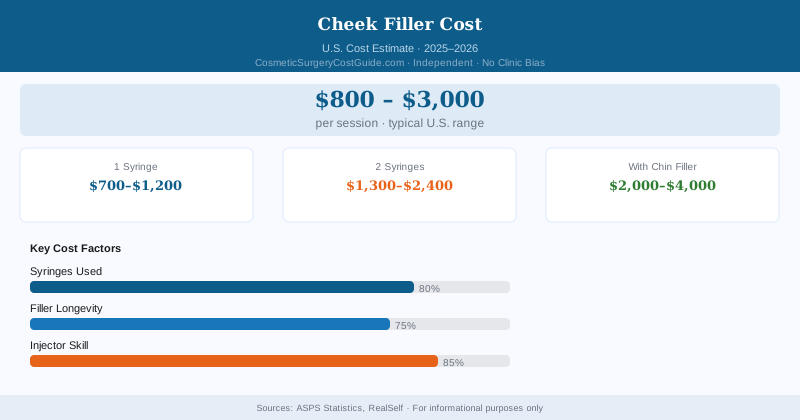
Juvederm Voluma was FDA-approved specifically for cheek augmentation in 2013 — and according to the American Society for Dermatologic Surgery (ASDS), mid-face fillers are now among the most commonly performed filler treatments in the country. That growth makes sense: mid-face volume is one of the first things to go with age, and restoring it with the right product in the right hands creates a lifting effect that runs all the way down to the jowls.
But “cheek filler” covers a wider range of products, techniques, and price points than most people realize. Here’s a realistic look at what you’ll actually spend.
Cheek Filler Cost in 2025
| Product | Cost Per Syringe | Syringes Needed | Total Cost | Duration |
|---|---|---|---|---|
| Juvederm Voluma | $850–$1,100 | 1–3 | $850–$3,300 | 18–24 months |
| Restylane Lyft | $750–$1,000 | 1–3 | $750–$3,000 | 12–18 months |
| Restylane Contour | $800–$1,050 | 1–2 | $800–$2,100 | 12–18 months |
| Radiesse | $750–$1,100 | 1–2 | $750–$2,200 | 18–24 months |
| Sculptra (per vial) | $800–$1,100 | 2–4 | $1,600–$4,400 | 2+ years |
How Many Syringes for the Cheeks?
This is the question every patient asks first, and the honest answer is: it depends on how much volume you’ve lost and what you’re going for.
- Mild volume loss or enhancement only: 1 syringe per side (2 total) is typical
- Moderate volume loss: 1.5–2 syringes per side (3–4 total)
- Significant volume loss (often 50s and older): 2–3 syringes per side (4–6 total)
Most providers inject both cheeks at the same appointment, splitting the volume to maintain symmetry. If you’re trying filler for the first time, 1 syringe total (0.5mL per side) is a reasonable conservative start — though a lot of patients find that minimal and want more at follow-up. Better to start conservative and add than to start aggressive and wish you hadn’t.
Juvederm Voluma: The Market Leader for Cheeks
Juvederm Voluma is the only filler with an FDA-specific approval for cheek augmentation and midface volume restoration. Its Vycross cross-linking technology makes it the firmest, most lifting member of the Juvederm family — which is exactly what you want for structural cheekbone support.
Two syringes is the most common starting dose. Results typically hold 18–24 months, and a single syringe follow-up at 12–18 months can extend things further.
Run the math: 2 syringes of Voluma at $950 each = $1,900 every 18 months, which works out to roughly $1,265/year.
Sculptra is a collagen stimulator rather than a direct filler — it triggers your own collagen production over 3–4 months. For cheek volume, a full Sculptra course requires 2–4 vials injected over 2–3 sessions. The results build gradually (not immediately visible like HA fillers), last 2+ years, and cannot be dissolved.
Cost comparison over 5 years:
- Juvederm Voluma: 2 syringes every 18 months = ~3.3 treatments × $1,900 = $6,270
- Sculptra (full course): $3,000–$4,000 upfront, potentially one touch-up after 2 years = $3,500–$5,000
For patients committed to long-term volume maintenance, Sculptra often offers better value. The trade-off: gradual results, non-reversible, and the patient must be comfortable with the delayed gratification.
High Cheekbones vs. Volume Restoration: Different Goals
These two goals look similar from the outside but require very different injection techniques. Be clear about which you want when you sit down with your injector.
Volume restoration for aging: Replacing fat pad volume that’s descended with age. Filler goes medially — at the cheekbone and in the submalar hollow below it — to rebuild the rounded fullness that was there before.
Cheekbone enhancement for contouring: Building more prominent cheekbones in someone who never had strong definition, or who wants a more sculpted look. Here the filler sits more laterally and superiorly at the zygomatic arch to create a structural bone-like appearance.
Both require solid knowledge of facial anatomy. Don’t assume your injector will know which goal you have — say it out loud at your consultation.
The Lifting Effect of Cheek Filler
Here’s something a lot of patients don’t expect: cheek filler often improves the lower face too. Restoring mid-face volume repositions the descended fat pad, which creates a subtle lift on nasolabial folds and jowling. You’re essentially addressing multiple areas with a single treatment. That “vector lifting” effect is a big reason why cheek filler tends to deliver more visible change per syringe than filler placed in other locations.
Cheek filler injected into the wrong plane or in the wrong location can cause an unnatural, “pillow face” appearance — a common complaint about overdone cheek work. Proper placement at the cheekbone structure itself, rather than diffuse mid-face injection, produces the most natural and structural result. Always review your injector’s before-and-after photos carefully, specifically looking at whether results look like natural-looking enhancement or obvious filler.
How Long Before You Can Judge the Final Result?
Cheek filler doesn’t settle the way lip filler does. It takes longer and goes through an overfilled-looking phase that can be alarming if you’re not prepared for it.
- Immediate: Some swelling and puffiness
- Days 3–7: Peak swelling — cheeks may look overfilled at this point
- Day 14: 70–80% of the final result is visible
- 4–6 weeks: Final result established as the filler integrates with the surrounding tissue
Don’t make any judgments about your result for at least 2 weeks. Ideally, wait the full 4 weeks before you decide whether you want adjustments.
Bottom Line
Budget $1,500–$2,200 for 2 syringes of Juvederm Voluma — that’s the most common cheek filler treatment in the US, and it lasts 18–24 months. Sculptra offers better long-term value if you’re committed to ongoing treatment and don’t mind gradual, non-reversible results. Whichever product you choose, pick your injector based on their before-and-after portfolio for cheek work specifically — not just their general filler reputation. The mid-face is a different skill set.