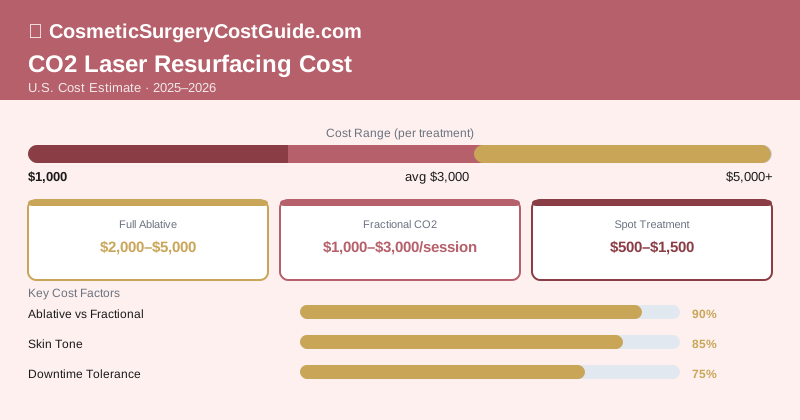
Before you try to evaluate CO2 laser resurfacing quotes — and a $1,200 quote and a $4,500 quote for “the same procedure” is a real thing that happens — you need to understand that CO2 laser isn’t one procedure. It’s two fundamentally different treatments that happen to share a wavelength. Full-ablative CO2 removes the entire surface of treated skin. Fractional CO2 removes thousands of microscopic columns while leaving the surrounding tissue intact.
The results are different. The downtime is different. The risks are different. The appropriate candidate is different. And yes, the prices are very different. The ASPS reports ablative laser resurfacing as one of the procedures with the highest patient satisfaction ratings in facial rejuvenation — but only when patient and procedure are properly matched.
CO2 laser pricing by type and treatment area
| Treatment Type | Treatment Area | Cost Range | Downtime |
|---|---|---|---|
| Full-ablative CO2 | Full face | $2,000–$5,000 | 10–14 days |
| Full-ablative CO2 | Perioral region only | $800–$2,000 | 7–10 days |
| Full-ablative CO2 | Periorbital region only | $700–$1,800 | 7–10 days |
| Fractional CO2 | Full face | $1,000–$3,000 | 5–7 days |
| Fractional CO2 | Neck / décolletage | $800–$2,000 | 5–7 days |
| Fractional CO2 | Spot treatment (scar, etc.) | $500–$1,500 | 3–5 days |
| CO2 + Erbium combination | Full face | $2,500–$5,500 | 7–14 days |
These prices reflect total costs — physician fee, facility, and anesthesia or sedation for full-ablative treatments, plus a post-procedure care kit. Board-certified plastic surgeons and dermatologists perform most ablative CO2 procedures; fractional CO2 is also performed by trained PAs and NPs at medical spas with physician oversight.
Full-ablative vs. fractional: choosing the right tool
Full-ablative CO2 is the most powerful skin resurfacing intervention available short of deep chemical peels or surgery. It vaporizes the entire epidermis and controlled depths of the dermis, forcing complete regeneration from below. The results are dramatic: significant reduction in deep wrinkles, sun damage, actinic keratoses, and overall skin quality. The perioral area — the lips and the lines radiating outward from them — is where full-ablative CO2 is uniquely effective. No other modality reliably produces comparable results in that specific zone.
The cost of that efficacy is 10–14 days of real social downtime. The skin weeps, crusts, and is raw for the first week. Redness persists for 4–8 weeks. Most patients genuinely need help at home for the first 2–3 days. This is not a treatment you schedule around a lunch break.
Fractional CO2 treats 10–40% of the skin surface per session, creating thousands of microscopic treatment zones while leaving surrounding tissue intact. That preserved tissue accelerates healing. The results are real — genuine collagen remodeling, real improvement in texture, wrinkles, and pigmentation — but less dramatic per session than full ablative. Most patients need 2–3 fractional sessions spaced 6–12 weeks apart to approach what a single full-ablative session achieves.
For patients under 55 with moderate concerns and limited downtime, fractional CO2 is usually the practical choice. For patients with significant photoaging, deep perioral lines, or severe actinic damage who can accommodate the recovery — full-ablative is the tool that actually delivers the result.
This is the most important safety consideration in CO2 laser treatment. Ablative CO2 carries significant risk of post-inflammatory hyperpigmentation (PIH) in darker skin types.
The Fitzpatrick scale matters:
- Fitzpatrick I–III (fair to medium skin): Full-ablative CO2 is generally safe with appropriate parameters and an experienced provider
- Fitzpatrick IV (olive/tan skin): Fractional CO2 is preferred; full-ablative carries meaningful PIH risk; provider experience is critical
- Fitzpatrick V–VI (brown to dark brown/black skin): Full-ablative CO2 is generally contraindicated; fractional CO2 with conservative parameters and mandatory pigmentation protocols may be appropriate; some providers recommend alternative modalities entirely
Technique and provider experience matter enormously here. But skin type is the first filter. If a provider recommends full-ablative CO2 for Fitzpatrick IV+ skin without an extensive discussion of PIH risk and prevention protocols, consider that a significant red flag.
CO2 vs. Erbium vs. Halo: choosing your laser
Erbium laser (2,940nm) is ablative but gentler than CO2 — less thermal damage, shorter downtime (3–7 days), and less collagen stimulation. Cost: $1,500–$3,500 for a full face. Good choice for Fitzpatrick III–IV skin and moderate concerns.
Halo hybrid laser combines ablative and non-ablative wavelengths in one pass. Cost: $1,500–$4,000. It lands between fractional CO2 and full-ablative in result intensity, with about 4–5 days of downtime. Growing in popularity for patients who want visible improvement without extended recovery.
For laser skin resurfacing overall, the hierarchy from most to least aggressive runs: full-ablative CO2 → Erbium ablative → fractional CO2 → Halo hybrid → non-ablative fractional → IPL.
CO2 laser resurfacing and sun exposure are a genuinely dangerous combination. Treat lasered skin as radiation-sensitive for a minimum of 6 weeks post-procedure — broad-spectrum SPF 50+ every single day, reapplied every two hours when outdoors. UV exposure on recently resurfaced skin is one of the primary causes of post-treatment hyperpigmentation, which can be more visible and longer-lasting than the original skin concerns you came in to treat. Also: if you have any history of oral herpes (HSV-1), you must be prescribed antiviral prophylaxis before any ablative procedure. Laser-induced reactivation can cause severe facial herpetic outbreaks that significantly worsen the healing process.
Bottom Line
Full-ablative CO2 at $2,000–$5,000 is among the most effective single-session skin resurfacing procedures in existence — genuinely dramatic, long-lasting results, particularly for deep wrinkles, perioral lines, and significant photodamage. Fractional CO2 at $1,000–$3,000 per session is the more accessible entry point, requiring multiple sessions but offering real improvement with shorter recovery. The right choice depends on your skin concerns, your Fitzpatrick type, and how much downtime you can honestly accommodate. Always consult a board-certified dermatologist or plastic surgeon — not just a med spa technician — before committing to any ablative CO2 treatment.