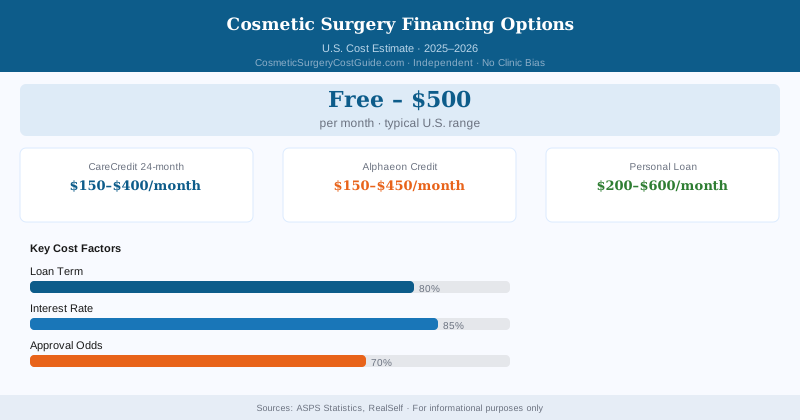
Most cosmetic surgery patients don’t pay cash. Whether you’re looking at a $3,000 injectable treatment or a $20,000 mommy makeover, financing is a normal part of how these procedures get funded. A 2023 RealSelf survey found that fewer than 30% of cosmetic surgery patients paid out of pocket entirely — the rest used some form of financing.
The options aren’t complicated, but choosing the wrong one can cost you thousands in unnecessary interest. Here’s how to think through each one.
All Financing Options Compared
| Financing Type | APR Range | Best For | Key Risk |
|---|---|---|---|
| CareCredit (0% promo) | 0% (deferred) then 29.99% | Can pay off in 24 months | Deferred interest trap |
| Alphaeon Credit | 0% promo then 26.99% | Multiple procedures | Same deferred interest risk |
| Prosper Healthcare Lending | 5.99–35.99% | 2–7 year terms | Higher rates for poor credit |
| Surgeon payment plan | Varies (often 0%) | Established patient relationships | May require down payment |
| Personal loan (bank/CU) | 6–25% | Longer payoff without deferred interest | Rate depends on credit |
| Home equity loan/HELOC | 4–9% | Large amounts, good equity | Home at risk |
| Credit card (regular) | 20–30% | Rewards; pay in full monthly | Very expensive if carried |
| HSA/FSA (qualified procedures) | 0% (your own money) | Medically necessary components | Limited by account balance |
What’s the difference between CareCredit and Alphaeon?
Honestly, not much. Both are medical credit cards with promotional periods. Both use deferred interest — meaning if you don’t pay off the full balance before the promotional period ends, you get hit with back-interest on the original amount at their standard rate.
CareCredit (Synchrony Bank): Accepted at most plastic surgery practices; promotional periods of 6–24 months; standard APR of 29.99% if you carry a balance past the promo period.
Alphaeon Credit (Comenity Capital Bank): Similar promotional structure; sometimes offers slightly longer periods; standard APR 26.99% — marginally better than CareCredit but the same mechanics apply.
The practical answer: use whichever your surgeon accepts that offers the longest promotional period for your situation. The more important question is whether to use either one versus a personal loan.
What if I need more than 24 months to pay it off?
Then medical credit cards probably aren’t your best tool. Prosper Healthcare Lending offers true installment loans — not deferred interest products. Interest starts accruing from day one at a fixed rate, but there’s no deferred-interest trap waiting at the end of a promotional period.
- APR range: 5.99–35.99% (depends heavily on credit score)
- Terms: 24–84 months
- Loan amounts: $2,000–$50,000
For patients with strong credit (750+) who need 36+ months to repay, Prosper’s best rates undercut CareCredit’s long-term plan significantly. For patients with poor credit, the rate could end up higher than CareCredit’s — so it cuts both ways.
Credit score 750+:
- Best option: Personal loan from bank/credit union (6–10% APR) or Prosper Healthcare Lending at their best rates
- Second best: CareCredit 0% promo if you can pay off within period
Credit score 680–749:
- Best option: CareCredit 0% promo with disciplined payoff
- Alternative: Prosper at 12–18% APR for multi-year terms
Credit score 620–679:
- CareCredit promotional financing if approved
- Surgeon payment plans if available
- Saving and paying cash is often smarter than high-rate financing
Credit score below 620:
- Medical financing approval becomes difficult
- Consider delaying and saving
- Some practices offer in-house layaway-style plans
Can I just work out a payment plan directly with my surgeon?
Sometimes yes. A lot of plastic surgery practices offer in-house payment plans that aren’t advertised anywhere — you just have to ask. Terms vary a lot:
- Some require 50% down with the balance due 90 days later
- Some offer 0% installments over 3–6 months with a soft credit check
- Some let you pay toward a future surgery over several months before scheduling
The advantages are real: often 0% interest, no hard credit inquiry, more flexibility than a third-party card. The downside is that terms are usually shorter (3–6 months vs. 12–24), and not every practice offers them. Still worth asking. It costs nothing.
Is a regular personal loan better than a medical credit card?
For amounts over $5,000 with a payoff horizon longer than 24 months — often yes. Compare rates from:
- Your current bank
- Credit unions (often the best rates for members — 6–12% for good credit)
- Online lenders: LightStream, SoFi, Marcus by Goldman Sachs (rates 7–15% for good credit)
Run the numbers: a 36-month personal loan at 9% vs. CareCredit’s 17.90% plan on $10,000:
- Personal loan: total paid = $11,424 ($1,424 interest)
- CareCredit 36-month: total paid = $12,960 ($2,960 interest)
- Savings: $1,536 just by choosing the personal loan
On larger amounts and longer terms, that gap grows significantly.
What about using my home equity?
A HELOC or home equity loan offers the lowest interest rates of any option — currently 4–9% depending on market conditions. But you’re putting your home on the line. If you default, you can lose it.
This is worth considering for very large amounts ($20,000+) if you own your home outright or have strong equity and absolute confidence in your ability to repay. It’s not the right call for anyone in an unstable financial position or who’s stretching to make the payments work.
Never take on debt for elective cosmetic surgery that you cannot realistically service with your current income. High-interest medical debt — particularly at CareCredit’s 29.99% standard APR — can cause significant financial hardship if your income changes or if unexpected costs arise. Do an honest budget exercise: after your regular expenses (rent, utilities, food, transportation, existing debt), do you have the monthly payment available? If the answer requires optimistic assumptions, consider delaying the procedure and saving.
What if I just saved up instead?
It’s an underrated option that nobody in the medical credit business wants to mention. Saving for elective surgery eliminates interest entirely and gets you to the procedure from a position of financial stability rather than debt.
- $500/month × 12 months = $6,000 (covers many single procedures)
- $500/month × 24 months = $12,000 (covers most major procedures)
- Park it in a high-yield savings account at 4–5% APY and your savings actually earn something while you wait
The patience required is real. But arriving at surgery without a debt load makes the recovery period dramatically less stressful. For non-urgent procedures, it’s worth at least doing the math.
Bottom Line
For amounts you can pay off in 24 months: CareCredit or Alphaeon promotional financing can work — but understand the deferred interest mechanics cold before you sign. For amounts that need 36+ months to repay: compare personal loan rates from banks and credit unions against medical financing rates. For large amounts and strong home equity: a HELOC at 4–9% beats every other option on rate. For any amount with poor credit: seriously consider delaying and saving rather than taking on high-interest medical debt. The procedure will still be available in 12–18 months. Debt at 29.99% APR starts compounding immediately.