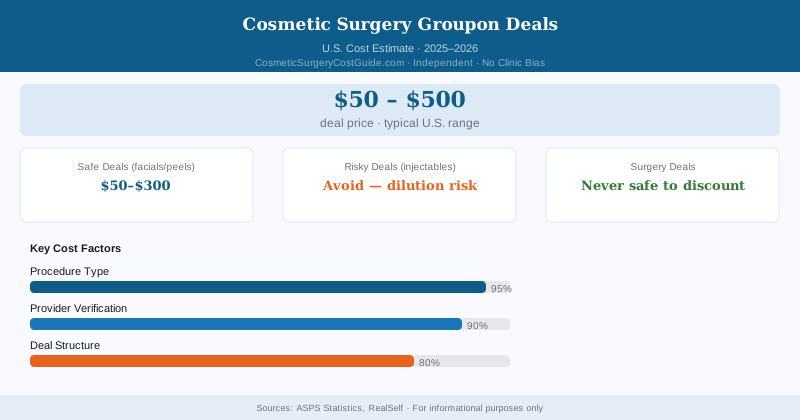
A Groupon for $99 Botox. A Living Social deal for a HydraFacial at 60% off. A “limited time offer” for $299 lip filler from a med spa you’ve never heard of. These deals are everywhere, and some of them are genuinely fine. Others are genuinely not.
The difference is procedure type, provider type, and what the discount is actually hiding. Use this step-by-step framework to sort them before you spend anything.
Step 1: Determine Whether the Procedure Type Is Even Discount-Safe
Before you look at price, provider, or anything else — the first filter is the procedure itself.
A cosmetic treatment deal is reasonably safe when:
- The procedure has a wide safety margin (the worst-case risk is “it didn’t work well”)
- The discount reflects savings on overhead or marketing, not product quality
- The provider can be independently verified
- The treatment is reversible or self-limiting
A deal is risky when:
- The procedure has a narrow error margin where mistakes cause real harm
- The discount might reflect diluted or counterfeit product
- The provider isn’t independently verifiable
- Complications require costly correction to fix
| Treatment | Deal Safety Level | Reason |
|---|---|---|
| HydraFacial | Low risk | Mechanical; no injectables |
| Microneedling (no PRP) | Low risk | Technique-dependent but low harm potential |
| Chemical peels (light/medium) | Low-moderate risk | Verify provider training |
| Laser hair removal | Moderate risk | Fitzpatrick skin type must be assessed |
| Botox / Dysport | Moderate-high risk | Product authenticity concern; technique matters |
| Dermal fillers | High risk | Vascular occlusion possible; product source critical |
| CoolSculpting | Moderate risk | PAH risk; technique matters |
| Surgical procedures | Never discount-hunt | No |
Step 2: For Botox Deals Specifically, Understand the Product Math
Botox is the most commonly discounted injectable on deal platforms — and it’s the one where the product authenticity issue is most acute.
Allergan (Botox) and Ipsen (Dysport) sell exclusively to licensed medical providers at regulated wholesale prices. A standard 50-unit treatment costs the provider roughly $100–$130 at wholesale.
When a provider is selling Botox treatments for $99, the math doesn’t work. Something has to give:
- They’re diluting the product below its labeled concentration (diluted Botox wears off faster and works poorly)
- They’re using a gray-market or counterfeit product not from Allergan
- They’re using it as a loss leader to pressure you into upsells during the appointment
- They’re using a cheaper neuromodulator and calling it Botox
None of these create the same physical danger as filler complications — but you’re paying for something you’re not receiving. The ASDS regularly cautions patients about diluted injectables from discount providers.
Before purchasing any injectable deal:
- Search the provider on your state medical board — verify the supervising physician’s license is active and unrestricted
- Ask specifically: “What product are you using? Is it Allergan Botox or Ipsen Dysport from an authorized distributor?”
- Check if the provider is an authorized Allergan or Galderma partner — Allergan’s Brilliant Distinctions program and Galderma’s Aspire Rewards only include authorized providers
- Ask who is performing the injections — licensed RN, NP, PA, or physician? What is their training in injectables?
- Review their before-and-after portfolio for the specific treatment you’re considering
A provider that can’t answer these questions directly shouldn’t be injecting your face.
Step 3: For Filler Deals, Understand Why the Risk Is Different
Filler discounts carry more risk than Botox discounts — not marginally more, but meaningfully more — for one specific reason: filler complications can cause serious harm. Vascular occlusion, where filler is accidentally injected into or compresses a blood vessel, can cause tissue necrosis or, in rare cases, blindness.
This risk exists even with excellent injectors working with verified product. With a discount provider using unverified product under time pressure to process high deal volume, the risk goes up in ways that aren’t visible to you as a patient.
The counterfeit filler market is also documented and real. Counterfeit Juvederm and Restylane products sourced from overseas have turned up at discount med spas in the US. These products may contain non-FDA-approved ingredients, contaminated formulations, or different concentrations than labeled.
Skip the filler deals. If cost is the real issue, look at reputable providers who participate in the Allē program (Allergan products) or Aspire Rewards (Galderma) — these offer legitimate points and discounts on properly sourced product.
Step 4: Know What’s Actually Fine to Discount-Shop
HydraFacial: Mechanical, no injectables, wide safety margin. The machine does most of the work; provider variation mostly affects the experience quality rather than safety. A discounted HydraFacial at a reputable, verified location is a reasonable purchase.
Light chemical peels: A licensed esthetician or nurse doing a superficial glycolic or lactic acid peel at a discount is generally low-risk. Just verify the provider has training in the specific peel type they’re offering.
Microneedling (without PRP): Technique affects results, but the main risk of poor technique is suboptimal results — not serious harm. At a verified, licensed facility, a discounted basic microneedling is acceptable.
Laser hair removal: Requires proper Fitzpatrick skin type assessment to avoid burns on darker skin. If the discounted provider is genuinely doing that individual assessment, it’s a reasonable purchase. High-volume operations running patients through without assessment? Skip.
Step 5: Go In Ready for the Upsell
Heavily discounted deals are almost always loss leaders. The practice makes little or nothing on the deal price and plans to make it up when you’re in the chair. Common upsells you’ll hear:
- “You really need 40 units, not 20” (after you’ve already paid for the 20-unit deal)
- “Your skin type requires our premium laser add-on for safety” (often unnecessary)
- “This is the introductory treatment; for real results you need the full package”
- “One session won’t do anything — you’ll need a series of 4” (after they marketed it as a single-session deal)
Some of these upsells are legitimate. Some aren’t. Walking in knowing the upsell is coming lets you hold the line on what you actually came to purchase without feeling pressured in the moment.
Never purchase a discounted deal for any surgical procedure. Cosmetic surgery — rhinoplasty, liposuction, breast augmentation, facelifts, tummy tucks — does not belong on deal platforms. Surgeons offering surgical procedures through Groupon-type platforms are an immediate red flag. The cost structure of cosmetic surgery (surgeon fee + facility + anesthesia + implants) makes legitimate discounting through deal platforms essentially impossible. If it looks like a deal, something is wrong with the picture.
Where Legitimate Discounts Actually Come From
Real, reliable ways to save on cosmetic treatments — without the risks above:
- Allergan Allē and Galderma Aspire programs: Points and discounts on Botox, Juvederm, Sculptra, and Dysport through authorized providers only
- Seasonal promotions directly from established practices: Posted on practice websites, email lists, and social media — these are legitimate because the practice stands behind their reputation
- Patient loyalty programs: Return patient discounts are common at established practices and are genuinely valuable
- RealSelf offers: Some practices post verified promotional offers on RealSelf — these providers are typically verifiable through the platform
Bottom Line
HydraFacials, light chemical peels, and basic microneedling at discounted prices from verified, licensed providers are generally reasonable purchases. Botox deals require you to verify product authenticity — many simply aren’t delivering what they advertise. Filler deals carry serious safety concerns that go beyond the product authenticity issue, and are better avoided through deal channels entirely. Surgical procedures on Groupon are a hard no under any circumstances — the cost structure of cosmetic surgery makes legitimate discounting through those platforms essentially impossible.