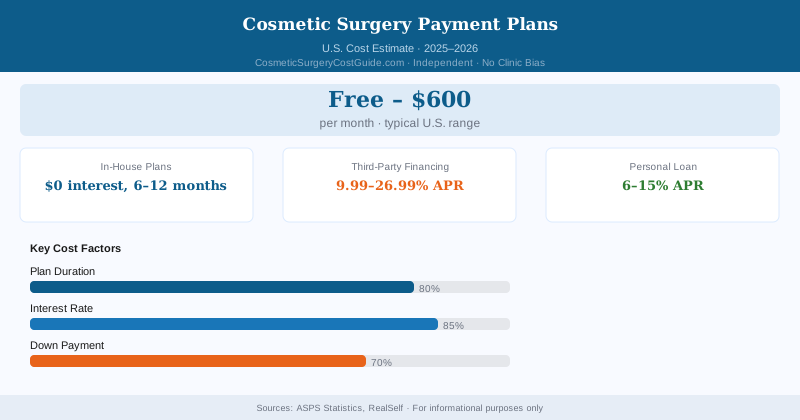
Ask a hundred plastic surgery patients how they financed their procedure, and the overwhelming majority will say CareCredit or Alphaeon. Ask them if they asked about in-house payment plans at their consultation, and most will say no — because nobody told them that was an option.
It is. A lot of plastic surgery practices offer direct payment arrangements with no third-party card company involved, no deferred interest trap, and sometimes no credit check. They don’t advertise it. You have to ask. Here’s everything you need to know before you walk into that consultation.
Why Surgeons Offer Payment Plans
The incentive makes sense from the practice’s side too. In-house payment plans:
- Cut out the 3–5% processing fee that medical credit companies charge on every transaction
- Let the practice book procedures for patients who don’t qualify for third-party credit
- Build patient loyalty — people return to the practice that worked with them
- Skip the awkwardness some patients feel about formally applying for medical credit
For patients, the advantages are real:
- Often 0% interest with no deferred-interest trap
- Sometimes no credit inquiry required
- More flexible terms, especially for established patients
- A direct relationship with the practice rather than a third-party card issuer
Common In-House Payment Plan Structures
| Structure | Terms | Best For |
|---|---|---|
| Deposit + balance at surgery | 25–50% down, remainder due before surgery date | Short-term planning |
| Deposit + monthly payments (pre-surgery) | Pay toward balance over 3–6 months, then schedule | Budget discipline |
| Post-surgery installments | 50% down, remainder in 2–4 monthly payments | Cash-flow managed |
| Layaway-style plan | Full payment in installments before surgery | No credit required |
| Extended monthly plan | Full payment over 12+ months | Limited to established patients |
How to Ask About Payment Plans
It won’t come up on its own — you need to initiate this. The conversation is simple:
At the consultation: “Do you offer any in-house payment options, or is it only third-party financing through CareCredit?”
If yes: “What are the terms? Is a down payment required? Is there interest? How long can I spread the payments? Does it require a credit check?”
If no: “Would you consider a payment arrangement if I put [X]% down and paid the remainder over [X] months?” — direct negotiation works more often than patients expect, particularly for larger procedures or for patients referred by someone already in the practice.
When In-House Plans Are More Likely Available
You’re more likely to get a yes in these situations:
- Large or combined procedures — higher value gives both sides more negotiating room
- Existing patients with a history at the practice
- Smaller-volume practices where individual patient retention matters more
- Pre-payment arrangements where you’re paying toward a future procedure over time
- Patients who were referred by someone already in the practice
Negotiating the Best Terms
Cosmetic surgery pricing isn’t fixed the way hospital billing is. There’s real room to negotiate — especially for larger or combined procedures. A few approaches that actually work:
Full payment discount: Ask directly: “I’d like to pay in full — do you offer a discount for cash or check payment?” Many practices knock off 3–5% because they avoid the card processing fee. It’s worth asking.
Bundle pricing: “If I schedule both procedures together, what’s the best pricing you can offer?” Surgeons have strong incentive to fill OR time efficiently, and bundling works in your favor.
Seasonal timing: Some months are slower — often October–November before the holiday rush, and certain summer months in some markets. Practices are more open to negotiation when they’re looking to fill schedules.
Referral consideration: “I have friends who’ve been asking about your practice — is there any referral program?” Some practices have formal programs; others will negotiate informally. It’s a low-effort ask.
Whatever payment arrangement you negotiate, get it in writing before you pay any money. The written agreement should specify:
- Total amount owed
- Down payment amount and due date
- Schedule of subsequent payments (dates and amounts)
- What happens if you miss a payment (is surgery rescheduled? Is a late fee charged?)
- Whether the surgical date is held or released if payment schedule slips
- Whether the agreed price is locked (not subject to increase if surgery is delayed)
A handshake agreement about payment terms with a practice you’ve only met once is inadequate. Written terms protect both parties.
In-House Plans vs. CareCredit: A Practical Comparison
| Factor | In-House Plan | CareCredit (0% promo) |
|---|---|---|
| Interest | Often 0% | 0% if paid off in promotional period |
| Credit check | Often not required | Yes, hard pull |
| Flexibility | Negotiable | Fixed terms |
| Credit limit | Limited by what practice agrees to | Up to $25,000 |
| Risk of deferred interest | No | Yes, if not paid off in time |
| Accepted everywhere | No (only this practice) | 225,000+ locations |
For a specific procedure at a specific practice, an in-house 0% plan beats CareCredit on almost every dimension — if the practice offers it. For practices that don’t, CareCredit or a personal loan becomes the comparison.
Practices Most Likely to Offer Flexible Terms
High-end, low-volume practices: A surgeon seeing 3–4 patients per day has far more latitude to negotiate individual arrangements than a high-volume practice running 20 patients daily through a standardized process.
Independent surgeons (not large group practices): Solo practitioners make their own financial decisions. Large group practices typically have standardized policies that leave less room for individual negotiation.
Practices in competitive markets: In cities with many plastic surgeons competing for the same patient pool, practices often differentiate on service — and financing flexibility is part of that service.
Never agree to in-house payment plan terms that you can’t clearly articulate after the consultation. If the coordinator is pressuring you to sign “today” for a special deal, or if the terms are complex or confusing, take time to review them and potentially have them looked at by someone you trust. Reputable practices don’t pressure patients into rushed financial decisions.
Building Credit for Better Financing Options
If you’re planning surgery 12–18 months out and your credit isn’t where you want it, the timeline is your friend. Steps that actually move the needle:
- Pay down existing credit card balances (the single highest-impact action)
- Don’t open new credit accounts — each hard inquiry temporarily dips your score
- Make every payment on time, consistently
- If your credit file is thin, a secured credit card used responsibly builds history fast
Moving from 650 to 720 over 12 months can reduce your CareCredit APR meaningfully or open up personal loan options at rates 8–10% lower. That difference on a $10,000 procedure adds up fast.
Bottom Line
Always ask about in-house payment options at your consultation. Many practices offer them and don’t mention it unless you ask directly. The best outcome for most patients is a 0% in-house plan negotiated directly with the practice — no third-party card, no deferred interest trap. When that’s not available, compare CareCredit’s promotional periods (the right tool if you can genuinely pay it off in time) against personal loans from banks and credit unions (better for longer terms and good credit). Whatever you agree to, get it in writing before you hand over a dollar.