“I’ll just work from home the first week.”
If you’ve said those words — or are currently thinking them — this guide is specifically for you. Underestimating recovery is so common that plastic surgeons talk about it as a predictable patient behavior pattern. People research procedures thoroughly, then give recovery planning roughly 20 minutes of thought and a shrug.
Here’s what actually happens, broken down by phase and procedure, with the logistical details most articles skip over.
The Three Timelines Nobody Explains Clearly
Recovery has three distinct milestones. Confusing them is the root cause of most recovery problems.
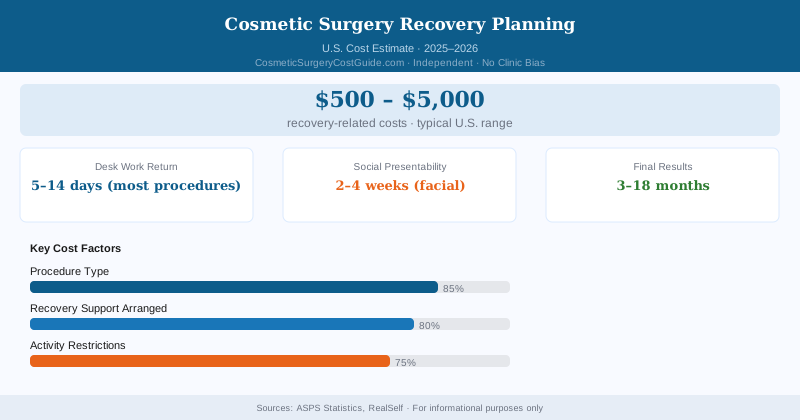
Medically cleared for work/activity: The date your surgeon says you can return to specific activities. This is a floor, not a ceiling — being cleared doesn’t mean you feel good or look presentable.
Socially presentable: The point where bruising and swelling have receded enough that you could be in public without explaining yourself. For facial procedures, this is often 1–3 weeks after being “medically cleared for desk work.” These are two different dates.
Final results: Swelling continues to resolve for months. For most procedures, 80% of the result is visible at six weeks, but the final outcome isn’t visible until three to six months — and for rhinoplasty especially, up to 12–18 months.
Many patients return to desk work in 1–2 weeks — but this doesn’t mean they’re healed. Swelling, bruising, and internal healing continue for months. Returning to activity too soon increases complication risk and can affect your final result.
Set expectations for all three milestones, not just the first one.
Recovery Timelines by Procedure
These are realistic ranges based on ASPS post-operative guidelines and clinical practice norms. Individual variation exists — your surgeon’s specific instructions always take precedence.
| Procedure | Back to Desk Work | Presentable in Public | No Strenuous Activity | Final Results |
|---|---|---|---|---|
| Botox / Fillers | Same day | Same day (minor bruising possible) | No restrictions | 2 weeks (Botox), 2–4 weeks (fillers) |
| Chemical peel (medium) | 7–10 days | 10–14 days | No restrictions | 4–6 weeks |
| Laser resurfacing | 7–14 days | 14–21 days | 2 weeks | 3–6 months |
| Blepharoplasty | 7–10 days | 10–14 days | 3–4 weeks | 3–6 months |
| Rhinoplasty | 10–14 days | 2–3 weeks (cast off) | 4–6 weeks; no contact sports 3 months | 12–18 months |
| Breast augmentation | 5–7 days (desk) | 1–2 weeks | 4–6 weeks, no upper body exercise | 3–6 months |
| Facelift | 2 weeks | 3–4 weeks | 4–6 weeks strenuous | 3–6 months |
| Liposuction | 5–7 days | 2–4 weeks (compression garment) | 4–6 weeks | 3–6 months |
| Tummy tuck (abdominoplasty) | 2–3 weeks | 3–4 weeks | 6–8 weeks, no core exercise | 6–12 months |
| Body lift | 3–4 weeks | 4–6 weeks | 8–12 weeks | 12–18 months |
The Recovery Phases
Acute phase (days 1–7): The most demanding period. Expect peak swelling and bruising, limited mobility depending on procedure, discomfort managed by prescribed pain medication transitioning to over-the-counter options by days 3–5, and surgical drains if applicable (facelift, tummy tuck, body lift). You’ll need someone with you for at least the first 24–48 hours — not optional.
Subacute phase (weeks 2–4): Most activity restrictions remain in effect. Swelling is still prominent for facial procedures; compression garments are required for body procedures. This is the phase where patients most often push too far, too fast. The fact that you feel better than you expected doesn’t mean internal healing is complete.
Intermediate phase (weeks 4–8): Most patients are back to most normal activities. Residual swelling is still present but less visible to others. Scar management typically begins during this phase — silicone sheeting, scar massage per surgeon’s guidance.
What to Actually Arrange
The logistics of cosmetic surgery recovery are more involved than most people plan for — especially if you’re the primary caregiver in your household.
Transportation: You can’t drive yourself home from surgery, and you can’t drive for several days to weeks depending on procedure and medications. You need a designated driver for surgery day, and ideally someone to take you to follow-up appointments in the first week.
Childcare: Lifting restrictions hit parents of young children hard. A tummy tuck prohibits lifting anything over 10 pounds for 4–6 weeks. If you have children under age 5, this requires serious planning — not “my husband will help when he gets home.”
Work leave: Many patients tell themselves they’ll work from home on a laptop within days. Fatigue, pain medication effects, and the cognitive load of recovery make that optimistic for the first week of any major procedure. Plan for real time off, even if you feel guilty about it.
Pet care: Medium and large dogs that jump or need walks on a leash create real complications during recovery. Arrange for help or boarding.
Compression garment care: Body procedures typically require compression garments worn 23 hours a day for 4–6 weeks. Most patients need two so one can be washed. Budget for this and ask your surgeon what they recommend.
What to Have at Home Before Surgery
Stock these before your procedure date — you won’t want to go out afterward, and you shouldn’t have to:
- Prescribed medications filled and ready (pain medication, antibiotics, nausea medication)
- Loose, front-opening clothing (zip-up tops, elastic-waist pants) — nothing that goes over the head for facial or upper body procedures
- Soft, easy-to-prepare foods; stock for at least a week
- Ice packs or gel packs for facial swelling
- Extra pillows for elevation (head and upper body for facial/breast procedures)
- Entertainment — audiobooks, streaming, podcasts — you’ll be stationary more than you expect
- Phone charger at an accessible bedside location
Do not book surgery within two weeks of a major social obligation — a wedding, reunion, or job interview. “Medically cleared” and “looking like yourself” are not the same date. Most facial surgeons will tell you three to four weeks minimum before any social event you care about. Build buffer, then add a few more days.
The Longer Arc
The reality of cosmetic surgery recovery is that the most demanding part — the first 7–10 days — is followed by a months-long process of gradual improvement that requires patience. Results aren’t linear. You may look worse at two weeks than you did at one week for some procedures as swelling redistributes. That’s normal. Final results are worth the wait, but only if you’ve given recovery the same attention you gave to selecting the procedure in the first place.