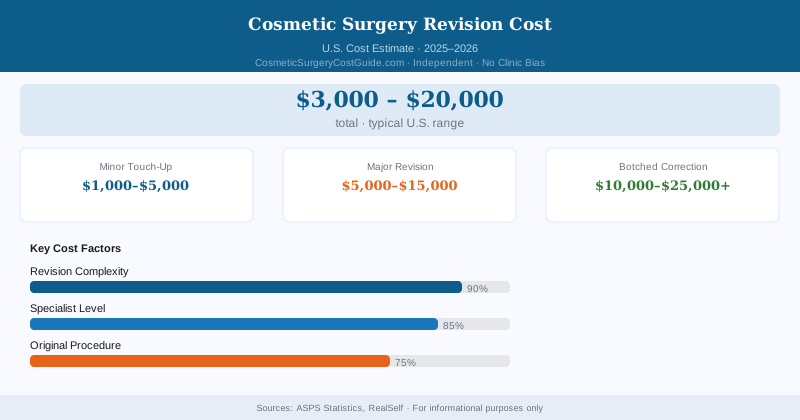
Here’s a widespread misconception about cosmetic surgery: “If I’m not happy with the result, my surgeon will redo it for free.” Surgeons do sometimes waive their own fee for revision within a certain window — but that’s only one piece of the bill. Anesthesia, facility fees, and any implant costs are separate charges that the surgeon has no control over. A “free revision” from your surgeon can still run $1,500–$3,000 once everything is accounted for.
That’s the financial reality most patients don’t discover until they need a revision. The ASPS reports revision rates that range from 5% for procedures like eyelid surgery up to 25% for breast augmentation over a 10-year window. Understanding revision costs before your primary procedure helps you plan — and helps you evaluate whether your surgeon’s warranty is actually as good as it sounds.
Revision Rate by Procedure (Industry Data)
| Procedure | 10-Year Revision Rate | Common Revision Reasons |
|---|---|---|
| Breast augmentation | 20–25% | Implant exchange, capsular contracture |
| Rhinoplasty | 8–15% | Functional improvement, aesthetic refinement |
| Facelift | 5–10% | Scar revision, asymmetry, secondary aging |
| Tummy tuck | 5–12% | Dog ear correction, scar revision |
| Breast lift | 10–20% | Recurrent ptosis, scar issues |
| Liposuction | 5–10% | Contour irregularity, additional areas |
| Eyelid surgery | 5–8% | Asymmetry, over/under-correction |
What Revision Surgery Typically Costs
| Revision Type | Typical Cost | vs. Original |
|---|---|---|
| Minor revision (scar, small adjustment) | $1,000–$3,500 | 10–30% of original |
| Moderate revision (new OR time needed) | $3,000–$8,000 | 30–60% of original |
| Major revision (significant re-operation) | $6,000–$15,000+ | 60–100%+ of original |
| Revision rhinoplasty | $7,000–$20,000 | 130–200% of primary |
| Implant exchange (breast) | $4,000–$9,000 | 50–80% of primary |
| Capsular contracture correction | $6,000–$12,000 | 70–100% of primary |
What Your Original Surgeon Covers vs. What You Pay
This is exactly where the “free revision” myth falls apart. Revision policies vary widely by practice, but here’s the pattern:
What surgeons commonly waive:
- Minor adjustments within 1 year when the surgeon agrees the result is below expectations
- Touch-up procedures taking less than 30 minutes under local anesthesia
- The surgeon’s own fee for revisions within the first 12 months
What you almost always pay regardless:
- Anesthesia fee — the anesthesiologist is a separate provider, not your surgeon
- Facility fee — the surgery center has its own cost structure your surgeon doesn’t control
- Implant costs if any implants are replaced
- Your time off work, again
Even a completely “no surgeon fee” revision can cost $1,500–$3,000 once anesthesia and facility are factored in. Know this before you negotiate warranty terms — and know it before you pick your surgeon based on their “lifetime guarantee.”
Ask during your consultation — before you sign anything:
- How long is your warranty or revision period?
- For what circumstances would you revise at no surgical fee?
- If I need revision, will I still pay for anesthesia and facility?
- Do you have a policy for revisions required due to complications vs. patient preference?
A practice that can’t answer these questions clearly, or that seems annoyed by the questions, is telling you something. High-quality practices with confident surgeons welcome these questions because their policies are clear and fair.
Why Revision Rhinoplasty Is Uniquely Expensive
Revision rhinoplasty typically costs 30–100% more than the primary procedure — and sometimes more than that. Three specific reasons:
- Scar tissue: Prior surgery leaves scar tissue that makes every step of dissection more technically demanding and time-consuming
- Cartilage grafting: Often necessary to correct structural issues from the first surgery — whether the source is ear, rib, or septum, this adds technical complexity and significant OR time
- Specialist demand: The surgeons who do revision rhinoplasty well are in high demand specifically because so few surgeons have the skills to fix what went wrong. Premium fees follow naturally.
Revision rhinoplasty at top US practices runs $15,000–$25,000. That’s often more than the original procedure cost. It’s the clearest illustration of why surgeon selection for primary rhinoplasty matters financially — a failed primary and a revision can easily cost more in total than going to a top surgeon the first time.
When You Need to Change Surgeons for Revision
If your original surgeon did the procedure correctly and you’re seeking refinement, they’re often your best option — they know your anatomy better than anyone else will.
But some situations call for a different surgeon entirely. Look for a new provider when:
- The original surgeon dismisses your concerns or gets defensive when you raise them
- The complication or aesthetic problem is outside their primary area of expertise
- A consultation with another board-certified surgeon indicates the original approach was inappropriate
- You’ve genuinely lost confidence in the provider
One thing to know when changing surgeons: the new surgeon has no obligation to honor any warranty or revision policy from the original practice. You’re starting fresh financially.
Never rush a revision. Most cosmetic surgery revision candidates benefit significantly from waiting at least 6–12 months from the primary procedure before undergoing any revision. Swelling takes months to fully resolve; what looks like a problem at 3 months often improves substantially at 9–12 months as tissue settles. Revision performed too early often addresses problems that would have self-resolved, while simultaneously making the anatomy more complex for future correction if needed. Patience is almost always medically and financially rational.
Insurance Coverage for Cosmetic Revisions
Revisions to cosmetic procedures are almost never covered. The exceptions are narrow:
- Revisions to procedures originally performed for medical reasons — functional rhinoplasty, breast reduction for back pain, reconstruction — may be covered with appropriate documentation
- Complications causing documented medical problems: infection debridement, wound repair, and similar issues can sometimes qualify
One more thing to know: breast implant manufacturers offer warranties that may cover the device itself in the event of rupture or contracture. That reduces revision cost by the implant replacement fee — typically $1,000–$2,000 per implant — which can make a meaningful dent in the total bill.
Bottom Line
Build revision costs into your long-term financial picture before you book surgery. For procedures with the highest revision rates — breast augmentation and breast lift in particular — the honest long-term cost includes the realistic probability of one or two additional procedures over 20 years. Get your surgeon’s revision policy in writing before you sign anything. Then wait: 6–12 months from your primary procedure before pursuing any revision for aesthetic concerns. What looks like a problem at 3 months often resolves considerably by month 9 or 10. Patience here is almost always the financially rational move.