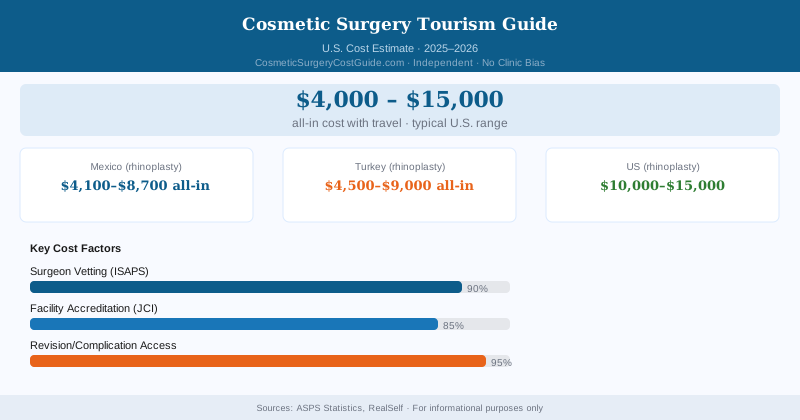
The savings look undeniable on paper: a rhinoplasty that runs $12,000 in New York goes for $3,000 in Tijuana and $2,500 in Istanbul. For someone paying out of pocket — which is everyone, since cosmetic procedures aren’t covered — that’s a $9,000 difference. The coordinators emailing you back at 11pm are warm and responsive. The websites are polished. The before-and-after photos are compelling.
None of this makes medical tourism automatically dangerous. But it does mean the calculation is more complex than the sticker price comparison suggests — and there are a few things the sticker price isn’t telling you.
What the Advertised Price Doesn’t Include
The $3,000 rhinoplasty in Mexico doesn’t come with a $0 travel budget. The real cost of medical tourism includes:
Travel: Round-trip flights to Mexico run $300–$600 from most US cities; to Turkey, $800–$1,500; to Thailand, $1,200–$2,000. Business class — which many patients find necessary for post-operative comfort on return flights — significantly increases these figures.
Accommodations: Most medical tourism packages require 7–14 days in the destination country for post-operative monitoring. Hotel or recovery house costs run $50–$200/night depending on destination and facility quality. Budget $700–$2,800 for the stay.
Companion travel: Having someone with you during surgery and early recovery isn’t optional — it’s a safety requirement. Double the travel and accommodation costs.
Follow-up appointments: Your US surgeon won’t manage the post-operative care of another surgeon’s work, and the international surgeon is thousands of miles away. Many medical tourism packages include zero follow-up once you return home. If you need suture removal, seroma drainage, or healing monitoring, you’re finding and paying a US provider who had nothing to do with your case.
Revision costs in the US: US surgeons charge more for revisions of other surgeons’ work. Some decline revision cases entirely. If your result requires correction, you may be starting over at full US prices.
Unplanned medical costs: If you return home with an infection, hematoma, or other complication, US emergency care is entirely on you. A single ER visit runs $1,500–$5,000. A hospital admission for a surgical complication can run $30,000–$80,000.
Real Cost Comparison: Rhinoplasty Example
| Cost Component | US (Major City) | Mexico (Tijuana/CDMX) | Turkey (Istanbul) |
|---|---|---|---|
| Surgery (all-in quote) | $10,000–$15,000 | $2,500–$5,000 | $2,000–$4,500 |
| Round-trip flights (2 people) | $0 | $600–$1,200 | $1,600–$3,000 |
| Accommodations (10 nights) | $0 | $800–$2,000 | $700–$2,000 |
| Follow-up US appointments | Included | $200–$500 | $200–$500 |
| Revision buffer (if needed) | Usually included/discounted | $3,000–$8,000 | $3,000–$8,000 |
| Total (no complications) | $10,000–$15,000 | $4,100–$8,700 | $4,500–$9,000 |
| Total (with minor complications) | $10,000–$15,000 | $6,000–$12,000 | $7,000–$15,000 |
The savings narrow considerably when travel costs are honest. They narrow further if anything goes wrong.
What US Surgeons See on the Other End
US surgeons regularly see post-medical-tourism complications and revisions. The most common presentations: rhinoplasty patients with persistent irregularities or breathing issues, breast augmentation patients with implant displacement or capsular contracture, and liposuction patients with contour irregularities.
Revisions on other surgeons’ work are technically more complex — scar tissue, altered anatomy, and uncertainty about what was done internally all make the case harder. US surgeons charge accordingly, and some don’t take these cases at all. The revision market from medical tourism is substantial and growing year over year.
The American Society of Plastic Surgeons has documented increasing numbers of patients seeking revision or complication management after procedures performed abroad. This isn’t a moral judgment on the choice — it’s a practical warning about the financial and surgical realities at the other end.
When You Have No Recourse
This is the part that matters most and gets discussed least.
US medical malpractice law doesn’t apply abroad. If something goes wrong with a surgeon in Tijuana or Istanbul, your recourse is through that country’s legal system — which is inaccessible to most US patients practically and financially. The surgeon’s malpractice insurance (if they carry it at all) is governed by local law.
In the US, an ABPS-certified surgeon at an accredited facility carries professional liability insurance. If they commit malpractice, you have access to a US legal process. Outcomes aren’t guaranteed, but the mechanism exists. Abroad, it often doesn’t.
How to Evaluate International Surgeons If You Proceed
Medical tourism isn’t uniformly dangerous, and dismissing it entirely ignores the reality that some international surgeons are highly trained, experienced, and ethical. If you’re moving forward, these considerations matter:
ISAPS membership: The International Society of Aesthetic Plastic Surgery (ISAPS) requires members to hold specialty certification in plastic surgery in their home country and adhere to ethical standards. ISAPS membership isn’t a guarantee, but it’s a meaningful signal. Check isaps.org.
Communication quality: A surgeon who answers complex questions thoughtfully in writing — not just through a coordinator — demonstrates genuine engagement with your case. Vague responses or deflection during pre-consultation communication are worth noting.
Before-and-after quality: The same standards apply internationally — consistent lighting, realistic results, photos of actual patients with similar anatomy.
Facility accreditation: International accreditation bodies like JCI (Joint Commission International) certify facilities abroad. A JCI-accredited facility in Mexico City or Istanbul has met standards that matter.
The highest-risk medical tourism category is complex body procedures — tummy tucks, BBL (Brazilian butt lift), body lifts, and combined procedures — at non-JCI facilities. The BBL has the highest mortality rate of any cosmetic procedure globally; rates at high-volume medical tourism facilities have been concerning enough that multiple countries have issued patient safety advisories. If you’re considering body procedures abroad, the evidence warrants your most rigorous evaluation.
The Honest Bottom Line
The savings are real. So are the risks. The question is whether the total cost — financial, medical, and in terms of recourse — makes sense for your specific situation.
Simple procedures (Botox, fillers, laser treatments) at reputable clinics in tourist-friendly cities carry genuinely low risk and can be excellent value. Complex surgical procedures with significant recovery requirements and complication potential require the most careful evaluation before crossing a border for them.
The most useful exercise: calculate the real total cost including travel, accommodation, and a worst-case revision estimate. Then compare that to US out-of-pocket cost from a qualified ABPS-certified surgeon. The gap often narrows more than the headline numbers suggest — and the comparison gives you the information you actually need to make the call.