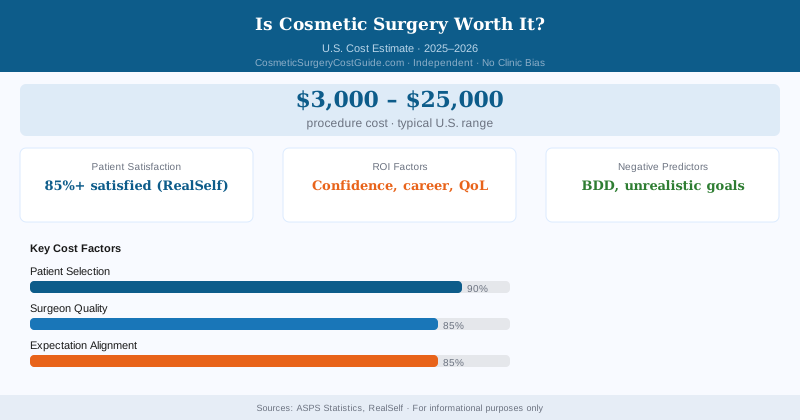
97% of breast augmentation patients said the procedure was worth it, according to RealSelf data. Facelift: 92%. Rhinoplasty: 90%. Those numbers get cited constantly — but they’re also self-selected toward the satisfied. People who regret a procedure don’t always go back to write the review.
Here’s the more useful question: what does the actual clinical research say about satisfaction, psychological outcomes, and how long results last? Because the answer shapes whether any of this is worth the $3,000 to $20,000+ you’re considering spending.
What the Research Actually Shows
The psychological research on cosmetic surgery outcomes is more solid than most people realize — and the findings are consistent.
A 2013 study published in Clinical Psychological Science tracked cosmetic surgery patients for six months and found measurable improvements in body image, self-esteem, life satisfaction, and goal achievement. Not just a post-op honeymoon effect — the improvements held at the 6-month mark. Control groups showed nothing comparable.
On breast augmentation: The ASPS notes that satisfaction rates across multiple published studies run 85–97%, with sustained body image improvement. The same data also shows clearly that patients with pre-existing psychiatric disorders or unrealistic expectations reliably score worse. Selection matters.
On rhinoplasty: Published satisfaction rates sit at 80–85% for properly selected patients. The dissatisfied minority clusters heavily among patients who showed signs of body dysmorphic disorder (BDD) before surgery.
The BDD exception: BDD affects roughly 2–3% of the general population but a higher share of people seeking cosmetic surgery, according to research cited by the American Society of Plastic Surgeons. These patients almost never find satisfaction through surgery — they request more procedures, then more. Reputable practices screen for it before operating.
| Procedure | RealSelf “Worth It” Rate | Published Satisfaction Rate | Result Longevity |
|---|---|---|---|
| Rhinoplasty | 90% | 80–85% | Permanent |
| Facelift | 92% | 88–92% | 7–12 years |
| Breast augmentation | 97% | 85–97% | 10–20 years (implant lifespan) |
| Breast reduction | 97% | 94–98% | Long-term to permanent |
| Liposuction | 81% | 75–85% | Permanent (fat cells removed) |
| Upper blepharoplasty | 96% | 90–96% | 10–15 years |
| Tummy tuck | 95% | 88–96% | Long-term; body weight maintenance dependent |
| BBL | 85% | 75–88% | 5–10 years |
What Predicts Satisfaction for a Specific Patient
“Worth it” means something different to everyone — but the satisfaction predictors are well-established enough that they’re worth knowing.
What consistently predicts a good outcome:
- A specific, realistic goal (not a vague desire to “look better overall”)
- Stable life circumstances — people in the middle of a divorce, job loss, or major transition tend to be harder to satisfy
- Doing it for yourself, not to please a partner or match someone else’s opinion of your appearance
- No significant unaddressed psychiatric concerns
- A genuine consultation with a surgeon you actually trust
- Realistic expectations about recovery time and the refinement period
What predicts disappointment:
- Expecting surgery to change relationships, career outcomes, or social status
- Patterns consistent with BDD — fixation on a specific minor flaw, a trail of prior procedures that never satisfied
- Very young age before the body has finished developing
- External pressure as the primary driver
The research finding that holds up most consistently: people who’ve wanted a procedure for years and are doing it for themselves tend to be satisfied. People doing it because someone else suggested it — or because they expect external change — tend not to be. That pattern shows up across procedure types and studies.
A useful framework for thinking about procedure cost vs. value:
For a rhinoplasty at $10,000 with a 15-year satisfaction window:
- Daily cost: $10,000 ÷ 5,475 days = $1.83/day
- Monthly cost: $10,000 ÷ 180 months = $55.56/month
Compare this to other spending that makes you feel good — gym membership, clothing, dining, travel. Most people spend more than $55/month on things they think of as non-negotiable personal expenses.
For Botox at $1,200/year:
- $3.29/day
- $100/month
Neither of these calculations makes the decision for you — but they reframe it. Spending $10,000 on something that changes how you feel about your appearance for 15 years is not obviously irrational compared to how people allocate discretionary spending in other categories.
Where Cosmetic Surgery Is Most Consistently Worth It
Breast reduction has the strongest and most consistent satisfaction data of any cosmetic procedure. We’re talking 94–98% satisfaction rates across multiple published studies — and for good reason. The physical benefits (back pain reduction, ability to exercise, better-fitting clothes) stack on top of the cosmetic result in a way that makes the outcome feel obviously worth it. The ASPS consistently highlights breast reduction as the procedure with the highest functional-plus-aesthetic satisfaction combination.
Functional blepharoplasty — upper eyelid surgery that restores visual field — delivers a measurable, objective improvement alongside the cosmetic one. That combination is hard to argue against after the fact.
Rhinoplasty with a genuine functional component — deviated septum, nasal valve collapse — has a built-in satisfaction floor from the breathing improvement alone. Purely aesthetic rhinoplasty doesn’t have that.
Any procedure addressing a specific, longstanding concern: regardless of what the procedure is, this pattern holds. A 45-year-old who’s been self-conscious about their nose since high school and finally gets it fixed is almost always satisfied. The same surgery on a 45-year-old whose partner suggested it tends to land differently.
Where Cosmetic Surgery Underdelivers
Procedures driven by social media comparison: Social media has produced a set of aesthetic benchmarks — specific lip proportions, jawlines, body curves — that are mostly based on edited images and specific lighting conditions. Procedures motivated by these goals underdeliver because the goal itself wasn’t real. You can’t achieve an edited Instagram photo through surgery.
Liposuction without weight maintenance: Lipo permanently removes fat cells from treated areas, but if you gain weight afterward, remaining fat cells expand — sometimes in different areas than before. Patients who don’t maintain their weight post-procedure often feel the results didn’t last, even though the procedure technically worked as designed. That’s a real dissatisfaction driver, and it’s worth knowing going in.
Revision after revision: Each rhinoplasty revision typically produces smaller improvements than the last — scar tissue accumulates, cartilage becomes limited. If you’re considering a third or fourth rhinoplasty, the research strongly suggests you’re on a trajectory where surgery isn’t the fix. This pattern applies to other procedures too, though rhinoplasty is the clearest example.
The Financial Reality Check
Cosmetic surgery isn’t a financial investment — it won’t directly increase your income in most cases. The return is psychological: how you feel about your appearance every day, less self-consciousness, the sense that your outside actually matches your inside.
That return is real. The clinical research confirms it. But it’s only accessible to patients who have realistic expectations, the right motivations, and a specific goal for a specific procedure. For everyone else, the same money doesn’t produce the same result.
The question “is it worth it?” has an important prerequisite question: “worth it compared to what?” Cosmetic surgery at $10,000 might be worth it compared to 15 years of dissatisfaction with a physical feature you’ve wanted to change for a decade. It might not be worth it compared to addressing the financial emergency in your life first, or compared to a mental health treatment that might more directly address the underlying concern. The cost calculation always exists in a personal context that only you can fully evaluate.
Bottom Line
High satisfaction rates are real — but they’re real for well-selected patients with specific goals and reasonable expectations. Not for everyone. The strongest predictors of a good outcome are doing it for yourself, having a concrete and realistic goal, being in a stable life situation, and choosing a surgeon you trust. For patients who fit that description, the numbers consistently support the decision. For patients who don’t — or who’d be stretching financially in ways that add real stress — the research is pretty clear that the results don’t hold up the same way.