Let’s kill the most persistent myth about this treatment before we get into pricing: dermaplaning does not make facial hair grow back thicker or darker. This claim circulates constantly on social media as though it’s a settled fact. It isn’t — it’s biologically wrong. Vellus hair (peach fuzz) is determined by the hair follicle structure, not by whether the visible shaft has been cut. You can dermaplane monthly for years without altering your hair texture or color at all. Now that that’s cleared up — here’s what dermaplaning actually costs, and what it actually does.
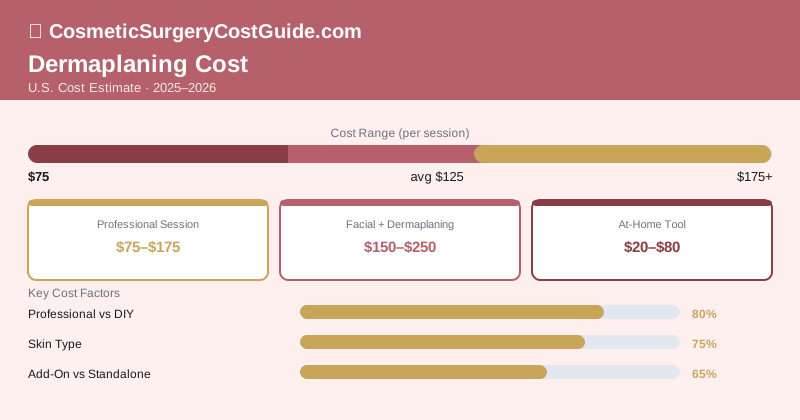
Professional sessions run $75–$175. At-home tools run $20–$80. RealSelf data shows dermaplaning holds an 87% “Worth It” rating, one of the highest of any skin treatment in that price range. The question isn’t whether it works — it’s whether you need professional treatment or whether a good at-home blade will get you where you want to be.
Professional dermaplaning pricing
| Service | Price Range | Notes |
|---|---|---|
| Professional dermaplaning session | $75–$175 | 30–45 minutes, dermatologist or med spa |
| Dermaplaning facial (combined service) | $150–$250 | Adds mask, serums, LED or massage |
| Monthly maintenance (annual cost) | $900–$2,100 | If done monthly at $75–$175/session |
| Add-on to chemical peel or facial | $40–$75 | Often discounted as an add-on |
| Dermatologist office session | $100–$250 | Higher overhead; clinical supervision |
At-home tools range from $20 to $80 — safety razors engineered with a specific blade angle for facial use. The gap between professional and at-home cost reflects some real differences worth understanding before you decide which approach fits your goals.
What professional treatment delivers that a $20 blade can’t
Blade quality and technique. Professional dermaplaning uses a sterile surgical #10 scalpel held at a precise 45-degree angle. The technique requires consistent pressure, stable angle control, and knowledge of facial anatomy — particularly around the nose, orbital bones, and mandible, where the angle has to shift to follow facial contour. At-home tools are deliberately designed to restrict blade depth and angle range for safety reasons, which also limits their exfoliation effectiveness.
Pre- and post-treatment care. A professional session includes skin assessment, proper surface prep, and strategic application of actives immediately after treatment. A freshly dermaplaned surface absorbs hyaluronic acid, vitamin C, and peptides significantly more efficiently — and a skilled esthetician will use that penetration window intentionally.
Consistent coverage. Beginners at home frequently miss patches, apply uneven pressure (causing irritation in some spots and insufficient exfoliation in others), and nick themselves at angle transitions. Professionals with hundreds of treatments work efficiently and uniformly. That consistency matters when you’re paying for results.
Dermaplaning accomplishes:
- Physical removal of the stratum corneum (outermost dead skin cells) — same goal as microdermabrasion, different mechanism
- Removal of vellus hair (peach fuzz), creating a smoother surface for makeup application
- Enhanced penetration of topical skincare applied immediately after treatment
- Immediate brightness and smoother texture — results you can see and feel the same day
Dermaplaning does NOT accomplish:
- Treating acne scarring beyond the most superficial texture issues
- Collagen stimulation (no injury response is triggered at stratum corneum depth)
- Wrinkle reduction beyond temporary smoothing of fine surface lines
- Treating hyperpigmentation that lives in the dermis rather than the superficial epidermis
- Any permanent change to hair follicles or regrowth texture
Who should avoid dermaplaning
Active acne is the primary contraindication. Running a blade across active pustules spreads bacteria across the skin surface — a guaranteed way to worsen a breakout. Cystic acne is an absolute contraindication, full stop.
Rosacea patients need to approach dermaplaning cautiously. In subtypes involving telangiectasias (visible capillaries) and reactive flushing, mechanical stimulation can trigger flares. Some rosacea patients tolerate dermaplaning well; others don’t. A test patch on a small area is smart before committing to a full treatment.
Patients on active isotretinoin (Accutane) or within six months of finishing a course should avoid any mechanical exfoliation. Skin barrier function is compromised during and after Accutane, and the risk of irritation, scarring, and delayed healing is genuinely elevated.
Active seborrheic dermatitis, eczema, and psoriasis are also contraindications — any active inflammatory condition on the skin surface means hold off.
At-home dermaplaning carries real risk for first-timers. Most nicks happen at three spots: the chin cleft, the sides of the nose, and the philtrum (the groove above the upper lip). These areas require blade angle adjustment that takes some practice. If you’re new to it, start with just one of these areas per session — don’t attempt your full face on the first try. Use a magnifying mirror, go slowly, and keep a clean gauze pad nearby. A cut on freshly prepped skin bleeds more than you’d expect from something so minor.
Monthly maintenance cost and the at-home hybrid approach
Many patients land on a hybrid: professional dermaplaning every other month or quarterly ($75–$175 per session), combined with at-home dermaplaning monthly between appointments ($20–$80 one-time tool investment). This keeps annual spend reasonable while maintaining a consistently smooth surface.
Full professional treatment every 4 weeks: $900–$2,100/year. Hybrid (professional every 8 weeks + at-home monthly): $450–$1,050/year for professional sessions plus the one-time tool cost.
Compare this to chemical peels at $100–$800/session for deeper correction, or microneedling at $200–$700/session for collagen induction. Dermaplaning sits firmly in the maintenance tier — keeping skin smooth and bright between more intensive treatments.
Bottom Line
Professional dermaplaning at $75–$175 per session is an excellent maintenance treatment: zero downtime, results you can see immediately, and a genuinely smart prep step before deeper treatments or important events. At-home tools at $20–$80 are legitimate but require some technique to avoid irritation and patchy coverage. If your skin goals extend beyond texture and brightness — scarring, wrinkles, significant laxity — dermaplaning should be one piece of a broader treatment plan, not the centerpiece.