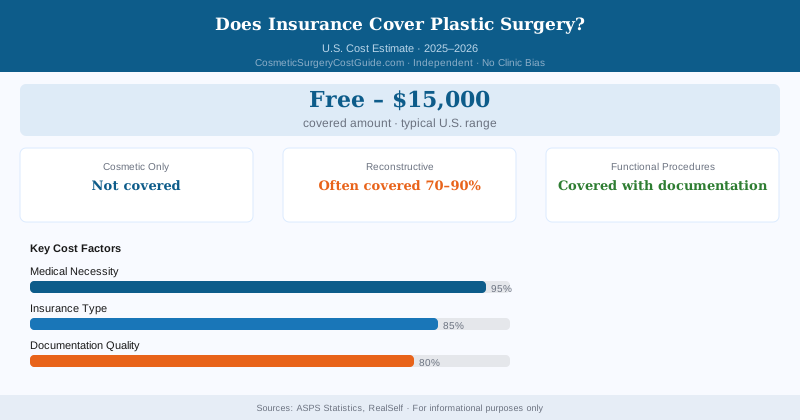
The common assumption — “insurance never covers plastic surgery” — is only half right. The accurate version: insurance doesn’t cover purely cosmetic procedures. But a meaningful number of procedures that overlap with cosmetic surgery have real medical indications that insurance does cover, sometimes paying for the majority of the cost.
The difference between coverage and no coverage often isn’t anatomy. It’s documentation. Knowing how to build the case can save you thousands of dollars on procedures you may already qualify for.
Procedures That Can Be Covered (With Documentation)
| Procedure | Medical Indication Required | Coverage Likelihood |
|---|---|---|
| Breast reduction | Back/neck pain, skin infections, functional impairment | Moderate-high |
| Upper eyelid surgery | Ptosis obstructing visual field | Moderate |
| Rhinoplasty (partial) | Deviated septum, breathing obstruction | Moderate |
| Gynecomastia surgery | Documented pain, asymmetry, psychological harm | Low-moderate |
| Abdominoplasty (panniculectomy) | Skin infections, intertrigo, functional impairment | Low-moderate |
| Ear surgery (otoplasty) | Congenital deformity, significant psychological impact | Low |
| Breast reconstruction | Post-mastectomy (federal mandate) | High |
| Skin lesion removal | Any suspicious lesion, confirmed pathology | High |
| Scar revision | Functional impairment, contracture limiting movement | Moderate |
| Hyperhidrosis treatment | Conservative treatment failure, documented severity | Moderate |
Myth: “If It Changes Your Appearance, Insurance Won’t Touch It”
Not true. The actual distinction insurers use is cosmetic versus reconstructive:
Cosmetic: Reshaping normal structures to improve appearance. Not medically necessary — not covered.
Reconstructive: Restoring function or normal appearance after disease, injury, or a congenital defect. May be covered.
The gray zone is real and large. Rhinoplasty for both breathing function and appearance is the clearest example — the functional component (septoplasty) is often covered, the cosmetic component isn’t. Surgeons can and do itemize procedures to bill the functional portion through insurance while you self-pay for the rest. That split billing is completely legitimate and common.
Myth: “Getting Coverage Approved Is Nearly Impossible”
It’s harder than just showing up, but it’s far from impossible — especially for procedures like breast reduction and eyelid surgery. The key is building a paper trail in your medical records before you ever contact a surgeon about surgery.
Step 1 — See your primary care physician. Describe your symptoms specifically and with concrete detail. “My neck and shoulder pain is a 7/10 daily, limits my ability to exercise, and affects my work productivity.” Say it that specifically. It needs to be written in the chart, not just heard and nodded at.
Step 2 — Get the right diagnostic workup. For breast reduction: document bra size, shoulder grooving from straps, tissue weight. For eyelid ptosis: visual field testing. For a deviated septum: nasal endoscopy or CT scan. These create objective proof.
Step 3 — Try conservative treatment first and document it. Most insurers want 3–6 months of documented conservative treatment before they’ll consider surgery. For breast-related back pain: physical therapy, properly fitted bras, anti-inflammatory medications. Keep records.
Step 4 — See a specialist. An ophthalmologist, plastic surgeon, or ENT documents their clinical findings and a surgical recommendation.
Step 5 — Submit pre-authorization. Your surgeon’s office does this, but your job is to make sure the documentation package is complete. Be involved in the process.
Pre-authorization (pre-auth) is required before any elective surgery with insurance involvement. The process:
- Surgeon’s office submits a pre-auth request with clinical documentation
- Insurer reviews and makes a coverage decision (typically 14–30 days)
- Approval: proceed with scheduling
- Denial: appeal with additional documentation (most initial denials can be successfully appealed)
Denials are common and not the end of the process. The appeals process allows you to submit additional physician letters, peer-reviewed medical literature supporting coverage, and patient advocacy. Many initially denied cases are ultimately covered after a first-level appeal.
Myth: “Only Breast Reconstruction After Cancer Is Covered”
Breast reconstruction post-mastectomy is definitely covered — federal law (WHCRA 1998) mandates it for any insurer that covers mastectomy, including both breasts and all related complications. But that’s not the only procedure with real coverage pathways.
Breast reduction: The most commonly covered cosmetic-adjacent procedure. Requires documenting minimum tissue removal (typically 400–500g per side), physical symptoms like back pain or skin infections, and failed conservative treatment. Most major insurers actually publish their coverage criteria — you can look them up before you even see a surgeon.
Upper eyelid surgery: Covered when visual field testing shows 12+ degrees of superior field improvement with lids taped versus natural position. Your ophthalmologist does the testing. It costs $150–$300 and is usually covered as a diagnostic test.
Rhinoplasty: The cosmetic component isn’t covered — but septoplasty for documented nasal obstruction often is. Combined septorhinoplasty lets you split the bill between insurance and self-pay.
Abdominoplasty/panniculectomy: A cosmetic tummy tuck isn’t covered. But panniculectomy — removing a hanging skin fold causing infections, rashes, or hygiene problems — may be covered when you have documented skin infections or intertrigo in your medical record. Different procedure, different code, different coverage outcome.
Never misrepresent a purely cosmetic procedure as medically necessary. Insurance fraud (billing cosmetic surgery as reconstructive without genuine medical indication) is a federal crime that can result in prosecution of both the patient and the provider. The distinction must be genuine — not manufactured for insurance purposes. If your procedure is purely cosmetic, pay for it out of pocket. The shortcuts aren’t worth the legal risk or the ethical problem.
Myth: “A Denial Means It’s Over”
It doesn’t. Initial denials on elective procedures are common — insurance companies often issue a denial on first pass to see if you’ll appeal. Most people don’t appeal. Most people who do appeal win or get partial coverage.
Here’s what the common denial reasons mean and how to respond:
“Not medically necessary”: Appeal with additional physician documentation, peer-reviewed medical literature supporting coverage criteria, and more detailed symptom descriptions. Your surgeon’s office should be able to pull supporting literature.
“Cosmetic in nature”: Provide evidence of functional impairment — clinical photos, functional assessments, physical therapy records, specialist notes documenting what you physically can’t do because of this condition.
“Insufficient conservative treatment”: You need documented proof that you tried and the conservative approach failed. Duration matters — show you gave it the required months.
“Pre-existing condition exclusion”: Less relevant post-ACA for most people. If this applies, talk to an insurance attorney.
Bottom Line
Several procedures that feel cosmetic — breast reduction, eyelid surgery, functional rhinoplasty — have legitimate insurance pathways when medical necessity is properly documented. The coverage won’t come to you. You have to build the case, starting months before surgery, with your primary care physician and specialist. Initial denials are common and not final. If any procedures on this list are relevant to you, start documenting your symptoms now, even if surgery is a year away. That paper trail is what makes the difference.