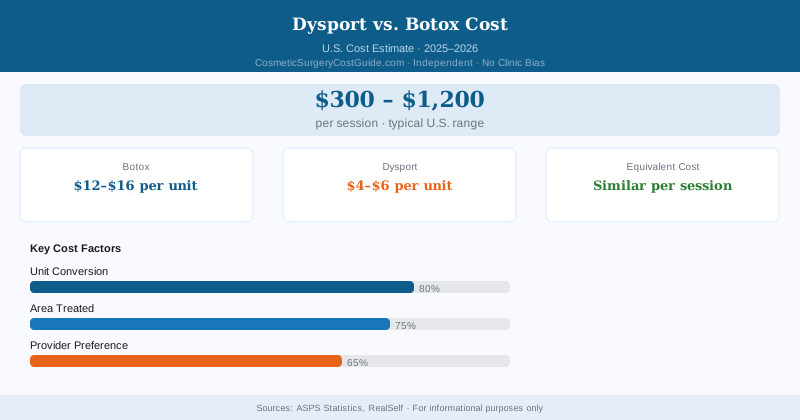
Dysport at $4 per unit versus Botox at $14 per unit: on paper, that looks like a massive deal. In practice, it’s basically a pricing illusion — and understanding why might save you from making the wrong choice for the wrong reasons.
Dysport requires 2.5 to 3 times more units to achieve the same clinical effect as Botox. The actual treatment cost ends up roughly equivalent. Here’s what the comparison actually looks like when you do the math properly.
Botox vs. Dysport: Per-Treatment Cost Reality
| Treatment Area | Botox Units | Botox Cost | Dysport Units | Dysport Cost |
|---|---|---|---|---|
| Forehead | 10–20 units | $150–$360 | 30–50 units | $150–$350 |
| Glabella (frown lines) | 15–25 units | $225–$450 | 40–70 units | $200–$490 |
| Crow’s feet | 10–20 units | $150–$360 | 30–50 units | $150–$350 |
| Upper face (all 3 areas) | 40–65 units | $600–$1,100 | 100–175 units | $500–$1,100 |
| Masseter (both sides) | 30–50 units | $400–$850 | 75–125 units | $375–$875 |
As you can see: per-treatment cost is essentially equivalent when the correct dose conversion is applied.
The Conversion Ratio: Why Per-Unit Price Is Meaningless Alone
The generally accepted conversion: 2.5 Dysport units ≈ 1 Botox unit. Some providers use 2:1, some use 3:1 depending on the area and their preference.
This is why advertising “$3/unit Dysport” as though it’s dramatically cheaper than “$12/unit Botox” is misleading. A 30-unit Dysport treatment costs $90; a 12-unit Botox treatment costs $144. But 12 Botox units and 30 Dysport units aren’t equivalent doses — they just happen to produce similar effects.
The question to ask your provider isn’t “what’s your per-unit price?” It’s: “How many units will you use and what will the total treatment cost?” That’s the number that actually lets you compare apples to apples.
Because the exact dose equivalence between Dysport and Botox isn’t perfectly established, different providers use different conversion ratios. This creates legitimate variation in outcomes: a provider using a 2:1 ratio may under-dose Dysport relative to a provider using 3:1. If Dysport seems to wear off faster or work less well than your Botox experience, the dose may be too conservative. Discuss your historical Botox doses with any Dysport provider to help calibrate.
Dysport vs. Botox: The Clinical Differences That Actually Matter
OK so the price is roughly the same. Are there real reasons to choose one over the other?
Onset: Dysport tends to kick in slightly faster — some patients see results at 2–3 days compared to Botox’s typical 3–5 days. Neither is dramatically faster in a way that changes how you’d plan your treatment.
Spread: This one actually matters. Dysport spreads more from the injection point — it diffuses over a wider area. For large, flat muscles like the forehead, that’s often an advantage — you can cover the area with fewer injection points. For very targeted treatments near the eyes or smaller muscles, that spread can be a disadvantage.
Duration: Both typically last 3–4 months. Individual metabolism matters more than which product you used.
Resistance: Some patients develop antibodies to botulinum toxin A over time and find their results getting shorter or weaker. Switching products — Botox to Dysport, or to Xeomin — can sometimes restore responsiveness, since each product has a slightly different protein profile. This is a legitimate clinical reason to switch, not just variety.
The Full Neuromodulator Landscape in 2025
| Product | Manufacturer | Units Per Area | Relative Cost | Key Difference |
|---|---|---|---|---|
| Botox (onabotulinumtoxinA) | Allergan/AbbVie | Baseline | $12–$18/unit | Most studied, longest track record |
| Dysport (abobotulinumtoxinA) | Galderma | 2.5x more | $4–$6/unit | Slightly faster onset, spreads more |
| Xeomin (incobotulinumtoxinA) | Merz | ~1:1 with Botox | $10–$16/unit | “Naked” toxin, less protein complex |
| Jeuveau (prabotulinumtoxinA) | Evolus | ~1:1 with Botox | $9–$15/unit | Newest product, competitive pricing |
| Daxxify (daxibotulinumtoxinA) | Revance | ~1:1 with Botox | $13–$20/unit | Lasts 6+ months (unique) |
Daxxify is worth singling out: it uses a novel peptide formulation that extends duration to 6–9 months for many patients — nearly double the standard 3–4 months. Per-session cost is higher at $400–$700 per area, but the annual math often works out comparable or better if you’d otherwise be coming in every 3 months.
So Which One Should You Actually Choose?
Botox: Go here if you have established dosing history with it, if your provider is most comfortable with it, or if you’re treating areas where precise placement is critical and you don’t want spread.
Dysport: Makes sense if your provider has better pricing for it, you want slightly faster onset, or Botox has underperformed for you. Don’t switch just for the per-unit price — do the total cost math.
Xeomin: The right choice if you’re experiencing resistance to Botox or Dysport, or if you want a “naked” toxin without accessory proteins that may contribute to antibody development.
Daxxify: If you hate the maintenance schedule — four appointments a year, fitting it around work, the whole routine — Daxxify’s longer duration might justify the higher session cost. Do the annual math before deciding.
Never let per-unit price be the primary factor in choosing a neuromodulator. The most important variables are: your provider’s experience and training, the total dose used (not just per unit), and the skill with which the product is placed. A less expensive product delivered by an inexperienced injector will produce worse results than a premium product in experienced hands. The per-treatment cost difference between neuromodulators is generally small compared to the experience gap between providers.
Bottom Line
Dysport and Botox are not meaningfully different in price when you account for correct dosing. Both run approximately $500–$1,000 for a full upper face treatment at a reputable practice. There are real clinical reasons to prefer one over the other — spread, onset, resistance, duration — but the per-unit price difference isn’t one of them. Choose based on your provider’s recommendation for your anatomy, not the cheapest unit price advertised online.