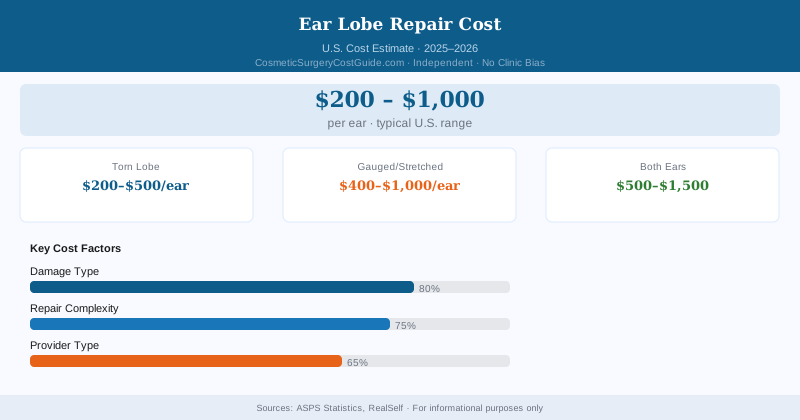
Picture this: you’re getting dressed, catch your earring on your sweater pulling it off, and feel — and hear — a small tearing sensation. Or maybe it wasn’t one moment at all, just years of heavy gold hoops that slowly stretched a piercing hole until it’s now a slit that runs halfway to the edge of your lobe. Or you’re 28, have a good job interview coming up, and you stretched your earlobes to 00 gauge at 19 and you’d really like them back.
These are the three scenarios that send people to a plastic surgeon or dermatologist for earlobe repair. All three are straightforward procedures under local anesthesia with predictably good results — and the cost is a lot more manageable than people expect.
Earlobe Repair Cost
| Procedure | Cost Per Ear | Both Ears | Notes |
|---|---|---|---|
| Torn/split earlobe repair | $300–$600 | $500–$900 | Minor, local anesthesia |
| Elongated/stretched piercing repair | $250–$500 | $450–$800 | Tighten oversized hole |
| Gauge stretching closure (small, <5mm) | $400–$700 | $700–$1,200 | Excision and closure |
| Gauge closure (medium, 5–15mm) | $500–$1,000 | $900–$1,800 | More tissue needed |
| Gauge closure (large/major, >15mm) | $800–$1,800 | $1,400–$3,000 | May need tissue flap |
| Keloid removal (earlobe) | $400–$800/ear | $700–$1,400 | Plus steroid treatment |
Torn Earlobe Repair
Heavy earrings gradually elongate piercing holes over years. When a hole finally tears completely or nearly completely — splitting the lobe — repair is straightforward.
Here’s what the procedure actually involves:
- A small injection of local anesthesia into the earlobe
- The surgeon freshens the edges along the tear — the old healed skin has to be removed so the wound can close properly
- Sutures close the lobe in layers
- Sutures come out at 5–7 days
- You can re-pierce at 3–4 months
The scar from a properly done repair is typically minimal and tucks into the natural contour of the ear. Most patients say it’s barely visible once fully healed.
Partial tear (elongated hole, not split through): Can be repaired more conservatively; less tissue removal needed. Lower cost and faster recovery.
Complete tear (split lobe): Requires more tissue freshening and careful closure. Results are generally excellent in experienced hands.
Repair at an aesthetician vs. physician: Minor earlobe repair is performed by some experienced aestheticians and piercers as well as physicians. For simple torn lobes, an experienced piercer may charge $100–$250. For those with medical complexity, skin conditions, or heavy keloid tendency, physician management is safer.
Gauge Stretching Correction
Gauge reversal is an increasingly common request — and what’s possible depends heavily on how far the stretching went.
Small gauges (up to 2 gauge / ~6mm): Good news here. The tissue often has enough elasticity to retract on its own after you remove the jewelry. After 6–12 months without jewelry, some patients find the lobe has tightened considerably. Surgical repair at this size is usually conservative — suturing closes what didn’t retract on its own.
Medium gauges (0 gauge to 00 gauge / 8–10mm): The tissue may not retract adequately without help. Surgical closure creates a small scar but restores near-normal earlobe shape. Most patients are happy with the result.
Large gauges (over 10mm, “tunnels”): More involved reconstruction is needed. Skin flap techniques come into play. The earlobe will have some visible scar and may end up slightly smaller than its original size — that’s just the reality of reconstructing tissue that’s been stretched that much.
Very large gauges (over 40mm): Complex reconstruction, significant size reduction, more visible scarring. Still doable, but set realistic expectations going in.
Earlobe Keloids
Keloids — raised, hard overgrowths of scar tissue at a piercing site — are trickier than simple tears. They’re more common in people with darker skin tones, and the challenge is that they come back aggressively if you just cut them off.
Here’s what actually works:
- Intralesional steroid injections: $100–$300 per session, typically 3–8 sessions needed
- Surgical excision plus immediate steroid injection: $400–$800 per ear
- Surgical excision plus radiation (for severe, recurrent keloids): $800–$2,000+
The critical point: simple excision alone leads to recurrence in the vast majority of cases. You have to combine removal with steroids, and sometimes radiation, to meaningfully reduce recurrence risk. If a provider recommends just cutting it off with no follow-up treatment plan, that’s a red flag.
Earlobe piercing in patients who are keloid-prone (especially those with keloids elsewhere or with darker skin tones predisposing to keloid formation) carries significant risk of keloid development at the piercing site. If you’re keloid-prone and want ear piercings, discuss this risk with a dermatologist beforehand. Prophylactic steroid injection at the time of piercing can reduce keloid risk in high-risk individuals.
Will Insurance Cover Earlobe Repair?
Almost certainly not — it’s a cosmetic procedure in nearly all cases. The rare exception is a very large tear or stretch causing genuine functional problems like repeated catching, pain, or recurring infection. Even then, insurance coverage is unlikely. Budget to self-pay.
Re-Piercing After Repair
You can re-pierce at 3–4 months once healing is complete. Scar tissue actually holds a piercing well — that’s not usually the concern. But place the new piercing at a slightly different location than the original to avoid weakening the repaired area.
One rule that matters long-term: avoid heavy earrings going forward. Scar tissue is more vulnerable to re-tearing than intact earlobe, especially in the first year after repair. If heavy earrings were what caused the problem in the first place, you’ll want to rethink your jewelry choices permanently.
Bottom Line
Torn earlobe repair for both ears runs $500–$900 at a dermatologist, plastic surgeon, or facial plastic surgeon. Small gauge correction: $700–$1,200 for both ears. Larger gauge reconstruction: $1,400–$3,000. These are quick procedures under local anesthesia — no OR, no general anesthesia, back to your day the same afternoon. Satisfaction rates are high because the results are definitive and the recovery is minimal.