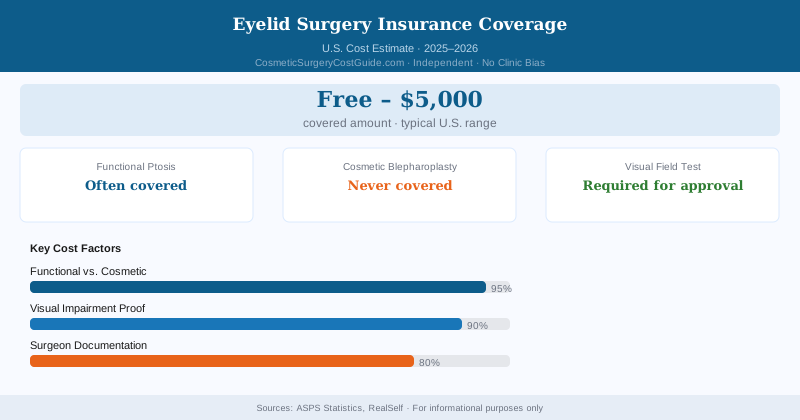
Upper eyelid surgery has something no other cosmetic procedure does: a legitimate insurance coverage pathway that turns on a single objective test. The technique is identical whether the procedure is classified as medical or cosmetic — same incision, same tissue removal. What changes is whether your drooping is severe enough to obstruct your vision, and whether you have the documentation to prove it.
Here’s exactly how to find out where you stand and what to do about it.
What Insurance Covers vs. What It Doesn’t
| Scenario | Coverage | Requirements |
|---|---|---|
| Upper eyelid ptosis blocking visual field | Yes | Visual field test, examination |
| Upper eyelid cosmetic improvement only | No | No medical indication |
| Lower eyelid surgery (puffiness, wrinkles) | No | No functional indication |
| Dermatochalasis causing visual obstruction | Yes | Documented with visual field testing |
| Brow ptosis contributing to visual field loss | Yes | If brow lift is needed for vision |
| Ptosis repair vs. skin excision only | Depends | Some insurers cover ptosis repair, not skin excess alone |
Step 1: Get the Visual Field Test
This is the critical first step — the objective proof that your drooping upper eyelids actually obstruct your vision. Here’s how it works:
- You go to an ophthalmologist or optometrist
- They measure your superior visual field — how far upward you can see — with your lids in their natural position
- They tape your eyelids up, mimicking what surgery would do
- They re-measure your superior visual field with the lids taped open
- If your visual field improves by a threshold amount, you may qualify for coverage
What the threshold actually looks like by insurer:
- Most require 12+ degrees of superior visual field improvement with lids taped
- Some require field loss below 30 degrees from fixation in natural state
- Some require more than 30% loss of superior visual field
The test itself costs $150–$300. It’s typically covered as a diagnostic test by your vision or medical insurance. This means you can find out whether you qualify without spending much.
Most insurers also require standardized photographs showing:
- Patient looking straight ahead with eyes open naturally
- Lid margin at or below the midpoint of the pupil
- Photographs taken with standard illumination and positioning
Your ophthalmologist or plastic surgeon’s office will take these at your examination. The photographs combined with visual field testing make a complete documentation package for pre-authorization.
Some insurers specifically require photographs showing the measured margin-reflex distance (MRD1) — the distance from the corneal light reflex to the upper lid margin. An MRD1 of 2mm or less is often used as an objective marker for significant ptosis.
Step 2: Understand What You’re Actually Being Diagnosed With
Your ophthalmologist will distinguish between two conditions — and the distinction affects your coverage:
True ptosis: Weakness of the levator muscle that lifts the upper lid. The muscle problem, not just excess skin. Most insurers treat this as the more clearly medical condition.
Dermatochalasis: Age-related excess upper eyelid skin that droops over the lashes. This is what most people picture when they say “droopy eyelids.” Coverage is possible when it’s severe enough to obstruct your visual field — but criteria are stricter than for true ptosis, and some insurers exclude dermatochalasis excision from coverage entirely regardless of severity.
Know which diagnosis applies to you before the pre-auth is submitted. Both the diagnosis code and the clinical distinction matter for your insurer’s review.
Step 3: Build the Pre-Authorization Package
Your surgeon’s office will manage the submission, but you should know what a complete package looks like:
- Clinical examination notes from your ophthalmologist or plastic surgeon
- Visual field test results (both with and without taping — both sets of numbers)
- Standardized photographs (straight ahead, natural lid position, standard lighting)
- Documentation of functional symptoms: difficulty reading, driving, or performing daily activities
- ICD-10 diagnosis codes — ptosis is H02.4xx, dermatochalasis is H02.3x
Ask your surgeon’s office explicitly whether they have experience submitting pre-auth for eyelid surgery to your specific insurer. Some practices do this routinely and know exactly what each carrier wants.
Step 4: Know What You’ll Still Owe After Coverage
Insurance approval doesn’t mean zero out-of-pocket cost. Here’s the math on a realistic scenario:
- Procedure total: $5,000
- Your deductible: $2,000
- Coinsurance: 20% of costs after deductible
- You pay: $2,000 (deductible) + 20% of $3,000 ($600) = $2,600 total
- Insurance pays: $2,400
That’s still significantly less than $5,000–$9,000 out of pocket. And if you’ve already met your deductible for the year through other medical expenses, you’d pay only the coinsurance portion.
A few other things to check: whether your surgeon and facility are in-network, and whether your plan covers the cosmetic portion if you’re planning any aesthetic enhancements beyond the functional correction.
Lower Eyelid Surgery: Don’t Count On Coverage
Lower eyelid surgery for cosmetic concerns — puffiness, under-eye bags, wrinkles — has no functional indication and is virtually never covered. The rare genuine exceptions:
- Ectropion (lid turns outward) causing dry eye or exposure keratitis
- Entropion (lid turns inward) causing corneal irritation from lashes rubbing the eye
- Lower lid malposition from a prior injury or surgery
These are distinct functional conditions that an ophthalmologist would diagnose and refer for repair — not cosmetic lower blepharoplasty dressed up as functional. Don’t approach them as the same thing.
Some providers attempt to bill cosmetic blepharoplasty as medically necessary without proper visual field testing documentation. This is insurance fraud. Insurers have become increasingly sophisticated at detecting inappropriate billing for eyelid surgery — a procedure they know has a cosmetic demand market. Always have proper testing done and submit only what you legitimately qualify for. The consequences of fraudulent billing fall on both the provider and the patient.
Combining Insurance Coverage with Cosmetic Eyelid Work
Many patients qualify for covered upper lid surgery and also want cosmetic lower lid work. Here’s how that combination usually works:
- The upper lid functional surgery goes through insurance
- You self-pay for the lower lid cosmetic work
- Both are performed in the same surgical session — you pay for anesthesia and the facility once, with costs allocated between insurance billing and self-pay
This is a legitimate and common arrangement that saves money compared to two separate surgical episodes. Ask your surgeon’s office explicitly how they handle the billing split.
Bottom Line
The protocol is: get the visual field test first. It costs $150–$300, it’s usually covered as a diagnostic, and it tells you definitively whether you qualify for insurance coverage. If you do qualify, your surgeon submits pre-auth with the test results, photographs, and clinical notes. If you don’t qualify, you’ll have lost $150–$300 and a few hours — but you’ll know exactly where you stand and can plan accordingly. Private-pay upper blepharoplasty runs $2,500–$6,000 all-in for those who don’t qualify.