Filler vs. fat transfer: here’s what actually separates them. Filler is predictable, dissolvable, and maintenance-dependent — you’re going back every year. Fat transfer uses your own tissue, potentially lasts a decade or more, but involves surgery, a real recovery, and results that take months to fully settle.
Neither is universally better. For the right patient, fat transfer is the more economical long-term choice by a significant margin. For someone who values predictability and no downtime, filler is the smarter call. Knowing which category you’re in starts with understanding what fat transfer actually costs and involves.
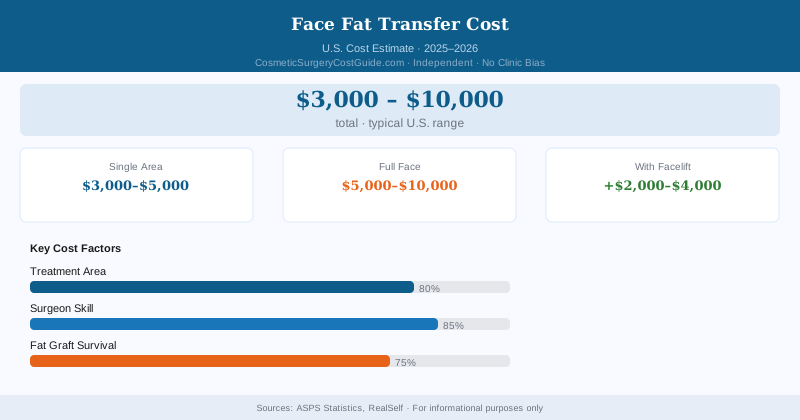
According to ASPS data, standalone facial fat transfer averages $4,000–$6,000 all-in — though the range is wide depending on how many areas you’re treating.
Cost Breakdown
| Scenario | Cost Range |
|---|---|
| Fat grafting to one area (e.g., cheeks only) | $2,500–$4,500 |
| Comprehensive facial fat transfer (multiple areas) | $4,500–$8,500 |
| Fat grafting added to facelift | +$1,500–$3,000 |
| Fat grafting added to eyelid surgery | +$1,000–$2,500 |
| Under-eye fat transfer specifically | $2,500–$4,500 |
| Fat grafting + mini lipo (donor site) | $4,000–$7,500 |
How the Procedure Works
Facial fat transfer is a three-step process — and understanding each step helps clarify why the recovery is more involved than filler:
Harvesting: Fat is removed via small-cannula liposuction from the abdomen, inner thighs, or flanks. Tiny incisions, 1–2mm. But it’s still liposuction, which means the donor site has some soreness and bruising for a week or two.
Processing: The harvested fat is centrifuged or filtered to remove blood, oil, and damaged cells, concentrating only the viable fat cells for injection.
Injection: Purified fat is injected in small droplets through fine cannulas into the target facial areas — cheeks, temples, tear troughs, nasolabial folds, lips, jawline.
Total time: 1–3 hours depending on how many areas are treated.
What Areas Can Be Treated
- Cheeks/mid-face: Restore volume lost to aging; create structural lift
- Tear troughs: Soften under-eye hollowing (technically demanding, higher risk)
- Temples: Fill temporal hollowing that ages the upper face
- Nasolabial folds: Soften “smile lines” from volume loss
- Jawline and prejowl area: Improve lower face definition
- Lips: Natural volume addition
- Forehead: Smooth deeper lines caused partly by volume loss
Cheeks, temples, and nasolabial folds respond most predictably to fat grafting. The tear trough (under-eye) area requires the most surgical skill and has higher risk of irregularity — many surgeons prefer hyaluronic acid filler there and reserve fat for larger volume areas. Be sure to ask your surgeon which areas they most commonly treat with fat versus filler, and why.
The Reabsorption Reality: Fat Transfer vs. Filler Predictability
Here’s the honest tradeoff between fat transfer and filler that most people don’t hear clearly.
With filler: you see the result the same day. It’s adjustable. If you don’t like it, it can be dissolved. The predictability is high.
With fat transfer: 30–70% of injected fat reabsorbs in the first few months while surviving cells establish a blood supply. Experienced surgeons account for this by slightly overfilling. But the final result takes 4–6 months to emerge — and you might need a touch-up.
That variability is the main clinical drawback of fat transfer compared to filler. It’s not a reason to avoid it, but it’s something to go in with clear eyes about.
Touch-up sessions: Common for areas that under-corrected. Many surgeons offer them at reduced cost or include them in the original fee if performed within the first year. Ask about this policy before booking — it matters for your total cost calculation.
The Long-Term Cost Comparison: Fat Transfer vs. Filler
This is where fat transfer’s economics become compelling. The ASDS notes that hyaluronic acid filler typically requires repeat treatment every 6–18 months depending on the product and area. The math over five years:
- Dermal filler (cheeks): $1,400–$1,800/year → $7,000–$9,000 over 5 years
- Fat transfer (cheeks): $4,000–$6,000 one-time → potentially no repeat cost for 5–10 years
The breakeven point is typically around years 3–4. Patients who’ve been on a regular filler maintenance schedule and are satisfied with their overall look are often ideal fat transfer candidates — they already know what volume restoration does for their face, and they’d like to stop the repeat appointments.
Facial fat transfer results are highly technique-dependent. Overcorrection, lumpiness, or asymmetry can occur — and unlike filler, transferred fat can’t be dissolved. Choose a surgeon with significant experience in fat grafting specifically and ask to see before-and-after photos from multiple angles. Avoid surgeons who offer fat transfer as an add-on they rarely perform.
Recovery Costs and Timeline
This is one of the significant contrasts with filler — fat transfer recovery is real.
- Swelling and bruising at both the donor site and face: expect 2–3 weeks before you look “normal”
- Most patients take 1–2 weeks off work
- You may look overfilled for 3–6 weeks while the fat settles
- No compression garment on the face; small bandage on the donor site
- Post-op medications: $75–$150
What Drives the Price
Number of areas: Treating cheeks only versus a multi-area treatment significantly changes operating time.
Combination with other procedures: Fat transfer is a natural addition to facelifts or eyelid surgery. Adding it to an existing procedure costs $1,500–$3,000 incrementally — much less than scheduling it standalone.
Surgeon experience: Fat grafting is among the more technique-dependent facial procedures. High-volume specialists charge more. The outcome difference tends to justify the gap.
Bottom Line
Fat transfer or filler? For occasional, targeted volume correction — filler. For patients in their 40s or 50s who want lasting restoration and are willing to do surgery once rather than touch up indefinitely — fat transfer makes sense. Standalone cost runs $4,000–$7,500 at most reputable practices. As an add-on to a facelift or blepharoplasty, the incremental cost drops to $1,500–$3,000. Talk to your surgeon about which makes more sense given what you’re actually trying to achieve.