Picture this: you get two quotes for a facelift. One comes back at $7,500. The other says $19,000. You’re wondering if the cheaper one is just someone being efficient, or if it’s a completely different operation. It’s almost certainly a completely different operation.
Estimates include surgeon fee, anesthesia, and facility costs. Revision surgery, pre-op labs, and compression garments add cost. Get 2–3 in-person consultations for accurate quotes.
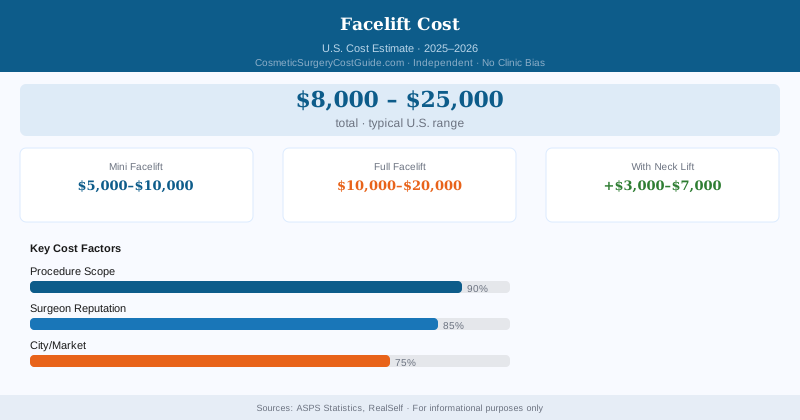
“Facelift” covers a spectrum that runs from a 90-minute mini-lift under local anesthesia to a 5-hour deep plane procedure addressing the face, neck, and underlying muscle layers. Both are technically facelifts. The ASPS puts the average surgeon fee at $8,005, but all-in costs at quality practices regularly run $12,000–$20,000 — and for good reason.
Mini Facelift vs. Full Facelift: Price Comparison
| Procedure | Surgeon Fee | All-In Cost |
|---|---|---|
| Mini facelift (S-lift) | $3,500–$6,000 | $5,500–$9,000 |
| Mid-face lift | $4,000–$7,000 | $7,000–$12,000 |
| Full facelift (SMAS) | $7,000–$15,000 | $12,000–$22,000 |
| Full facelift + neck lift | $9,000–$18,000 | $14,000–$28,000 |
| Deep plane facelift | $12,000–$20,000 | $18,000–$30,000 |
The deep plane facelift — the most extensive technique — addresses the deeper facial tissues, not just skin. It produces longer-lasting results, costs significantly more, and has a longer recovery. Top facial plastic surgeons who specialize in deep plane techniques tend to charge at the high end of these ranges.
What’s Actually Included in the Quoted Price
This is where quotes get misleading. A reputable practice gives you an all-in number that includes:
- Surgeon’s fee
- Anesthesia (IV sedation or general)
- Accredited surgical facility fee
- Pre-op labs and EKG
- Post-op garments
- All follow-up appointments for one year
Some practices quote only the surgeon’s fee. That can make a $15,000 facelift look like an $8,000 one on paper. Always ask specifically: “Is this quote all-in, or is this surgeon fee only?” Get the breakdown in writing.
Who Actually Needs Each Type?
Your anatomy determines the right procedure — not your budget. A mini facelift works well for patients in their 40s to early 50s with mild jowling and early skin laxity. A full SMAS facelift is the typical recommendation for moderate to significant laxity in the lower face and neck. Deep plane techniques are reserved for patients with substantial volume loss and deep structural changes that skin-level lifting won’t adequately address.
Choosing a less extensive procedure to save money when a more involved one is actually indicated usually leads to disappointment. You end up with a result that falls short, potentially needing revision — which costs more than doing it right the first time.
Some patients choose a mini facelift to save $5,000–$8,000, only to need a revision or full facelift within 3–5 years. A procedure well-matched to your anatomy typically lasts 8–12 years. When you factor in the cost of a revision, the less expensive option often isn’t cheaper in the long run.
What Drives the Cost Higher
Surgeon credentials: Board certification in plastic surgery or facial plastic surgery is the minimum. Surgeons who focus exclusively on facial procedures — and teach technique to other surgeons — charge more. Their revision rates tend to be lower. That math often makes them the better value even at higher fees.
Combining procedures: Many facelift patients also have eyelid surgery ($3,000–$6,000), a brow lift ($3,500–$5,500), or fat grafting ($2,000–$4,000) done at the same session. Combining saves on anesthesia and facility fees — typically 15–25% compared to scheduling each separately.
Geographic location: Manhattan, Beverly Hills, Scottsdale, and Miami command a premium. The same board-certified surgeon in Nashville or Minneapolis might charge 20–35% less for the same operation.
Facility type: Hospital ORs cost more than accredited outpatient surgery centers. Most facelifts can be safely performed at an outpatient facility — it’s worth confirming this when comparing quotes, because it can represent a meaningful cost difference.
Recovery Costs to Budget For
Facelift recovery isn’t free beyond the procedure itself. Plan for:
- Post-op medications: $100–$250
- Lymphatic drainage massages (optional but genuinely helpful for swelling): $75–$150/session, 4–8 sessions
- Arnica and supplements: $30–$80
- Help at home for the first week: variable depending on your situation
- Time off work: plan for 2–3 weeks depending on your job
Be skeptical of any “facelift” priced under $4,000 total, or procedures marketed as “lifestyle lift” or “lunch-hour facelift.” These typically involve skin-only techniques without addressing the deeper SMAS layer, producing results that look tight rather than natural and often last only 1–2 years. True surgical facelifts require a board-certified surgeon and proper surgical facility.
Financing a Facelift
Most practices offer financing through CareCredit or Alphaeon Credit. For a $15,000 procedure on a 24-month 0% promotional plan, you’re looking at about $625/month. After the promotional period, standard interest rates kick in — typically 26–29% APR. Pay it off within the 0% window.
Bottom Line
Budget $12,000–$20,000 for a full facelift with a board-certified surgeon at an accredited facility in most US markets. Mini facelifts can be done for less — but only if the technique actually fits your anatomy. Get at least two consultations and ask each surgeon specifically what technique they’d use and why. The answer to that question tells you a lot about whether they’re recommending what’s right for you or what’s easy for them.
Frequently Asked Questions
A mini facelift typically costs $8,000–$12,000 and takes about 90 minutes under local anesthesia, while a full facelift ranges from $15,000–$25,000 and involves 4–5 hours of surgery under general anesthesia with deeper tissue work. The price difference reflects the scope of work: mini lifts address mild sagging in specific areas, while full facelifts reshape the face, neck, and underlying muscle layers.
Facelift surgery is considered cosmetic and is almost never covered by insurance, leaving patients responsible for the full cost out-of-pocket. Some surgeons offer financing plans or payment arrangements to help spread the $8,000–$25,000 expense, but you should expect to pay 100% of the surgical fee yourself.
Most patients can return to light desk work within 2–3 weeks, though visible bruising and swelling typically take 4–6 weeks to fully resolve. A full facelift requires more downtime than a mini facelift due to the deeper incisions and tissue manipulation, so plan for at least 3 weeks away from strenuous activity and public-facing work.