The aesthetic industry has gotten much better at talking about what can go right. It’s still pretty quiet about what happens when something goes wrong — or when your taste simply changes. Filler dissolving is one of the most underappreciated tools in a skilled injector’s arsenal, yet most patients don’t even know it exists until they’re already unhappy.
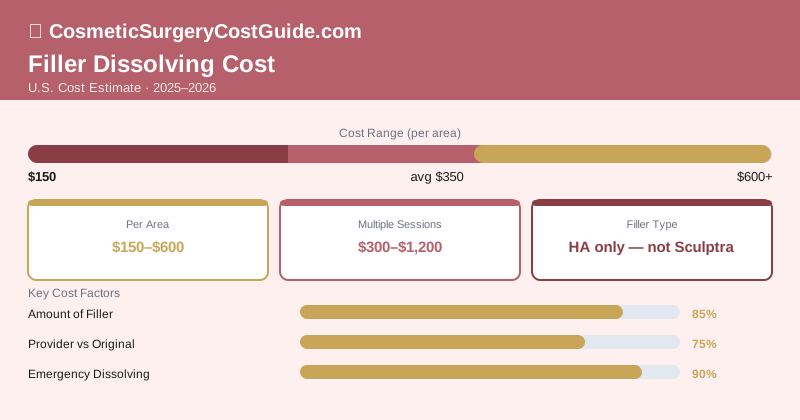
Here’s the number that matters if you’ve had hyaluronic acid filler: $150–$600 per area to dissolve it. That’s the cost of a reset. And according to RealSelf data, requests for filler dissolution rose sharply between 2019 and 2023 — directly tracking the peak and decline of the hyper-filled “Instagram face” aesthetic. Overfill, migration, and just plain changing your mind are all valid reasons to dissolve. Here’s how the procedure and pricing actually work.
What filler dissolving costs
| Treatment Scenario | Cost Range | Sessions Typically Needed |
|---|---|---|
| Single small area (lips, one cheek) | $150–$400 | 1–2 |
| Larger area (full cheeks, under-eye) | $300–$600 | 1–3 |
| Full face dissolve (multiple areas) | $600–$1,500 | 2–4 |
| Vascular occlusion emergency | No standard fee (urgent care context) | 1+ immediate |
| Touch-up at original provider | Often included or discounted | 1 |
| New provider correcting another’s work | $300–$600 per area | 2–3 |
Geography shapes these numbers considerably. High-end practices in Manhattan or Beverly Hills run $400–$600 per area. In lower cost-of-living markets, the same intervention often costs $150–$300. One thing worth asking before your initial filler appointment: does the practice include one complimentary dissolve session within 30–60 days if you’re unhappy? Some do — and knowing that policy upfront changes how you evaluate the relationship with your injector.
What can (and can’t) be dissolved
This is where a lot of patients get blindsided. Hyaluronidase dissolves exactly one category of filler: hyaluronic acid (HA) products. The most common include Juvederm Ultra, Juvederm Voluma, Restylane, Restylane Lyft, Belotero, and Revanesse.
Fillers that cannot be dissolved with hyaluronidase:
- Sculptra (poly-L-lactic acid): Stimulates collagen. No reversal agent exists. Results fade over 2–3 years as your body gradually metabolizes the PLGA microspheres.
- Radiesse (calcium hydroxylapatite): No reversal agent. Degrades naturally over 12–18 months.
- Bellafill (polymethylmethacrylate): Permanent. PMMA microspheres don’t dissolve. Surgical excision is the only removal option.
- Silicone injections (illegal in many states, still performed): No reversal. Extremely difficult to remove surgically.
If you’re not sure what filler you received, ask your provider for the product name and lot number — it should be in your chart. If records aren’t available, hyaluronidase can function as a diagnostic: if the area responds to enzyme injection, it was HA.
Vascular occlusion — when filler is inadvertently injected into or compresses a blood vessel — is the most serious complication of filler injection. Signs include:
- Blanching (white or gray discoloration) of the skin during or immediately after injection
- Pain disproportionate to the procedure
- Blue or purple mottling (livedo reticularis pattern) appearing hours after treatment
- Vision changes (most serious — can indicate retinal artery occlusion)
In these cases, high-dose hyaluronidase injection is an emergency, not a cosmetic appointment. The enzyme is injected in large volumes immediately, regardless of cost. Any injector who doesn’t have hyaluronidase on hand at every HA filler appointment should not be injecting filler. Ask about this before your next appointment.
Why people dissolve filler (beyond emergencies)
Most filler dissolving is elective — patients unhappy with results, not in a medical crisis. The most common reasons:
Overfill. The “pillow face” phenomenon — too much volume, especially in cheeks and under the eyes — is the single most common reason patients seek dissolution. This became especially prevalent during the era of aggressive filler stacking, when multiple syringes across multiple appointments piled up without any rest period.
Migration. Lip filler in particular has a tendency to migrate beyond the vermilion border over time, blurring the upper lip edge. Patients with repeated lip treatments over many years are most vulnerable to this.
Changing taste. Aesthetic trends shifted hard between 2020 and 2024. The hyper-filled look that dominated Instagram has largely given way to a more subtle, structural approach, and many patients who were treated during peak “Instagram face” now want to dissolve and start fresh with lighter hands.
Asymmetry correction. When one side settles differently than the other, selective dissolving lets the injector rebalance before re-injecting.
Hyaluronidase is derived from bovine or ovine (sheep) sources and carries a small but real risk of allergic reaction, including anaphylaxis. Patients with known allergies to bee stings, wasp venom, or animal-derived products should inform their provider and discuss allergy testing before proceeding. Also worth knowing: the enzyme doesn’t discriminate. It’ll dissolve your body’s own naturally produced hyaluronic acid in the treatment area along with the filler — which is why some temporary “hollowing” or deflation right after dissolving is completely normal.
Bottom Line
Dissolving HA filler costs $150–$600 per area and is one of the most effective corrective tools in aesthetics — but it only works on hyaluronic acid products. If you’re unhappy with results, act sooner rather than later; fresh filler responds faster and more completely to hyaluronidase than filler that’s been in place for a year or more. See also: dermal fillers cost overview for a complete picture of filler types, longevity, and pricing before your next appointment.