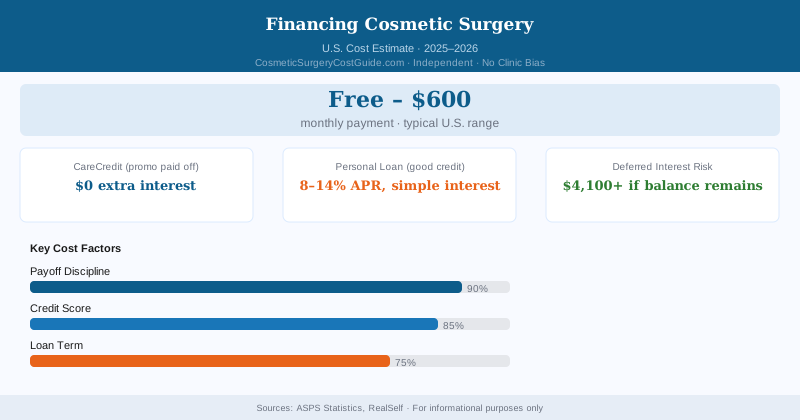
Picture this: you financed an $8,000 rhinoplasty on a 24-month 0% promotion. You paid faithfully every month, but had a slow month and left $100 on the balance when the promotional period ended. Your next statement arrives and you owe an additional $4,100.
That’s not a hypothetical scare story — it’s exactly how deferred interest works, and it’s the part of cosmetic surgery financing that practices don’t explain at checkout. The 0% financing banner in the waiting room is a genuinely good deal under exactly one condition. Miss that condition by a dollar, and the math turns against you fast.
CareCredit: The Most Common Option
CareCredit is a revolving credit line — essentially a credit card — used specifically for healthcare expenses, accepted at most cosmetic surgery practices. The promotional structure works like this: for qualifying purchases over a certain amount, you get a 0% APR period of 6, 12, 18, or 24 months depending on the offer.
The catch is in the fine print. CareCredit uses deferred interest, not true 0% interest. That distinction is critical.
With true 0% financing (like many retail credit promotions), if you carry a balance after the promotional period, you start accruing interest going forward at the regular APR. With deferred interest, if any balance remains on the last day of the promotional period, the issuer charges all the interest that would have accrued from day one — retroactively applied to your entire original balance.
You finance an $8,000 rhinoplasty on a 24-month 0% CareCredit promotion. CareCredit’s standard APR is 26.99%.
Scenario A: You pay off the full $8,000 before month 24. Interest charged: $0. This works exactly as advertised.
Scenario B: You have $100 remaining on day 730. CareCredit charges you the interest that would have accrued on your entire original balance over 24 months — approximately $4,100 in backdated interest charges, added to your bill.
The $100 you didn’t pay costs you $4,100. Set up autopay and put a calendar alert on your phone for 60 days before the promotional end date.
CareCredit’s regular APR is currently 26.99%. After the promotional period ends — or if you don’t qualify for a promotional rate — that’s what you pay.
Alphaeon Credit
Alphaeon is CareCredit’s main competitor in the cosmetic space. It works similarly: revolving credit line, 0% promotional periods of 12–24 months for qualifying purchases, accepted primarily at cosmetic surgery and aesthetic practices.
Alphaeon’s standard APR after promotional periods is 29.99% — slightly higher than CareCredit. The deferred interest structure applies here as well.
One practical note: Alphaeon sometimes approves applicants that CareCredit doesn’t. If you’re concerned about credit, knowing both options exist is worth it.
Personal Loans: The Cleaner Option
A personal loan from a bank, credit union, or online lender (SoFi, LendingClub, Marcus by Goldman Sachs, Lightstream) works differently. You borrow a fixed amount, pay a fixed monthly payment over a fixed term, and interest accrues only on the remaining balance — no deferred interest trap.
Rates range from approximately 8% to 25% depending on your credit score and lender. With strong credit (720+), you can find personal loan rates around 8–12% for cosmetic surgery purposes. That’s meaningfully cheaper than CareCredit’s 26.99% if you won’t pay the full balance within the promotional window.
The trade-off: personal loans require a hard credit inquiry, have a formal approval process, and funds come to you directly — meaning you’re responsible for paying the surgeon, not the lender.
| Financing Option | APR Range | Interest Type | Real Cost: $8,000 / 24 mo | Best For |
|---|---|---|---|---|
| CareCredit (promo period paid in full) | 0% promotional | Deferred | $0 extra | Disciplined payoff, full amount |
| CareCredit (balance remaining at promo end) | 26.99% | Deferred (backdated) | $4,100+ in backdated interest | No one — avoid this scenario |
| Alphaeon (promo paid in full) | 0% promotional | Deferred | $0 extra | Same as CareCredit |
| Personal loan (good credit) | 8–14% | Simple | $680–$1,200 extra | Longer repayment, no risk of deferred trap |
| Personal loan (fair credit) | 18–25% | Simple | $1,900–$2,800 extra | Can’t qualify for better rate |
| Home equity loan | 6–9% | Simple | $510–$770 extra | Homeowners with equity, lowest rate |
| HELOC | 7–10% variable | Simple/variable | Varies | Homeowners, flexible draw |
Home Equity: The Lowest Rate, The Highest Risk
A home equity loan or home equity line of credit (HELOC) uses your home as collateral and typically offers rates in the 6–9% range — the lowest available for cosmetic surgery financing. If you have significant equity and strong credit, this is the cheapest borrowing option on paper.
The risk is obvious: defaulting puts your home at risk. Most financial advisors don’t recommend tapping home equity for elective medical procedures. But the math is real — the rate differential over $10,000–$20,000 on a major procedure amounts to thousands of dollars.
HSA and FSA: Where Cosmetic Surgery Doesn’t Qualify
Health Savings Accounts (HSA) and Flexible Spending Accounts (FSA) cannot be used for cosmetic surgery. The IRS defines cosmetic surgery expenses as non-medical for tax purposes.
However, procedures that are medically necessary — septoplasty for nasal obstruction, blepharoplasty for visual field obstruction, breast reduction for documented macromastia — do qualify as medical expenses. If your procedure has a covered functional component, HSA/FSA funds can potentially apply to that portion.
How to Make the Decision
Use CareCredit or Alphaeon promotional financing if: You’re confident you can pay the full balance before the promotional period ends. Set up automated monthly payments that will clear the balance with at least 30 days to spare. Never rely on “I’ll pay a lump sum later.”
Use a personal loan if: The procedure cost plus recovery expenses puts full payoff within the promo window out of reach — or you don’t trust yourself to track a hard deadline over 24 months. Simple interest is predictable.
Don’t finance an amount you can’t afford to repay: Cosmetic surgery results can be genuinely life-changing; going into high-interest debt for them can also be life-changing, in the wrong direction. If the monthly payment on any financing option would strain your budget, the timing may not be right.
One practical step before you do anything else: check whether your bank or a credit union offers personal loans at competitive rates. The comparison takes 20 minutes and could save you thousands over CareCredit if full payoff within the promotional window isn’t realistic for your situation.