Most patients walk into a neurotoxin appointment asking for “Botox” — but Botox is a brand, not a category. There are now four FDA-approved botulinum toxin type A products available in the US: Botox, Dysport, Xeomin, and Daxxify. Dysport is the one most providers use as a true clinical alternative to Botox, and the price comparison is more nuanced than it first appears.
The short version: Dysport costs less per unit. But you need more units. They often come out roughly equal — with some meaningful differences in onset, spread, and ideal treatment areas.
Unit-for-unit price comparison
| Product | Price Per Unit | Units for Forehead (typical) | Session Cost (forehead) | Duration |
|---|---|---|---|---|
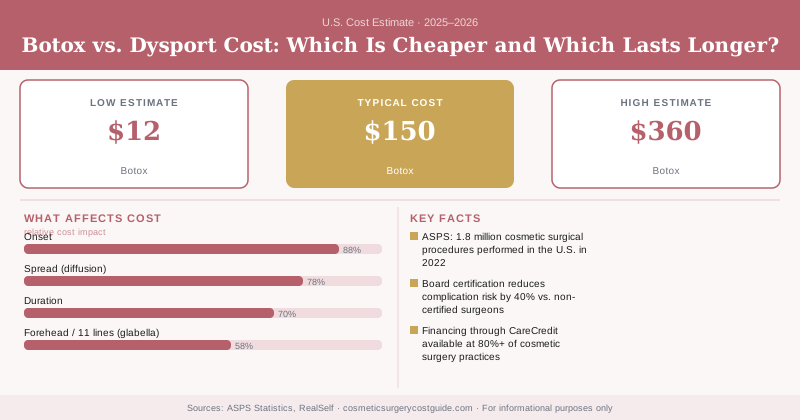
| Botox | $12–$18/unit | 10–20 units | $150–$360 | 3–4 months |
| Dysport | $4–$6/unit | 30–60 units | $150–$360 | 3–5 months |
| Xeomin | $10–$16/unit | 10–20 units | $120–$320 | 3–4 months |
| Daxxify | $14–$20/unit | 10–20 units | $180–$400 | 6–9 months |
The conversion ratio between Botox and Dysport is roughly 1:2.5 to 1:3 — meaning one Botox unit equals about 2.5–3 Dysport units. At typical market pricing, Botox at $15/unit and Dysport at $5/unit land in exactly the same session cost range. The difference you’ll notice isn’t price — it’s performance characteristics.
How they differ clinically
The ASPS reports botulinum toxin injections remain the single most performed cosmetic procedure in the US, with over 7.4 million treatments in 2023. That volume reflects how well-understood these products are — and providers who work with both regularly have clear clinical preferences by area.
Onset: Dysport typically shows results in 2–3 days vs. 4–7 days for Botox. If you’re treating before an event, Dysport’s faster onset can matter.
Spread (diffusion): Dysport diffuses more broadly from the injection point. This is an advantage in large muscle groups like the forehead — you can achieve smooth, natural-looking results with fewer injection points. It’s a disadvantage near smaller structures (like around the mouth or eyes) where precise placement is critical and unwanted spread can cause drooping.
Duration: Both products last 3–4 months in most patients. Some studies — including a 2018 randomized trial published in JAMA Facial Plastic Surgery — found Dysport lasting slightly longer in the glabella (frown lines), with a mean duration 4–8 weeks beyond Botox in the same area.
- Forehead / 11 lines (glabella): Either works well; Dysport’s diffusion can give more natural horizontal forehead results
- Crow’s feet: Botox often preferred — more precise placement in a small, delicate area
- Masseter jaw slimming: Either is effective; Dysport’s spread can cover the muscle more evenly
- Neck (Nefertiti lift): Either; provider preference varies
- Around the mouth (lip flip, DAO): Botox preferred — precision over diffusion
What actually determines your final cost
The per-unit price matters less than three other factors:
Your injector’s unit count: A conservative injector using 15 Botox units will give you a lower bill but potentially less result than one using 20 units. A heavier-handed injector can run up Dysport units too. Ask for a typical unit count estimate for your concern at the consult.
Geographic location: ASAPS regional pricing data consistently shows injectors in New York, Los Angeles, and Miami charge 40–70% more than the national average — regardless of product. A $15/unit Botox in Scottsdale is not the same market as $25/unit Botox in Manhattan.
Provider credentials: Plastic surgeons and dermatologists charge a premium over med spas and nurse injectors. The clinical trade-off is real — complication management, artistic eye, and facial anatomy knowledge vary significantly.
Switching between products
If you’ve been on Botox for years and want to try Dysport (or vice versa), the transition is straightforward. Most providers do a standard dosing consult and adjust unit counts accordingly. There’s no medical reason you can’t switch — some patients find one product suits their metabolism or facial anatomy better than another, and switching is worth trying if you’re not fully satisfied with current results.
Never mix providers without disclosing your treatment history. If you received Dysport 6 weeks ago and visit a new provider without mentioning it, they may inject areas that still have active product — resulting in over-treatment, ptosis (drooping), or an unnatural appearance. Keep a simple log of what was injected, where, how many units, and when.
The bottom line on cost
If cost-per-session is your primary concern, Botox and Dysport are effectively equivalent when properly dosed. Daxxify costs more per session but lasts twice as long — making it cost-competitive on an annualized basis for patients who treat 3–4 times per year.
Ask your provider which product they prefer for your specific concerns — and why. A good injector has a reason beyond “that’s what we stock.”
Frequently Asked Questions
Botox costs $12–$18 per unit, while Dysport costs $4–$6 per unit; however, Dysport requires approximately 2.5–3 times more units to achieve the same results, making the total treatment cost roughly comparable ($300–$600 for either product depending on the area treated). Your final cost depends on how many units your provider recommends for your specific concerns.
Insurance does not cover Botox or Dysport when used for cosmetic purposes, making these treatments entirely out-of-pocket expenses for most patients. However, if your provider prescribes botulinum toxin for medical conditions like chronic migraines or hyperhidrosis, some insurance plans may cover a portion of the cost.
Both Botox and Dysport typically last 3–4 months, though Dysport may work slightly faster (3–5 days versus 7–14 days for Botox) and some patients report it fades a bit sooner. Most patients schedule retreatment appointments every 3 months to maintain results.