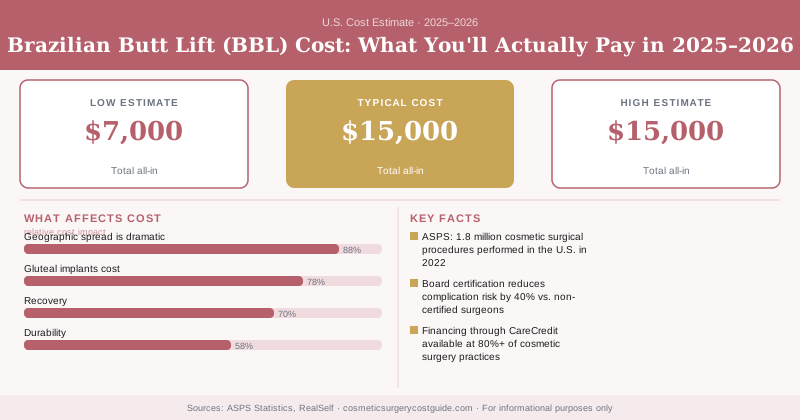
The average surgeon fee for a Brazilian Butt Lift hit $4,807 in 2024, according to the American Society of Plastic Surgeons — but that number will genuinely confuse you if you don’t know what it excludes. Add anesthesia, facility fees, compression garments, post-op lymphatic massage, and a BBL pillow you’ll need for three weeks, and you’re realistically looking at $7,500–$15,000 all-in at a reputable practice.
Here’s what the BBL actually is: not an implant, not filler — it’s your own fat. Surgeons liposuction fat from your abdomen, flanks, and back, purify it, then inject it strategically into the buttocks to reshape projection and width. You’re getting two procedures in one: contouring of the donor areas plus buttock enhancement. The tradeoff? Fat reabsorption is real — expect 30–50% of the transferred volume to dissolve over the first few months as your body remodels.
Full BBL Cost Breakdown
| Cost Component | Typical Range |
|---|---|
| Surgeon’s fee | $4,000–$9,000 |
| Anesthesia (general) | $1,200–$2,000 |
| Facility/OR fee | $1,000–$2,500 |
| Compression garment | $100–$300 |
| BBL pillow (required) | $30–$80 |
| Post-op lymphatic massages (5–10) | $500–$1,200 |
| Pre-op lab work | $150–$350 |
| Total all-in | $7,000–$15,000 |
What drives the price difference
Surgeon experience is the single biggest variable. High-volume BBL specialists — particularly in Miami — often charge less per procedure than general plastic surgeons doing occasional cases, because their overhead is structured around volume. That’s not necessarily a quality discount; Miami surgeons like this do hundreds of BBLs a year. What you’re actually paying more for in premium markets like New York and Beverly Hills is often boutique experience, longer OR time, and a more conservative fat transfer approach.
Geographic spread is dramatic:
- Miami / South Florida: $6,000–$12,000 (established BBL hub)
- Los Angeles / Beverly Hills: $9,000–$16,000
- New York City: $9,000–$17,000
- Dallas / Houston: $7,000–$12,000
- Chicago / Midwest: $7,000–$11,000
- Medical tourism (Colombia, Dominican Republic): $3,500–$6,500
The BBL had one of the highest mortality rates of any elective cosmetic procedure — estimated at 1 in 3,000 at its peak. The cause: fat injected into or below the gluteal muscle can enter blood vessels and trigger a fatal fat embolism. A 2018 joint safety advisory from ASPS, ASAPS, and ISAPS required technique changes, mandating injection above the muscle plane. Modern BBL done correctly carries a dramatically improved safety profile. Before booking, ask your surgeon directly: “Do you inject above or below the gluteal muscle?” The only correct answer is above (subcutaneous). If they can’t answer clearly, walk away.
BBL vs. gluteal implants
Not everyone has enough donor fat for a BBL. If your BMI is on the lower end, gluteal implants are the surgical alternative — but they come with their own tradeoffs.
- Gluteal implants cost: $6,000–$13,000 all-in
- Recovery: 2–4 weeks; can’t sit directly on the implants for 2 weeks
- Durability: Permanent, but implants can shift, ripple, or develop capsular contracture
- Feel: Less natural than transferred fat, which integrates with surrounding tissue
- Who’s a better candidate: Patients without enough body fat for harvest — typically BMI under 20
Most board-certified plastic surgeons prefer the BBL when sufficient donor fat is available. The results look more natural, and the donor-site contouring adds visual value you don’t get from implants.
Touch-up procedures
Because fat reabsorption is unpredictable, some patients opt for a touch-up session 6–12 months post-op to add volume or even out asymmetry. Touch-ups are less extensive than the primary procedure and typically run $3,000–$6,000 depending on how much additional liposuction and fat harvest is required.
Fat graft survival is heavily influenced by what you do post-op. The key rules: don’t sit directly on your buttocks for 2–3 weeks (a BBL pillow shifts pressure to your thighs and hamstrings); avoid strenuous lower-body exercise for 6 weeks; wear your compression garment as directed; and maintain your weight. Significant weight loss after a BBL shrinks the transferred fat along with the rest of your body. The $500–$1,200 you spend on post-op lymphatic drainage massages directly affects how much of your transferred fat survives long-term — skip them at your own risk.
Recovery costs to plan for
- General anesthesia recovery: 2–3 hours in recovery room
- No direct sitting on buttocks: 2–3 weeks
- Compression garment: 6–8 weeks
- Return to desk work: 2–3 weeks with accommodations
- Strenuous exercise cleared: 6 weeks
- Final results: 6 months
Bottom Line
Budget $8,000–$12,500 for a BBL with a board-certified plastic surgeon in most US markets. Don’t negotiate price by choosing a surgeon who can’t articulate their injection technique — the BBL is one of the few cosmetic procedures where cutting corners on surgeon selection can be fatal. Ask for credentials, ask about injection depth, review before-and-afters, and verify board certification through the American Board of Plastic Surgery before you book a single consultation.
Frequently Asked Questions
The all-in cost for a BBL ranges from $7,000 to $15,000, which includes the surgeon fee (averaging $4,807), anesthesia, facility fees, compression garments, and post-op care. The final price varies based on surgeon experience, geographic location, and whether you choose fat transfer or implants.
No, BBL surgery is considered cosmetic and is not covered by health insurance plans, making it an entirely out-of-pocket expense. Some patients use medical financing options or payment plans to spread the $7,000–$15,000 cost over 12–24 months.
Most patients need 2–3 weeks off work and must use a BBL pillow or special cushion for at least three weeks to protect the newly transferred fat. You can typically resume light exercise after 6 weeks, but full results appear after 3 months once swelling subsides.