What does it cost to fix or replace breast implants years after your original surgery? For a lot of patients, the number that comes back from a consultation is uncomfortably close to what they paid the first time around — sometimes higher.
Breast augmentation revision covers a wide range of scenarios: replacing ruptured or aging implants, correcting capsular contracture, fixing asymmetry, changing size, or addressing implants that have shifted or “bottomed out” over time. The specific problem determines both the surgical complexity and the price.
Revision cost by scenario
| Revision Type | Cost Range |
|---|---|
| Implant exchange (size/style change) | $6,000–$10,000 |
| Capsular contracture correction | $7,000–$12,000 |
| Implant rupture/replacement | $6,000–$11,000 |
| Revision + breast lift (mastopexy) | $9,000–$15,000 |
| Removal without replacement (explant) | $4,000–$8,000 |
Why revision costs rival or exceed the original surgery
A first-time breast augmentation is, relatively speaking, a clean procedure: create a pocket, place the implant, close. Revision surgery almost never starts from that clean slate. Surgeons typically have to remove the existing implant, address the surrounding scar capsule (which may be thickened, contracted, or need to be partially removed), and sometimes repair stretched or thinned tissue before placing a new implant. That extra work — capsulectomy, tissue repair, sometimes acellular dermal matrix (ADM) support for weakened tissue — adds real OR time and cost that a first-time augmentation simply doesn’t require.
Capsular contracture correction specifically tends to run toward the higher end of the range because it can require a more extensive capsulectomy (full removal of the scar capsule) rather than a simpler capsulotomy (releasing it), and severe cases sometimes need ADM to support the pocket going forward.
Most breast implant revisions are elective and not covered, but there are real exceptions. If your implant has ruptured (confirmed by MRI or ultrasound) or you have documented, symptomatic capsular contracture (Baker Grade III or IV) causing pain or visible deformity, some insurance plans will cover part of the removal/replacement cost since it’s classified as medically necessary rather than purely cosmetic. Ask your surgeon’s office to submit for prior authorization before assuming you’ll pay entirely out of pocket.
What drives the price within each category
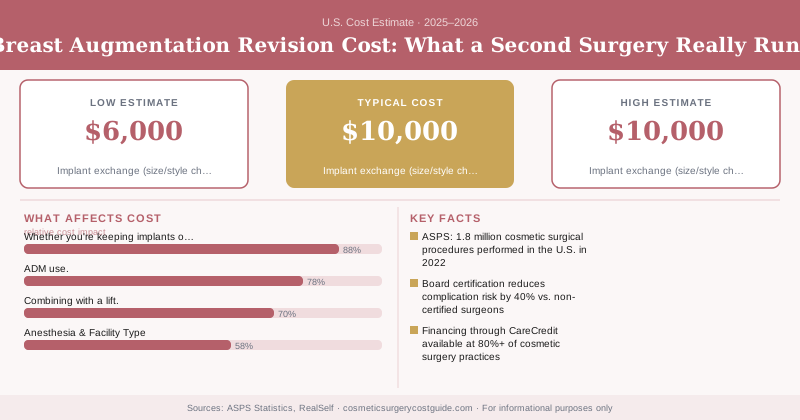
Whether you’re keeping implants or removing them entirely. Explant (removal without replacement) is generally the least expensive option since there’s no new implant cost and often shorter OR time, though adding a lift to address resulting skin laxity increases the total.
ADM use. Acellular dermal matrix, increasingly used to reinforce weakened tissue in revision cases, adds $1,500–$3,000 to the total procedure cost.
Combining with a lift. Many revision patients, especially those dealing with implants that have bottomed out or shifted, need a simultaneous breast lift to reposition the breast on the chest wall — this combination procedure costs meaningfully more than implant exchange alone.
Implant lifespan and planning ahead
The FDA explicitly states that breast implants are not lifetime devices. Many surgeons recommend patients plan financially and mentally for the possibility of a revision or replacement surgery every 10-15 years, even in the absence of complications, simply due to normal wear, capsule changes, or personal preference shifts over time. Building this into your original financial planning — rather than treating revision as an unexpected cost — makes the eventual bill less of a shock.
Financing an unplanned revision
Since revisions often arrive years after the original surgery and outside of any pre-planned budget, cosmetic surgery financing options are commonly used to cover the cost without depleting savings.
If you’re experiencing pain, hardness, visible distortion, or you suspect implant rupture, don’t delay evaluation while shopping for the lowest revision quote. Untreated capsular contracture can worsen, and a ruptured silicone implant (which often shows no obvious external symptoms — sometimes called a “silent rupture”) should be assessed by MRI regardless of cost considerations.
Bottom line
Breast augmentation revision typically costs $6,000–$15,000, often rivaling the original surgery’s price because of the added complexity of removing old implants, treating scar tissue, and repairing tissue changes. Ask specifically whether your situation might qualify for partial insurance coverage before assuming the full cost falls on you.
Frequently Asked Questions
Breast augmentation revision often costs as much or more than the original surgery because it typically requires removing the existing implant, addressing scar tissue or capsular contracture, and sometimes repairing stretched tissue — all of which add surgical complexity and OR time beyond a straightforward first-time augmentation. Total revision costs typically range from $6,000 to $15,000 depending on what specifically needs correcting.
Insurance may cover breast implant revision if it's medically necessary — for example, treating implant rupture, severe capsular contracture causing pain, or Breast Implant Illness-related removal — but purely cosmetic revisions (size change, lift, or repositioning for aesthetic reasons) are not covered. Check your policy and get documentation from your surgeon if you believe your situation may qualify for medical necessity coverage.
The FDA and most manufacturers note that breast implants are not considered lifetime devices, with many surgeons recommending patients plan for potential replacement or revision every 10–15 years, though many implants last considerably longer without issue. Common reasons for revision include capsular contracture, implant rupture or deflation, size change requests, or bottoming out over time.