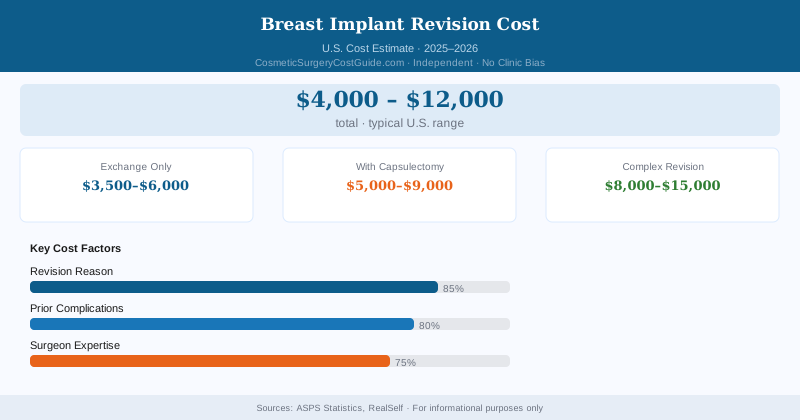
The original breast augmentation cost $5,000–$8,000. The revision can cost just as much — sometimes more. And here’s why revision is typically harder than the first surgery: it involves scar tissue, changed anatomy, and often the task of correcting the consequences of decisions made in a previous operation. None of that is easy, and the pricing reflects it.
ASPS data shows that roughly 1 in 5 breast augmentation patients needs some form of revision within 10 years. By year 20, the majority of patients have had at least one revision procedure. Implants are medical devices in a body that keeps changing. Revision isn’t a failure — it’s part of the realistic long-term picture.
Revision Cost by Type
| Revision Type | Surgeon Fee | All-In Cost |
|---|---|---|
| Implant exchange (size change only) | $3,500–$6,000 | $5,500–$9,000 |
| Capsular contracture correction | $4,500–$8,000 | $7,000–$12,000 |
| En bloc total capsulectomy (BII/ALCL) | $6,000–$10,000 | $9,000–$14,000+ |
| Implant malposition correction | $4,000–$7,000 | $6,500–$11,000 |
| Silicone rupture replacement | $4,000–$7,000 | $6,500–$11,000 |
| Saline rupture replacement | $3,500–$6,000 | $5,500–$9,000 |
| Implant removal only (explant) | $3,000–$6,000 | $5,000–$9,000 |
| Pocket conversion (sub-glandular to sub-muscular) | $5,000–$9,000 | $8,000–$14,000 |
Capsular Contracture: The Most Common Complication
Every implant develops a capsule — a layer of scar tissue around it. For most patients, it stays thin, soft, and unnoticeable. Capsular contracture happens when that capsule hardens, thickens, and squeezes the implant, causing firmness, visual distortion, and sometimes real pain.
Surgeons grade it Baker I through IV:
- Grade I: Breast looks and feels normal
- Grade II: Firmness without distortion
- Grade III: Firm and visibly distorted
- Grade IV: Hard, painful, and significantly abnormal in shape
Grade III and IV contractures typically require surgery — capsulectomy plus implant replacement. Capsulectomy type matters here. A partial capsulectomy that leaves capsule tissue behind has a higher recurrence rate than a complete capsulectomy that removes the entire scar lining.
The exact cause of capsular contracture isn’t fully understood, but subclinical bacterial biofilm at the time of the original surgery is the leading theory. High-volume, meticulous surgical technique — including antibiotic irrigation and minimal implant handling — is associated with lower contracture rates. Which is another reason the surgeon you chose for your first surgery matters.
Capsulectomy Types: What the Difference Means for You
If you need capsular contracture repair — or if you’re pursuing explant for breast implant illness (BII) concerns — understanding capsulectomy types matters before you walk into a consultation:
Partial capsulectomy: Portions of the capsule are removed. Typically reserved for Grade II contractures or straightforward implant exchange cases.
Total capsulectomy: The entire capsule is removed but not necessarily in one piece. More thorough than partial; appropriate for most Grade III–IV contractures.
En bloc capsulectomy: The implant and the entire surrounding capsule are removed as a single intact unit — nothing is opened or cut until it’s out. This is the gold standard for BIA-ALCL treatment and is also requested by many BII patients who want to ensure no capsule material contacts surrounding tissue during removal. It requires a larger incision, greater surgical skill, and longer OR time — which is why it commands the highest revision fees.
If BII is your concern, ask your surgeon specifically about their en bloc technique before you book surgery. Not all surgeons offer true en bloc, and some use the term loosely.
Breast Implant-Associated Anaplastic Large Cell Lymphoma (BIA-ALCL) is a rare type of non-Hodgkin’s lymphoma that develops in the scar tissue around breast implants. The FDA’s tracking data through 2022 identified 1,130 cases worldwide, with 59 deaths reported. The overwhelming majority of cases involved textured implants — the BIOCELL textured implants (Allergan) were recalled in 2019 specifically because of this risk. Smooth implants carry a dramatically lower risk.
If you have textured implants — particularly BIOCELL — and you develop unexplained swelling, pain, or a lump near an implant, see a physician immediately. BIA-ALCL caught early is highly treatable; delayed diagnosis is where poor outcomes occur. Treatment is surgical removal of the implant and complete capsule, and when caught before spread, it’s typically curative.
Rupture Detection: The MRI You Might Be Skipping
Saline implant rupture is obvious — the breast deflates and you know within days. Silicone gel rupture is different. The cohesive gel holds its shape, so rupture can be silent and symptom-free for years.
The FDA recommends MRI screening for silicone implants:
- First MRI: 5–6 years after placement
- Subsequent MRIs: every 2–3 years
An MRI costs $1,000–$2,000 without insurance coverage. Ultrasound is less expensive and more widely available but less accurate for detecting intracapsular rupture. If you have silicone implants and haven’t had imaging recently, this is worth addressing — not because rupture is inevitable, but because finding it early makes revision simpler and less expensive.
Does Insurance Cover Revision?
Almost never for cosmetic implants. The exceptions are narrow:
Silicone rupture: Some health plans cover implant removal and replacement when rupture is documented on MRI. Not universal — check your policy language. The implant manufacturer’s warranty may also provide a free replacement implant plus partial surgical cost assistance.
BIA-ALCL treatment: This is a cancer diagnosis, and treatment — implant removal, total capsulectomy — is covered by health insurance as medically necessary treatment for cancer.
Reconstruction revisions: If your original implants were placed for post-mastectomy reconstruction (not cosmetic augmentation), revisions may be covered under your health plan. The Women’s Health and Cancer Rights Act requires insurers to cover reconstruction and its complications for mastectomy patients.
For cosmetic revisions — size change, contracture, malposition, BII concerns not involving ALCL — plan on paying out of pocket.
Breast implant revision for complications is significantly more technically demanding than primary augmentation. A surgeon who’s excellent at first-time augmentation may not have the experience for complex revision cases. For symmastia, repeated capsular contracture, double bubble, or en bloc explant, specifically seek surgeons who have documented revision expertise — ask what percentage of their breast surgery practice is revision, and ask to see before-and-after photos of revision cases specifically. High volume in primary augmentation doesn’t automatically translate to revision skill.
Implant Exchange: The Most Common Revision
Size change — usually going larger, occasionally smaller — is the most common reason for revision. If the existing pocket accommodates the new implant size, the procedure is relatively straightforward: remove the old implants, insert the new ones.
Going significantly larger often requires pocket modification. Downsizing is trickier than most patients expect — the existing pocket is too large for the smaller implant, and the pocket must be reduced (often with internal sutures called a capsulorrhaphy) to prevent the smaller implant from moving around in the oversized space.
Bottom Line
Budget $6,000–$12,000 for most breast implant revisions with a board-certified plastic surgeon. Complex cases — en bloc capsulectomy, repeated contracture, symmastia — can run $10,000–$14,000+. Start by reviewing your implant warranty: a free replacement implant from the manufacturer can reduce your out-of-pocket by $1,000–$3,500 before you’ve done anything else. Then get at least two consultations from surgeons who can demonstrate specific experience with the exact revision you need.
Frequently Asked Questions
A partial capsulectomy removes only portions of the scar capsule. A total capsulectomy removes the entire capsule but not necessarily intact. An en bloc capsulectomy removes the implant and the entire surrounding capsule as a single, intact unit — the implant never exits the capsule during removal. En bloc is considered the gold standard for patients with BIA-ALCL or those with breast implant illness (BII) concerns, because it prevents any capsule contents from contacting surrounding tissue. It requires greater surgical skill and longer OR time, which is why it costs more.
Silicone gel implants can rupture silently — no obvious sign, because the cohesive gel stays in place rather than deflating like saline. You may notice gradual shape changes, firmness, or nothing at all. The FDA recommends MRI screening for silicone implants starting 5–6 years after placement and every 2–3 years after that. An MRI costs $1,000–$2,000 without insurance; ultrasound is cheaper but less accurate. If you have silicone implants and don't know when they were last imaged, this is worth scheduling.
Most major manufacturers (Allergan/AbbVie, Mentor, Sientra) provide a free replacement implant for rupture under their warranty programs, plus some financial assistance toward surgical costs — typically $1,000–$3,500 depending on the specific program and timing. The implant replacement itself is covered; the surgeon fee, anesthesia, and facility costs are still your responsibility. To file a warranty claim, you need your original implant sticker (placed in your surgical record at the time of placement) with the manufacturer, model number, and lot number.