“My breasts look deflated.” That’s how most patients describe what brings them to a mastopexy consultation — not a size complaint, but a shape and position complaint. A breast lift doesn’t add volume. What it does is remove excess skin and reposition the nipple-areola complex to sit where it should, restoring the projection and youthfulness that pregnancy, breastfeeding, weight changes, or time have taken away.
It’s also one of the more complex breast operations in terms of incision planning. Here’s what it actually costs and what drives the variation.
Breast Lift Cost by Technique (2025–2026)
| Technique | Incision Pattern | Surgeon Fee | Total All-In | Best For |
|---|---|---|---|---|
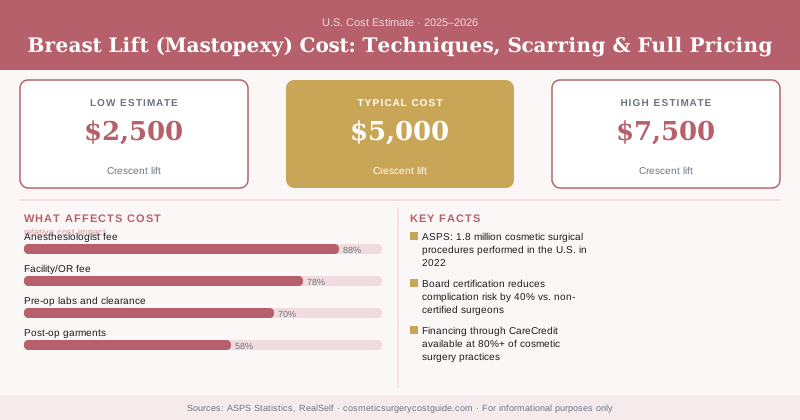
| Crescent lift | Small arc above areola | $2,500–$4,500 | $5,000–$7,500 | Minimal ptosis |
| Periareolar (donut) | Around areola only | $3,000–$5,000 | $5,500–$8,500 | Mild ptosis |
| Vertical (lollipop) | Around areola + vertical | $4,500–$7,000 | $7,500–$11,500 | Moderate ptosis |
| Inverted-T (anchor) | Around areola + vertical + horizontal | $5,500–$8,500 | $9,000–$14,500 | Severe ptosis |
What’s Included in the “All-In” Total?
The surgeon’s fee is only one piece. A complete mastopexy quote should include:
- Anesthesiologist fee: $1,200–$2,500 depending on case length
- Facility/OR fee: $1,500–$3,500
- Pre-op labs and clearance: $200–$500
- Post-op garments: $100–$300
- Follow-up appointments: Usually included
When you see a “$5,500 breast lift” advertised, ask what’s included. It may be surgeon fee only — the total with facility and anesthesia will be higher.
The Three Main Techniques: A Real Comparison
Crescent and periareolar lifts are the least invasive, but they have limitations. A donut lift tightens the periareolar skin but creates a flat appearance rather than true projection. Most board-certified surgeons will tell you these techniques are overpromised — patients with moderate ptosis often don’t get the result they expected from a “small scar” approach.
The lollipop lift is the workhorse of mastopexy. It reshapes the lower pole, lifts the nipple, and removes skin in two directions. Scarring is predictable and fades well in most patients. It’s the right choice for the majority of women seeking a lift.
The anchor (inverted-T) lift is for significant ptosis — nipple sitting well below the inframammary fold, significant skin excess. Yes, it has more scar, but it’s often the only technique that delivers a genuinely good result in that anatomy. A surgeon who offers a lollipop when you need an anchor is not doing you a favor.
According to the American Society of Plastic Surgeons 2023 statistics, breast lift procedures have grown more than 70% over the past 15 years — and mastopexy (without implants) is now performed more commonly than breast augmentation alone in women over 40. The trend reflects a shift toward shape restoration over size increase in the post-implant generation.
Breast Lift vs. Breast Lift With Implants
A significant percentage of mastopexy patients combine the procedure with an implant — the “augmentation mastopexy.” This addresses both volume and position in a single surgery.
Combined augmentation mastopexy costs $9,500–$16,500 all-in — more than a lift alone but less than two separate procedures. The trade-off is complexity: combining both operations in one sitting increases surgical risk and makes revision more complicated if needed.
The ASAPS reports that combination augmentation-mastopexy is one of the most technically demanding operations in plastic surgery, with higher revision rates than either procedure performed alone. That’s not a reason to avoid it — it’s a reason to choose your surgeon carefully.
Geographic Price Variation
This matters. A board-certified plastic surgeon in Nashville charges meaningfully less than one in Manhattan, even with comparable training and outcomes.
- NYC, LA, Miami, San Francisco: $10,500–$16,000+ all-in
- Chicago, Dallas, Atlanta, Seattle: $8,500–$13,000 all-in
- Smaller markets, Southeast, Midwest: $6,500–$10,500 all-in
Flying to a lower-cost market for surgery is common and reasonable — but factor in travel costs, the need for a follow-up flight, and whether your surgeon will be reachable if complications arise at home.
Breast lift results are permanent in terms of structure but not immune to the effects of future pregnancy, significant weight change, or continued aging. Women planning future pregnancies are generally counseled to delay mastopexy — pregnancy will stretch the skin and lower the breast again, potentially undoing the result. This is a surgical conversation worth having honestly with your surgeon before you schedule.
How to Evaluate Surgeons for a Mastopexy
Mastopexy outcomes are heavily technique-dependent. A few things to look for:
- Board certification by ABPS (American Board of Plastic Surgery) — this is non-negotiable
- Before-and-after photos of mastopexy specifically — not just augmentation
- Photos of patients with your degree of ptosis — ask to see cases similar to yours
- Candid revision rate conversation — a good surgeon will tell you honestly what they’d do if your result needed touch-up
Budget $7,500–$12,000 for a quality lollipop or anchor lift in most US markets. Don’t let the desire to save $1,500 push you toward a surgeon with less mastopexy-specific experience — this is a scar-producing operation, and the results live on your body permanently.
Frequently Asked Questions
A breast lift typically costs $6,000–$12,500 all-in, which includes the surgeon's fee, facility costs, and anesthesia. The final price depends on the technique used (crescent, lollipop, or anchor), surgeon experience, geographic location, and whether you combine it with implants, which adds $2,000–$4,000.
Most health insurance plans do not cover breast lift because it is considered cosmetic surgery, leaving you responsible for the full out-of-pocket cost of $6,000–$12,500. However, if a breast lift is medically necessary due to documented symptoms like shoulder pain or skin breakdown, some insurers may cover a portion; you should request a pre-authorization from your insurance company.
Most patients return to light daily activities within 1–2 weeks, though you should avoid heavy lifting, strenuous exercise, and sleeping on your stomach for 4–6 weeks to allow proper healing. Full results appear after 3–6 months once swelling subsides completely.