Brow bone reduction is one of the most technically demanding facial surgeries performed in the US — and one of the most transformative. It’s sought by patients who feel their prominent brow ridge gives their face an unintentionally harsh, heavy, or masculine appearance, and increasingly by transgender women as a core element of facial feminization surgery (FFS). It’s not a procedure you’ll find at a standard plastic surgery practice, and the cost reflects that.
Here’s what it actually costs, what the three surgical types involve, and what you need to know before consulting a surgeon.
Brow bone reduction cost by procedure type
| Procedure Type | Description | Low | Typical | High |
|---|---|---|---|---|
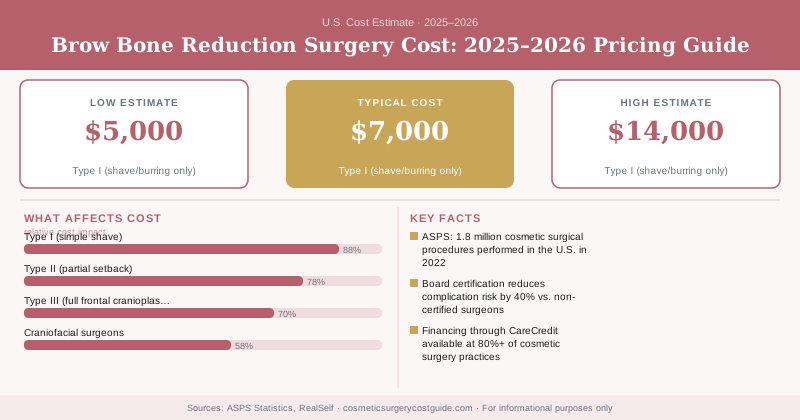
| Type I (shave/burring only) | Outer cortex filed down; no sinus involvement | $5,000 | $7,000–$9,000 | $14,000 |
| Type II (partial reconstruction) | Shave + partial anterior table setback | $6,000 | $9,000–$13,000 | $18,000 |
| Type III (full reconstruction) | Full anterior table removal, reshape, re-fixation | $8,000 | $12,000–$16,000 | $22,000 |
| Brow bone reduction + brow lift (combined) | Type III with simultaneous brow repositioning | $10,000 | $14,000–$18,000 | $25,000 |
| Standalone brow shave (mild prominence only) | In-office burring, local anesthesia | $4,000 | $6,000–$8,000 | $12,000 |
All surgical prices include surgeon fee, general anesthesia, accredited facility fee, and post-op follow-up. International destinations (Thailand, Spain) offer these procedures at $6,000–$12,000 all-inclusive; some US patients pursue this route but it requires careful vetting of the surgeon’s craniofacial training.
The three types: what they actually involve
Your brow bone anatomy determines which type of procedure is possible and effective.
Type I (simple shave): Only possible when the anterior frontal sinus wall is thick enough to allow shaving without breaking through to the air cavity. A small percentage of patients — perhaps 20–30% — have sufficiently thick bone here. The surgeon uses a high-speed burr to reduce the outer cortex. No plates or screws. Relatively simpler recovery.
Type II (partial setback): For patients whose brow bone projection is partly due to a pneumatized (air-filled) frontal sinus sitting just behind the outer cortex. The outer table is partially cut, reshaped, and re-fixed — more involved than a simple shave, but not a complete reconstruction.
Type III (full frontal cranioplasty): The most common approach for significant brow reduction. The entire anterior table (outer bony wall of the frontal sinus) is removed as a single piece, reshaped on the back table using a drill, and fixed back in place with titanium plates and screws. This allows complete three-dimensional reshaping of the brow contour. It’s the only option for patients with prominent brow ridges overlying a large pneumatized sinus.
Before surgery, CT imaging of the frontal region is essential. The scan reveals the thickness of the anterior sinus wall and the depth of the pneumatization. A surgeon who doesn’t order a CT preoperatively and claims to always do Type I is not following best practice. Most patients seeking significant feminization require Type III for meaningful results.
Who performs brow bone reduction?
This surgery is performed by:
- Craniofacial surgeons with plastic surgery or oral-maxillofacial training and specific fellowship training in facial skeletal procedures
- Facial feminization surgery specialists — a small group of highly specialized surgeons (Dr. Jeffrey Spiegel in Boston, Dr. Deschamps-Braly in San Francisco, and a handful of others in the US) who perform high volumes of this specific procedure
General plastic surgeons who don’t specialize in craniofacial work should not be performing Type III brow bone reconstruction. The technical demands — including managing the frontal sinus, achieving perfect symmetry during reconstruction, and securing the anterior table safely — require specific training and case volume.
ISAPS data context
ISAPS 2023 global statistics noted that facial feminization procedures, including brow bone reduction, are among the fastest-growing categories of facial surgery globally. While the ISAPS doesn’t break out brow bone reduction specifically, the broader FFS category saw significant year-over-year growth, driven partly by insurance coverage expansion in some states.
Does insurance cover it?
For transgender and non-binary patients, insurance coverage is increasingly possible. The Affordable Care Act prohibits discrimination based on gender identity, and several states have explicit protections requiring insurers to cover gender-affirming surgical procedures. Brow bone reduction as part of facial feminization surgery is covered by an increasing number of major insurers (Cigna, United, Aetna) when documented as medically necessary for gender dysphoria treatment.
For cisgender patients seeking brow reduction purely for aesthetic reasons, insurance coverage is not available.
The risks of brow bone reduction are significant and should be fully understood before proceeding. Type III procedures involve entering the frontal sinus — risks include CSF (cerebrospinal fluid) leak (rare but serious), infection, nerve injury (supraorbital/supratrochlear nerves — numbness in the forehead and scalp), asymmetry, plate palpability, and the need for revision surgery. A 2020 retrospective published in Plastic and Reconstructive Surgery reported revision rates of 8–12% for Type III procedures across multiple high-volume practices, primarily for asymmetry or contour refinement. This is not a procedure to book based on price alone.
Recovery timeline
- Surgery: 2–4 hours under general anesthesia; outpatient or one-night stay
- Incision: Typically bicoronal (ear to ear across top of scalp) or behind the hairline
- Week 1: Significant swelling and bruising, especially around the eyes; head elevated, limited activity
- Weeks 2–4: Most swelling resolved; return to desk work; suture/staple removal
- Months 3–6: Final contour visible; swelling fully resolved
- Hairline: Bicoronal incisions can cause temporary hair loss along the scar line; usually recovers within 6 months
Getting a consultation
Expect to provide CT imaging at or before consultation. Most specialized surgeons offer video consultations for out-of-state patients, which is particularly valuable given how geographically concentrated the US specialists are. Ask to see 3D CT modeling of your surgical plan — the leading practitioners now routinely use pre-surgical simulation to plan the exact amount of reduction and reshaping.
Summary on cost
At $8,000–$18,000 for a Type III procedure in the US, brow bone reduction is expensive — but for patients who want it, few other procedures produce as significant a facial transformation. For trans patients, pursuing insurance coverage first is worth the administrative effort; approvals have become more common than they were five years ago.
Frequently Asked Questions
Brow bone reduction surgery typically costs between $5,000 and $20,000 in the US, with the final price depending on the surgical technique (Type I, II, or III), surgeon experience, geographic location, and whether it's combined with other facial feminization procedures. Most patients in major metropolitan areas pay $10,000–$15,000 for the procedure alone, though renowned specialists may charge at the higher end of this range.
Most insurance plans classify brow bone reduction as elective cosmetic surgery and do not cover it, leaving patients responsible for the full cost out-of-pocket. However, if the procedure is medically necessary (such as addressing breathing problems related to prominent brow bone), some insurers may provide partial coverage; you should contact your plan directly and request a pre-authorization review with medical documentation.
Initial recovery takes 1–2 weeks, during which swelling and bruising are most visible and patients should avoid strenuous activity; most people can return to desk work within 7–10 days. Full healing and final results may take 3–6 months as residual swelling subsides, though the procedure requires significant bone contouring and is more invasive than standard brow lift surgery.