Some people can do calf raises for years and never see meaningful growth — a genetic reality that has less to do with effort and more to do with muscle fiber composition and insertion length. When exercise genuinely can’t close that gap, calf augmentation surgery is the option that actually can.
Calf augmentation costs by technique
| Technique | Typical Cost |
|---|---|
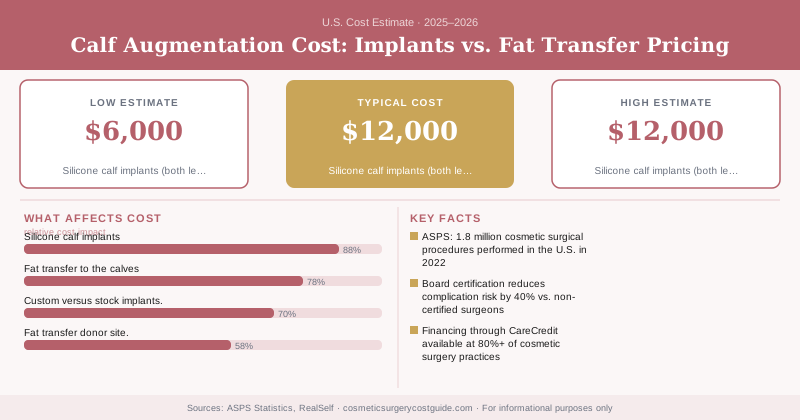
| Silicone calf implants (both legs) | $6,000–$12,000 |
| Fat transfer to calves (both legs) | $4,000–$8,000 |
| Fat transfer touch-up session | $2,000–$4,000 |
| Combined implant + fat transfer | $8,000–$14,000 |
Why some people can’t build calves through exercise alone
Calf muscle size is influenced significantly by muscle fiber type composition and tendon insertion length — both largely genetically determined factors that don’t change meaningfully with training, unlike many other muscle groups. Some individuals have a higher proportion of muscle fibers that respond poorly to hypertrophy training, or have calf muscles with a shorter belly and longer tendon insertion, both of which limit visible size regardless of training volume or intensity. This genetic reality is a major reason calf augmentation surgery has a steady, dedicated patient base among people who’ve already tried years of targeted training without meaningful results.
Implants versus fat transfer: the real trade-offs
Silicone calf implants are solid, custom-shaped silicone devices placed beneath the calf muscle fascia through a small incision behind the knee. They provide a permanent, predictable increase in calf size and definition, and don’t carry the “some may not survive” uncertainty that comes with any fat transfer procedure. The trade-off is a higher upfront cost and, since it’s an implant, a theoretical future risk of implant-related complications like shifting or capsular contracture, though these are less common with calf implants than breast implants.
Fat transfer to the calves uses your own liposuctioned fat, avoiding any foreign material, and can be combined efficiently if you’re already having liposuction elsewhere on the body. The downside: not all transferred fat cells survive the transfer process permanently, so results are somewhat less predictable, and many patients need a touch-up session to reach their desired final size.
Patients seeking maximum size and the most natural-looking muscle definition sometimes combine implants (for a reliable baseline volume increase) with fat transfer around the implant (for smoother blending and additional shaping). This combined approach costs $8,000–$14,000 but produces a result that’s difficult to achieve with either technique alone.
What the surgery and recovery actually involve
Calf implants are placed beneath the muscle fascia, an area that’s under constant mechanical stress from standing and walking, which makes recovery notably more involved than many other body contouring procedures. Most patients require crutches for several days and significantly limited weight-bearing activity for 2–3 weeks, with a full return to exercise and heavy leg use typically taking 6–8 weeks.
What determines your specific price
Custom versus stock implants. Custom-sized silicone implants matched to your specific leg proportions cost more than standard stock sizes but generally produce more proportional, natural-looking results.
Fat transfer donor site. If you’re already planning liposuction elsewhere, adding calf fat transfer in the same session is typically more cost-effective than as a fully separate procedure.
Surgeon specialization. Relatively few surgeons perform calf augmentation regularly compared to more common body procedures — surgeons with specific, demonstrated experience in this exact procedure may charge a premium, but this is not an area to prioritize the lowest quote.
Calf implant surgery carries risk of compartment syndrome — dangerous pressure buildup within the muscle compartment — if the implant is sized too large for the available space or if post-operative swelling isn’t carefully monitored. Choose a surgeon with specific experience in calf augmentation, follow all post-operative monitoring instructions closely, and report any unusual pain, numbness, or tightness immediately.
Bottom line
Calf augmentation costs $6,000–$12,000 for silicone implants or $4,000–$8,000 for fat transfer, with implants offering permanent, predictable results and fat transfer offering a foreign-material-free option that may require a touch-up session. For patients whose calves genuinely don’t respond to years of targeted training due to genetics, this is one of the few reliable ways to change that outcome.
Frequently Asked Questions
Calf implant surgery typically costs $6,000–$12,000, including the cost of silicone implants, surgeon fee, and anesthesia. Fat transfer to the calves, using your own harvested fat, generally costs less at $4,000–$8,000 but may require a touch-up session since not all transferred fat survives permanently.
Calf augmentation is popular among bodybuilders and fitness enthusiasts with naturally underdeveloped calf muscles that don't respond proportionally to exercise despite consistent training, as well as patients with congenital conditions like clubfoot or polio-related muscle asymmetry, and some patients undergoing gender-affirming procedures seeking a more traditionally masculine lower leg contour.
Recovery is more involved than many body contouring procedures because calf implants are placed beneath a muscle layer that's used constantly for walking and standing. Most patients need 2–3 weeks with significantly limited mobility, often using crutches for the first several days, and a full return to exercise typically takes 6–8 weeks.