Calf implants aren’t the first procedure most people think of when they think about body contouring — and that’s partly why they’re so often misunderstood. The truth is: calf augmentation has a straightforward application. Genetics determines calf shape more than almost any other body part. If you’ve been training legs for years and your calves just won’t respond, an implant is the only option that actually changes their shape. That’s a real, specific problem — and calf implants solve it.
Here’s the honest cost picture, including what’s driving the wide price range and what the recovery actually looks like.
Calf Implant Cost in 2025–2026
| Component | Cost Range | Notes |
|---|---|---|
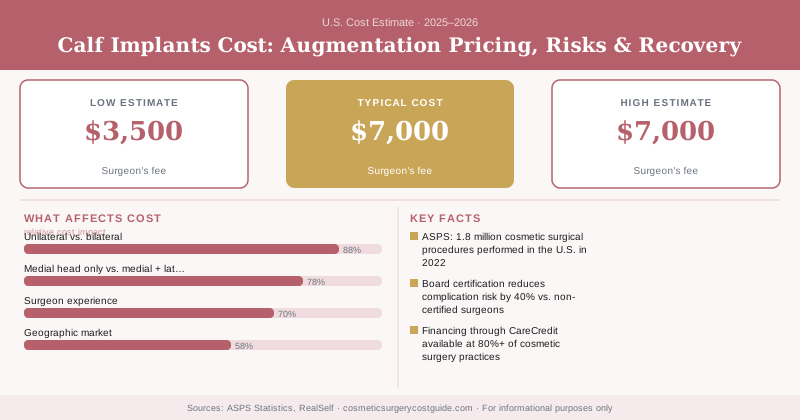
| Surgeon’s fee | $3,500–$7,000 | Bilateral (both legs); varies by region and technique |
| Anesthesia | $1,000–$2,000 | General or IV sedation |
| Facility fee | $1,200–$2,500 | ASC or hospital OR |
| Implants (per pair) | $800–$1,500 | Silicone solid or semi-solid |
| Total all-in | $5,500–$12,000 | Most patients pay $6,500–$9,500 |
Why Does the Price Range Span $6,000?
A few things drive the variation:
Unilateral vs. bilateral — Most patients want both calves augmented. If you’re only augmenting one calf (asymmetry correction, post-injury, neurological weakness causing atrophy), the cost is roughly half the bilateral price for surgeon and facility fees, but the implant cost doesn’t drop proportionally.
Medial head only vs. medial + lateral heads — The most common approach places implants in the medial (inner) head of the gastrocnemius. Patients wanting fuller calves all around can add lateral implants — adding roughly $2,000–$3,500 to the total.
Surgeon experience — Calf augmentation is a niche procedure. Very few plastic surgeons perform it regularly, and those with a real track record of calf-specific work charge accordingly. That premium is worth paying for a rare procedure.
Geographic market — Miami and New York surgeons routinely quote $9,000–$12,000. Surgeons in Texas, Nashville, and Phoenix-area markets typically run $6,500–$8,500 for the same procedure.
Who Gets Calf Implants?
The patient profile is more specific than you might expect:
- Aesthetic patients who train consistently but have genetically thin calves and want proportional lower legs
- Bodybuilders and physique competitors who want stage-appropriate symmetry and definition
- Post-polio syndrome or neurological atrophy patients where one or both calves have lost muscle mass due to injury or disease
- Clubfoot patients who may have significant asymmetry after corrective surgery in childhood
According to ASPS procedure data, calf augmentation remains one of the rarer body implant procedures — significantly less common than calf volume from fat transfer or non-surgical options — but it has maintained a consistent patient demand particularly among bodybuilders and athletes seeking symmetry.
Calf implants are not the same as breast implants. They’re typically made of solid or semi-solid silicone — firm enough to maintain shape under pressure (you’re standing on your calves constantly), yet pliable enough to move naturally with the muscle.
Soft gel implants are sometimes used but carry higher risks of rippling and migration in high-movement areas. Most experienced calf augmentation surgeons prefer semi-solid silicone for durability and natural appearance. The implant itself is placed in a subfascial pocket — above the gastrocnemius fascia — not under the muscle, which would be too deep and restrictive for normal gait.
Recovery: The Part That Surprises People
Calf implant recovery is more demanding than most patients anticipate. The calves bear your full body weight and are under constant contraction — that means healing is slower and more uncomfortable than upper-body procedures.
The realistic recovery timeline:
- Days 1–3: Significant tightness and pain; most patients need prescription pain management
- Week 1–2: Compression garments required, walking is possible but labored
- Week 3–4: Most patients return to sedentary/desk work
- Week 6–8: Light activity, no exercise
- Month 3: Cleared for running and lower body training
- Month 6: Final shape established as swelling fully resolves
Plan for real downtime. This is not a procedure to schedule before a trip or a physically demanding job commitment.
Alternatives to Consider First
Before committing to calf implants, two alternatives are worth evaluating:
Fat transfer to calves — Takes fat from donor areas (abdomen, thighs) and injects it into the calf. More natural-feeling, no implant foreign body risk. Downside: fat retention is unpredictable in the lower leg due to gravity and compression from standing/walking. Most surgeons see 40–60% fat retention in this area. For significant volume change, implants are more reliable.
Non-surgical muscle stimulation — Emsculpt Neo and similar treatments can improve calf definition in patients who have some muscle but want more definition. This won’t help true genetic hypoplasia but can add visible definition for aesthetic patients with mild goals.
Calf implants carry a higher complication rate than many other body implant procedures. Specific risks include implant displacement or migration (because the area is constantly moving), infection (the foot and lower leg are higher bacterial exposure zones than the abdomen), and delayed wound healing. Choose a surgeon who can show you a meaningful volume of calf augmentation cases specifically — not just general plastic surgery experience. This is a procedure where subspecialty experience matters significantly.
The Bottom Line
Calf implants aren’t for everyone — they’re not a casual decision and they’re not a minor procedure. But for the right patient with genuine calf hypoplasia or atrophy, the procedure delivers a permanent anatomical change that no amount of training or non-surgical treatment can produce.
Budget $7,000–$10,000 for a bilateral medial-head augmentation at a surgeon with documented calf implant experience. Do not compromise on the surgeon based on price for a procedure this specialized.
Frequently Asked Questions
Calf implants typically cost between $5,500 and $12,000 all-in, which includes the surgeon's fee, anesthesia, facility costs, and implant materials. The final price varies based on the surgeon's experience, geographic location, and whether you're having one or both calves augmented.
No, calf implants are considered cosmetic surgery and are not covered by health insurance, meaning you'll pay the full $5,500–$12,000 out-of-pocket. Some surgeons offer payment plans or financing options to help make the procedure more affordable.
Most patients can return to light activities within 1–2 weeks and resume normal exercise within 4–6 weeks, though full results and swelling reduction take 2–3 months. You'll need to avoid intense leg workouts and heavy lifting during the first month to protect the implants while they settle into place.