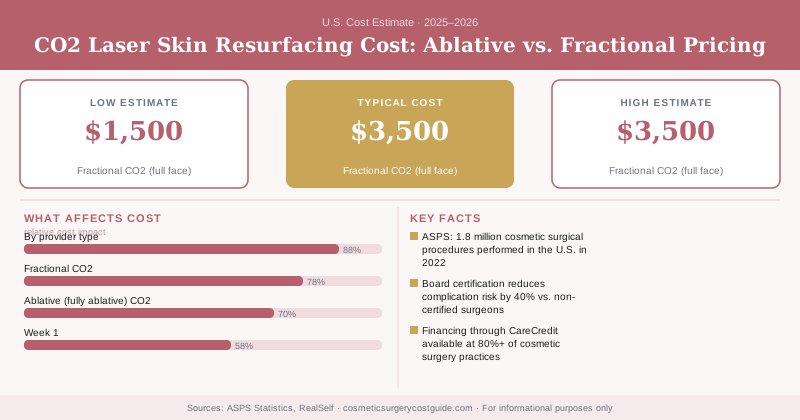
In 2010, a full-face ablative CO2 laser treatment cost around $3,800 and required two weeks of social downtime. Today, you can get fractional CO2 resurfacing for $1,500, be back to work in four days, and achieve results that would have required a full ablative treatment two decades ago. The technology has fundamentally changed — and so has the value equation.
Here’s where CO2 laser fits today, what it costs, and how to decide between ablative and fractional approaches.
CO2 Laser Resurfacing Cost in 2025–2026
| Treatment Type | Area | Average Cost | Downtime |
|---|---|---|---|
| Fractional CO2 (full face) | Full face | $1,500–$3,500 | 4–7 days |
| Fractional CO2 (targeted zone) | Perioral or periorbital | $900–$1,800 | 3–5 days |
| Ablative CO2 (full face) | Full face | $3,000–$6,000 | 10–14 days |
| Ablative CO2 (targeted zone) | Lips, eyes only | $1,500–$3,000 | 7–10 days |
| Fractional CO2 (neck/chest) | Décolleté | $1,200–$2,800 | 5–7 days |
Fractional vs. Ablative: The Key Difference
This is the most important decision, and it’s mostly about downtime tolerance vs. result depth.
Fractional CO2 treats thousands of microscopic columns of tissue while leaving surrounding skin intact. The intact skin acts as a reservoir for healing, dramatically shortening recovery. You’ll have red, swollen, peeling skin for 4–7 days — noticeable but manageable. Most patients see 40–60% improvement in texture, fine lines, and pigmentation.
Ablative (fully ablative) CO2 removes the entire surface of the skin in the treatment zone. Recovery involves 10–14 days of oozing, crusting, and significant redness that can persist for 4–8 weeks. But the results are in a different category — 60–80% improvement is realistic, and some patients describe it as a reset button on their skin. For deep perioral lines, severe photodamage, or significant acne scarring, ablative is the only laser that delivers those outcomes.
The American Academy of Dermatology notes that ablative laser resurfacing remains the gold standard for fine-line reduction and surface texture improvement — with fractional CO2 offering an excellent middle ground for patients who can’t take extensive downtime.
What CO2 Laser Actually Treats Well
CO2 laser is legitimately excellent for:
- Fine and moderate lines (especially perioral — around the mouth — where injectables underperform)
- Skin texture and tone irregularities from sun damage
- Superficial acne scars (rolling and superficial boxcar types)
- Diffuse pigmentation and brown spots
- Overall skin tightening via collagen remodeling
It’s less effective for deep acne ice-pick scars, significant skin laxity, or any pigmentation issue driven by deep dermal melanin. If you’re after dramatic lifting, this is not that — CO2 is a surface and texture treatment, not a structural one.
This is the thing most patients underestimate. With fractional CO2, the active peeling phase is 4–7 days — but pink-to-red discoloration often persists for 4–8 weeks. With ablative CO2, persistent erythema can last 3–6 months.
This isn’t a complication; it’s part of the healing process as new collagen forms. The redness is easily covered with mineral makeup after week 2 in fractional cases. Plan your timing around important events accordingly — no fractional CO2 within 6 weeks of a wedding, no ablative within 4 months.
Why Prices Vary So Much Between Providers
The laser machine itself matters — older CO2 systems and newer fractional platforms like Lumenis UltraPulse, Fraxel Re:pair, and ActiveFX produce very different results. A practice using an older machine at a lower price point isn’t always a bargain.
Provider training matters too. CO2 laser is a physician-only procedure in most states — or should be. The depth, density, and pattern settings require real judgment about skin type, treatment goals, and how to avoid complications. Board-certified dermatologists and plastic surgeons who perform CO2 regularly deliver consistently better outcomes than medspas operating with less experienced staff.
By provider type:
- Board-certified dermatologist or plastic surgeon: $2,000–$5,500 (full face fractional)
- Medspa with physician oversight: $1,200–$3,000
- Med school/teaching hospital: $1,000–$2,500 (residents supervised by attendings)
Fitzpatrick Skin Type Matters for CO2
CO2 laser carries a real risk of post-inflammatory hyperpigmentation (PIH) — dark spots where the laser treated — in patients with medium to deeper skin tones (Fitzpatrick types III–VI). This isn’t a dealbreaker, but it requires a different approach: lower fluence settings, more conservative passes, extended pre-treatment with hydroquinone, and longer healing time.
If you have a medium or darker skin tone and a provider doesn’t mention Fitzpatrick type at your consultation, that’s a red flag. The right approach changes substantially by skin type.
CO2 laser reactivates dormant herpes simplex virus (cold sores) in the treatment area. If you’ve ever had a cold sore — even once — you must take antiviral medication (acyclovir or valacyclovir) starting 2 days before your procedure and continuing for 5–7 days after. Skipping this step can cause a severe outbreak across your treated skin that significantly worsens outcomes and delays healing. Every reputable provider will ask about this. If yours doesn’t, ask yourself.
The Results: When Do You See Them?
Here’s an honest timeline for fractional CO2:
- Week 1: Active peeling, redness — the ugly phase
- Week 2–3: Smooth, pink new skin — the exciting phase
- Month 1–3: Progressive collagen remodeling continues — skin tightens and clarifies further
- Month 6: Final result visible — most patients see 40–60% improvement in texture and fine lines
That 6-month timeline is why CO2 resurfacing is often more impressive in retrospect. The before-and-after you take at month 6 looks far more dramatic than what you’d see at week 4.
For many patients, one well-done fractional CO2 treatment every 2–3 years outperforms an annual rotation of milder treatments. It’s a higher single cost but often lower cost over time — and a noticeably better outcome.
Frequently Asked Questions
CO2 laser resurfacing typically costs between $1,200 and $5,500, with fractional treatments averaging $1,500–$3,000 and full ablative treatments ranging from $3,500–$5,500. The final price depends on the treatment area size, whether you choose ablative or fractional technology, and your provider's experience level.
CO2 laser resurfacing is considered cosmetic and is not covered by most health insurance plans, meaning you'll pay the full cost out-of-pocket. The only exception is if the treatment is medically necessary to treat scars, burns, or precancerous lesions, in which case you should check with your insurer before scheduling.
Fractional CO2 laser treatments typically require 3–7 days of downtime, allowing most patients to return to work within four days with minimal visible redness. Ablative CO2 treatments are more intensive and usually require 10–14 days of social downtime, during which your skin will be red and peeling.