You did the hard part — 50 pounds gone. So why does the loose skin make you feel like the work isn’t finished? It’s one of the most common frustrations after major weight loss, and it’s exactly what body contouring surgery is built to solve.
Losing 50 pounds, whether through diet, exercise, bariatric surgery, or a GLP-1 medication, often leaves behind skin that’s stretched past its ability to snap back. The result is loose folds on the abdomen, arms, thighs, and chest. Surgery removes that excess skin — and because the loose areas usually come in clusters, combining procedures is the cost-smart move.
The need is widespread and growing. ASPS has tracked body-contouring-after-weight-loss procedures rising sharply in recent years, driven partly by the surge in GLP-1 medication users, and the Aesthetic Society reports steady demand for skin-removal surgery. A 50-pound loss is right in the range where excess skin becomes a surgical question.
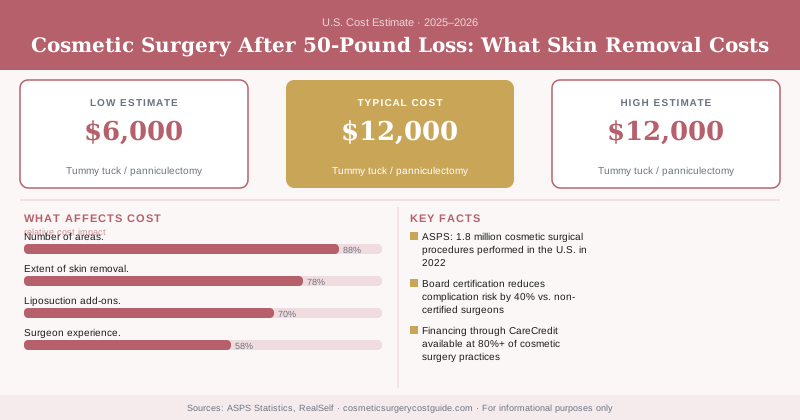
What Skin Removal Costs
| Procedure | Cost |
|---|---|
| Tummy tuck / panniculectomy | $6,000–$12,000 |
| Arm lift (brachioplasty) | $4,000–$8,000 |
| Thigh lift | $5,000–$10,000 |
| Breast lift | $5,000–$10,000 |
| Two areas combined (one session) | $11,000–$22,000 |
| Lower body lift (circumferential) | $12,000–$30,000 |
Why Combining Makes Sense Here
After a 50-pound loss, you rarely have just one loose area. The belly, arms, and chest often all need attention — and that’s precisely the situation where combining procedures pays off most.
Each separate surgery carries its own $3,000–$6,000 in anesthesia and facility fees. Combine a tummy tuck with an arm lift, or pair it with a breast lift, and you pay that overhead once. That saves $3,000–$7,000 and consolidates your recovery into a single window.
After a 50-pound loss, excess skin usually appears in several areas at once, which makes combining procedures the cost-smart choice. Two areas combined run $11,000–$22,000 — saving $3,000–$7,000 over separate surgeries by sharing one anesthesia fee. For more extensive cases, a body contouring plan staged across one or two sessions is common. Wait until your weight is stable for 6+ months first.
What Drives the Variation
Number of areas. One area is straightforward. Two or three combined climb in price but save on shared overhead.
Extent of skin removal. More loose skin means longer surgery and more cost. A 50-pound loss usually means moderate excess — significant, but less than the 100-pound-plus cases that need full circumferential lifts.
Liposuction add-ons. Pairing liposuction with skin removal refines the contour and is cheap when done in the same session.
Surgeon experience. Skin-removal surgery is technically demanding. Choose a board-certified surgeon with weight-loss-patient experience.
The Weight-Stability Rule
Here’s the part you can’t rush. Surgeons want your weight stable for at least 6 months before contouring — ideally longer. Operating while you’re still losing means the skin keeps changing afterward, and you may need revisions.
If you lost the weight on a GLP-1 medication, talk to your surgeon about your medication timeline, because it affects both stability and surgical planning.
The Safety Window
Combined skin-removal procedures run 3–6 hours. Surgeons aim to keep total anesthesia under 6 hours, so two areas usually fit; extensive multi-area cases may be staged. Your anesthesia fee is the cost you’re consolidating, so confirm it shows as one shared line.
Don’t schedule contouring while you’re still actively losing weight. Operating before your weight stabilizes means the skin keeps loosening afterward, often requiring revision surgery you’d pay for again. Wait for 6+ months of stable weight — the patience saves you money and a second operation.
Financing the Surgery
Insurance occasionally helps here. A panniculectomy — removing an overhanging skin fold that causes documented rashes or infections — is sometimes covered, unlike a cosmetic tummy tuck. Get pre-authorization in writing, because the criteria are strict.
For the cosmetic portions, practices offer financing through CareCredit or Prosper. A $16,000 combination on a 24-month plan runs around $700/month — confirm the APR before signing, since longer terms often carry 14–26% interest. Ask for an itemized quote with one shared anesthesia fee to confirm the combination savings.
Frequently Asked Questions
Cosmetic surgery for skin removal after a 50-pound weight loss typically ranges from $8,000 to $30,000, depending on how many areas need treatment and whether procedures are combined. A single area like the abdomen usually costs $8,000–$15,000, while combining the abdomen with arm lifts, thigh lifts, or body lift procedures can reach $25,000–$30,000 but often costs less per procedure than having them done separately.
Most insurance plans classify body contouring as cosmetic and do not cover it, leaving patients responsible for the full cost out-of-pocket. However, some insurers may cover skin removal if it causes functional problems like rashes, infections, or mobility issues—this requires medical documentation and pre-approval, and you should contact your plan directly to understand your coverage.
Recovery typically takes 2–3 weeks before you can return to light activities and desk work, though full recovery with unrestricted exercise usually takes 6–8 weeks. Most patients experience swelling and bruising for the first 2–3 weeks and should avoid heavy lifting, strenuous exercise, and swimming during this period to prevent complications.