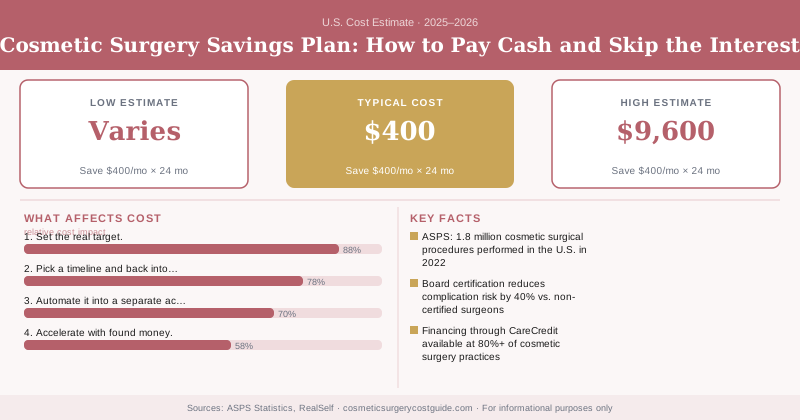
Here’s a number that reframes the whole financing conversation: saving $400 a month for 24 months gets you $9,600 in cash for a procedure — with exactly zero dollars of interest. Finance that same surgery at 18% and you’d hand a lender $2,000 or more on top. A cosmetic surgery savings plan isn’t glamorous, but it’s the cheapest money you’ll ever spend on a procedure, because it’s your own.
Let’s build a savings plan that actually gets you to the operating room.
Why Saving Beats Financing
Financing feels faster, but it’s a tax on impatience. Every month you wait to start saving is a month of opportunity; every month you carry a loan is a month of interest. Run the comparison:
| Approach | $9,600 Procedure | Total Paid | Extra Cost |
|---|---|---|---|
| Save $400/mo × 24 mo | Pay cash | $9,600 | $0 |
| Finance @ 12% / 36 mo | Borrow full | $11,500 | $1,900 |
| Finance @ 18% / 48 mo | Borrow full | $13,500 | $3,900 |
| Hybrid: save half, finance half | Mixed | ~$10,500 | ~$900 |
Even a hybrid — saving half and financing the rest — slashes interest because you borrow less. According to the Aesthetic Society, Americans spent more than $11 billion on aesthetic procedures in 2023, and a meaningful share is financed at interest that disciplined savers simply avoid.
A savings plan is the cheapest way to pay for cosmetic surgery — zero interest, no debt, full negotiating power as a cash patient. Automate a fixed monthly transfer to a separate high-yield account, set a realistic target date, and you’ll often beat financing by $2,000 or more on a mid-size procedure.
Build Your Plan in Four Steps
1. Set the real target. Get an itemized quote and add a 15% buffer for the costs people forget — see cosmetic surgery hidden fees so your goal covers everything, not just the surgeon’s fee.
2. Pick a timeline and back into the monthly number. Divide the total by the months you can wait. $9,600 over 24 months is $400; over 18 months it’s $533.
3. Automate it into a separate account. A dedicated high-yield savings account keeps the money out of sight and earns a little interest while you wait. Automation removes willpower from the equation.
4. Accelerate with found money. Tax refunds, bonuses, and seasonal income can shave months off your timeline.
The Cash-Patient Advantage
Saving doesn’t just dodge interest — it turns you into a cash patient, and cash patients negotiate. Many practices offer discounts for paying in full upfront because it eliminates their financing and collection risk. You also book in the cheapest season instead of rushing. Pair your savings plan with the timing tactics in how to save money on cosmetic surgery.
Don’t raid your emergency fund or retirement accounts to fast-track surgery. A cosmetic procedure is elective; a job loss or medical emergency is not. Keep three to six months of expenses untouched. If your savings timeline feels too long, that’s a sign to wait — not to drain safety-net money.
When to Blend Saving and Financing
A pure savings plan isn’t always realistic — sometimes there’s a medical or time reason to move sooner. In that case, save what you can as a down payment and finance the remainder. A 50% down payment roughly halves your interest. Compare loan and card options in cosmetic surgery financing once you know how much you’ll need to borrow.
Picking a lower-cost market shortens any savings timeline too. Plastic surgery cost by state shows where your dollars stretch furthest, and tummy tuck cost gives a realistic target for one of the most-saved-for procedures.
The Bottom Line
A cosmetic surgery savings plan is the lowest-cost path to the operating room — automate a fixed monthly transfer into a separate high-yield account, target a realistic date, and pay cash to skip $2,000+ in interest. Even saving half and financing the rest beats borrowing the whole amount. Just never tap your emergency fund or retirement to rush an elective procedure.
Frequently Asked Questions
Most cosmetic procedures range from $3,000 to $15,000, depending on the type and complexity. For example, a facelift typically costs $7,000–$12,000, while liposuction ranges from $2,000–$8,000. Using a savings plan to accumulate $400–$600 monthly can help you reach these amounts interest-free within 16–30 months.
No, standard health insurance does not cover purely cosmetic procedures since they are elective and not medically necessary. However, if a procedure has a reconstructive component (such as rhinoplasty after injury), some insurance may cover a portion, though you will likely pay $2,000–$5,000 out-of-pocket. Always verify with your insurer before scheduling.
Saving $400 monthly gets you to $9,600 in 24 months with zero interest charges, whereas financing that same amount at 18% APR costs an extra $2,000+. If you can save $600 per month, you reach a $9,000 procedure in just 15 months, making the savings-first approach significantly faster and cheaper than taking out a loan.