Most women researching facelifts in 2026 have already heard about “deep plane.” It shows up in every celebrity facelift article, every plastic surgery forum, every influencer post about looking “naturally refreshed.” The mystique around it is real. So is the price premium.
Whether it’s justified for you specifically depends on one thing: the anatomy driving your aging, not the technique’s prestige.
Facelift Cost Comparison
| Procedure | Surgeon Fee | Total Cost (All-In) | Operating Time |
|---|---|---|---|
| Mini facelift | $4,000–$8,000 | $5,000–$12,000 | 2–3 hours |
| SMAS plication facelift | $7,000–$14,000 | $10,000–$18,000 | 3–5 hours |
| SMAS imbrication facelift | $8,000–$15,000 | $11,000–$20,000 | 4–5 hours |
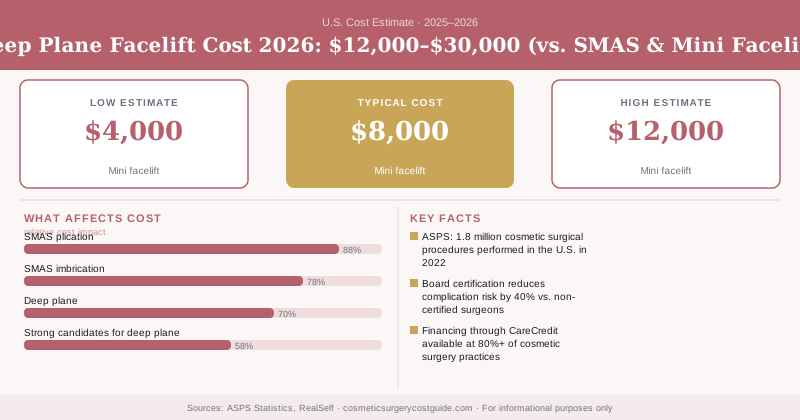
| Deep plane facelift | $12,000–$22,000 | $15,000–$30,000 | 5–8 hours |
| Composite facelift | $15,000–$25,000 | $18,000–$35,000 | 6–9 hours |
| Extended deep plane | $16,000–$28,000 | $20,000–$40,000 | 7–10 hours |
The cost difference isn’t cosmetic (no pun intended). Deep plane surgery takes 2–3 hours longer than SMAS techniques, requires more surgical precision, and demands a surgeon with specific training in deep dissection anatomy. All three factors drive up cost.
What Separates Deep Plane from SMAS Techniques
Understanding the anatomy helps explain why the price difference is real.
The face has layers. From outside in: skin, subcutaneous fat, SMAS (superficial musculoaponeurotic system), retaining ligaments, and deeper fat compartments. Traditional facelift techniques address the SMAS layer — the fibromuscular sheet beneath the skin and fat.
SMAS plication tucks and sutures the SMAS to itself without cutting into it. It’s faster, has a lower complication profile, and produces good results for patients with mild-to-moderate aging.
SMAS imbrication removes a small strip of SMAS before suturing — slightly more aggressive, slightly more lifting power.
Deep plane goes a step further. The surgeon dissects beneath the SMAS, releasing the key retaining ligaments (zygomatic, masseteric cutaneous, and cervical ligaments) that tether facial fat to the underlying bone. When these ligaments are released, the entire composite flap — SMAS, fat, and skin all moving together — can be repositioned as a unit.
Why does that matter? Because nasolabial folds (the lines from nose to mouth corners) are caused primarily by descent of the midface fat — cheek fat that has migrated downward due to ligament laxity. SMAS techniques pull on tissue above the fold. Deep plane releases the structures causing the fold. That’s why deep plane produces more natural-looking nasolabial fold improvement than any other non-fat-transfer technique.
If your primary concern is deep nasolabial folds or significant midface descent (flat cheeks, hollow under-eye area merging with cheek), SMAS plication or imbrication will likely disappoint you. These techniques can improve jowls and jawline definition effectively, but they don’t release the ligamentous tension causing nasolabial folds. If a surgeon proposes SMAS plication for significant midface descent, ask specifically how it will address the nasolabial fold.
Recovery Comparison
This is where deep plane’s cost premium extends beyond surgeon fees.
| Recovery Milestone | Mini Facelift | SMAS Facelift | Deep Plane |
|---|---|---|---|
| Return to light activity | 7–10 days | 10–14 days | 14–21 days |
| Presentable in public | 2–3 weeks | 3–4 weeks | 3–5 weeks |
| Return to exercise | 4–6 weeks | 5–8 weeks | 6–10 weeks |
| Final result visible | 3–6 months | 4–6 months | 6–12 months |
| Bruising/swelling mostly resolved | 3 weeks | 4–5 weeks | 5–7 weeks |
Deep plane recovery is longer because the dissection goes deeper — there’s more disruption of tissue planes, more temporary disruption of lymphatic drainage, and in some cases temporary nerve function changes (usually the marginal mandibular or zygomatic branches) that resolve over weeks. These aren’t dangerous; they’re anatomically expected and almost uniformly temporary. But they do mean more downtime.
For patients in their 40s–50s with demanding professional schedules, the recovery length is a real consideration. Many plan 3–4 weeks of reduced-visibility downtime, which affects the financial calculation when factoring in lost work days.
When Deep Plane Is Worth the Premium
Not every facelift candidate needs deep plane. Here’s a practical framework:
Strong candidates for deep plane:
- Age 45–60 with significant jowling AND deep nasolabial folds
- Patients with midface descent (cheek flattening, under-eye hollowing merging with cheek)
- Patients wanting the longest-lasting single procedure
- Those who can accommodate 3–5 weeks of social downtime
- Patients in whom prior SMAS facelift has “worn off” and structural work is needed
Better served by SMAS or mini facelift:
- Early aging (40–50) with primarily jawline/jowl concerns but minimal midface descent
- Patients who want results with 2 weeks of downtime maximum
- Those with adequate midface volume but skin laxity
- Budget-constrained patients where $5,000–$12,000 is the realistic range
- Patients who supplement with injectables regularly and want surgical refinement, not structural repositioning
Many surgeons now recommend thinking of deep plane as a structural reset and injectables (Sculptra, Restylane, Juvederm) as ongoing maintenance between procedures. A 50-year-old who does a deep plane facelift may maintain results beautifully for 10+ years with annual filler touch-ups costing $1,500–$3,000/year — still less expensive, over time, than repeated mini facelifts every 3–5 years.
Finding a Deep Plane Surgeon
This technique requires specific training that not all board-certified plastic surgeons have. Deep plane surgery was pioneered by Dr. Sam Hamra in the 1990s, and mastery requires deliberate experience under the supervision of surgeons who specialize in it. Not every FACS-certified surgeon performs deep plane.
When interviewing surgeons, ask directly:
- “How many deep plane facelifts do you perform per year?” (Look for 30+ annually)
- “Do you have before/after photos specifically at 12-month follow-up, not just 6 weeks?”
- “What is your revision rate, and what would that cost if needed?”
- “Do you perform deep plane exclusively, or also SMAS/mini facelifts when appropriate?”
The last question is important — a good surgeon recommends the right technique for your anatomy, not the most prestigious or most lucrative one.
ASPS Data: Who Gets Facelifts
According to the American Society of Plastic Surgeons, 148,461 facelifts were performed in the United States in 2022, making it one of the top five cosmetic surgical procedures. The median age at time of facelift is 55–60. Demand has grown 8% over five years, driven partly by what surgeons call the “Zoom effect” — pandemic video calls increasing facial self-awareness — and partly by longer, more active lives that make looking one’s age feel increasingly optional.
Be skeptical of surgeons who perform deep plane facelifts at total costs below $10,000. The operating time alone (5–8 hours) makes it nearly impossible to perform this procedure profitably at a price that covers proper anesthesia, facility, and surgeon time without corners being cut somewhere. A $7,000 “deep plane facelift” is almost certainly a limited SMAS procedure being marketed with a more prestigious name.
The Bottom Line
Deep plane facelift at $15,000–$30,000 is a significant investment — one that’s justified when your anatomy specifically calls for structural repositioning and you want results that last a decade-plus. It’s not justified when your concerns are mild, your budget is tight, or your downtime window is limited. The technique’s reputation is earned, but its value to you depends entirely on whether your anatomy is the problem it solves. The best plastic surgeon for this decision is one who’ll tell you honestly whether you need it — or whether something less aggressive will serve you better for less money.
Frequently Asked Questions
A deep plane facelift typically costs $15,000–$30,000 total, compared to $10,000–$20,000 for a standard SMAS facelift and $5,000–$12,000 for a mini facelift. The cost premium for deep plane reflects the significantly longer operating time (5–8 hours vs. 3–5 hours for SMAS), higher surgeon expertise requirements, and extended anesthesia costs. In major metropolitan markets like New York or Beverly Hills, top deep plane specialists may charge $25,000–$40,000 in surgeon fees alone.
A deep plane facelift typically lasts 10–15 years before meaningful aging catches up to the result, compared to 7–10 years for a full SMAS facelift and 3–5 years for a mini facelift. The longevity advantage of deep plane comes from releasing the actual ligamentous attachments that cause facial descent and repositioning tissue at the structural level — rather than pulling on the more superficial SMAS layer. Patients in their mid-40s to 50s who do a deep plane often don't need a repeat procedure until their late 50s or 60s.
The ideal candidate is typically 45–65 years old with significant jowling, deep nasolabial folds, midface descent (flattened cheeks), and neck laxity that a mini facelift or injectable treatment cannot adequately address. Deep plane specifically excels at correcting the nasolabial fold, which SMAS techniques often fail to improve because the fold is caused by structural ligament descent rather than skin excess alone. Patients with less severe aging — minimal jowls, early neck laxity — typically don't need deep plane's power and recover just as well from a mini or SMAS procedure.