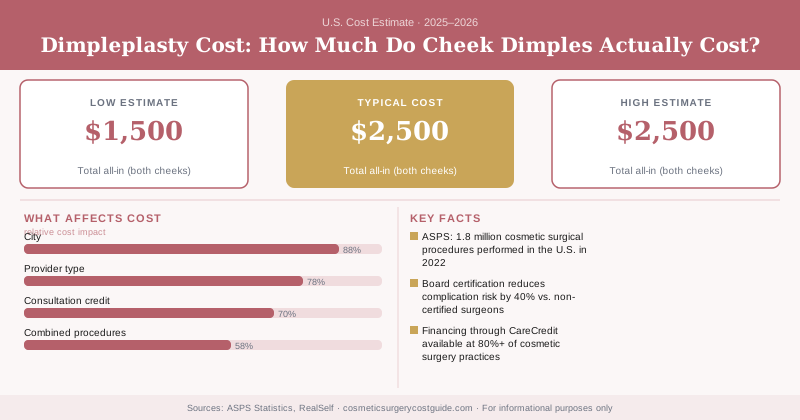
Most patients assume cheek dimples are purely genetic. They are — naturally. But a dimpleplasty creates them surgically in about 30 minutes, under local anesthesia, in an outpatient setting. No general anesthesia, no hospital stay, no external scars. And at $1,500–$2,500 for both cheeks, it’s one of the more affordable facial procedures you can book.
The American Society of Plastic Surgeons reported in 2023 that minimally invasive facial procedures saw a 12% year-over-year increase — and dimpleplasty fits squarely into that trend. It’s quick, relatively low-risk, and delivers a result that’s immediately visible. The question most people don’t ask upfront: the dimples may be visible all the time at first, not just when you smile, and the permanence depends on technique. That’s worth understanding before you book.
Dimpleplasty Cost Breakdown
| Cost Item | Typical Price |
|---|---|
| Surgeon’s fee (both cheeks) | $1,200–$2,000 |
| Local anesthesia | $100–$300 |
| Facility/procedure room fee | $200–$500 |
| Pre-procedure consultation | $100–$200 (often credited) |
| Post-procedure supplies | $50–$100 |
| Total all-in (both cheeks) | $1,500–$2,500 |
A single-cheek dimpleplasty isn’t common — most patients want symmetrical results — but it runs about $800–$1,400 when done solo. The surgeon’s fee usually covers both sides when booked together, which is why the per-cheek pricing doesn’t scale linearly.
How the procedure works
Here’s what actually happens in the OR: the surgeon marks the desired dimple location on the outside of your cheek, then makes a tiny internal incision inside the mouth — no external cuts, no visible scarring. A small, circular punch of muscle and buccal fat is removed, and the underlying dermis is sutured to the cheek muscle with an absorbable suture. That tension is what creates the dimple when you smile.
The whole thing takes 20–45 minutes per side. You’re awake the entire time. Most patients describe it as pressure and mild discomfort, not pain. You go home the same day.
The permanence caveat: The suture is absorbable, which means over weeks to months, the suture dissolves and the dimple’s permanence depends on how much scar tissue forms between the skin and muscle. In most cases, the dimple remains visible when smiling long-term. Some patients find it fades significantly over 1–2 years, particularly in those with thicker buccal fat pads. If permanence is important to you, ask your surgeon about non-absorbable suture options, which some practitioners use for longer-lasting tethering.
What affects your price
- City: New York, Los Angeles, and Miami practices charge significantly more than Midwest or Southeast practices. Expect to pay 20–40% more in major metros.
- Provider type: Board-certified plastic surgeons and oral/maxillofacial surgeons charge more than cosmetic surgeons doing high-volume minimally invasive work. Both can produce excellent results.
- Consultation credit: Many practices credit the consultation fee ($100–$200) toward the procedure cost. Ask upfront.
- Combined procedures: If you’re booking dimpleplasty alongside other facial work like buccal fat removal or cheek filler, surgeons typically offer package discounts.
Dimple placement is more art than anatomy. The most aesthetically common placement corresponds to where natural dimples occur — typically at the intersection of a horizontal line drawn from the corner of the mouth and a vertical line drawn down from the outer corner of the eye. But “standard” placement varies by facial structure. Bring reference photos. Ask your surgeon to mark placement before the procedure and show you in a mirror. The 10 minutes spent on placement discussion will matter more than anything else in determining whether you love the result.
Recovery and what to expect
Recovery is genuinely mild compared to most facial procedures. You’ll have intraoral sutures (inside the cheek) that dissolve in 1–2 weeks. Swelling peaks at 48–72 hours and typically resolves within 1–2 weeks. In the first few weeks, the dimple may appear even when your face is at rest — this is normal and generally softens as healing progresses, until the dimple shows primarily with animation.
Eating is restricted to soft foods for the first few days. Oral rinse with antibacterial mouthwash after meals is usually prescribed. Most people are back to work within 2–3 days.
Dimpleplasty is not reversible in the traditional sense. While some surgeons can revise or partially release the suture, there’s no reliable way to fully undo the procedure once scar tissue has formed. This matters more than most patients realize before booking. If you’re unsure, start with a non-surgical simulation: a skilled injector can temporarily create the appearance of a dimple with filler to let you live with the aesthetic before committing to the permanent version.
Is it worth $2,000?
That’s a genuinely personal answer. The procedure is safe, relatively affordable, and the recovery is easy. For patients who’ve always wanted cheek dimples and have realistic expectations about placement and the “resting” dimple period during initial healing, satisfaction rates are high. For patients expecting surgical precision on a feature that varies dramatically with facial expression and individual healing — it can disappoint.
The American Board of Cosmetic Surgery recommends verifying surgeon credentials and asking specifically about their dimpleplasty volume before booking. This is a niche procedure; you want someone who does it regularly, not occasionally.
Bottom Line
At $1,500–$2,500 for both cheeks, dimpleplasty is one of the most accessible facial procedures on the cosmetic surgery menu. The key variables are placement (spend time on this), provider experience with this specific procedure, and your understanding that early healing shows a dimple at rest — which softens over time. Get at least two consultations before committing.
Frequently Asked Questions
Dimpleplasty typically costs $1,500–$2,500 for both cheeks in the United States. This price covers the surgical procedure itself, which takes about 30 minutes under local anesthesia in an outpatient setting. Additional costs like consultation fees ($100–$300) or post-op care may apply depending on your surgeon and location.
No, dimpleplasty is considered a cosmetic procedure and is not covered by health insurance plans. You will pay the full $1,500–$2,500 out-of-pocket, though some surgeons offer payment plans or financing options through third-party lenders to help spread costs over time.
Surgical dimples created by dimpleplasty are permanent, as the procedure involves placing a suture that anchors the skin to the underlying muscle. Recovery is minimal—most patients return to normal activities within 3–5 days, though some swelling and tenderness may persist for 1–2 weeks.