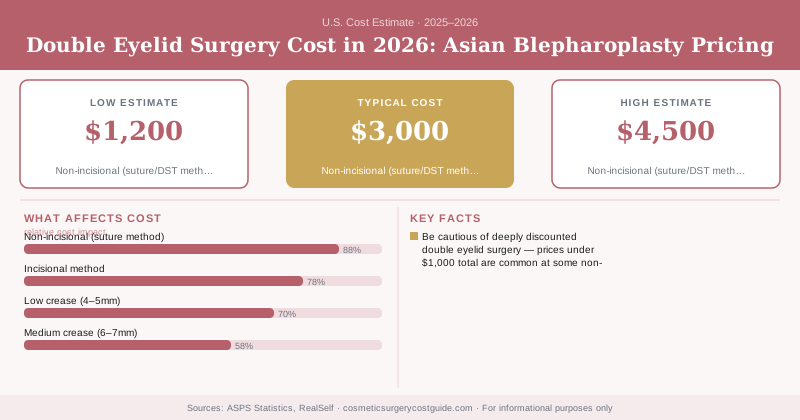
About 50% of East Asian individuals are born without a supratarsal crease — the fold that creates the “double eyelid” appearance. For those who want a crease, double eyelid surgery (Asian blepharoplasty) creates one surgically or with suture technique. It’s one of the most commonly performed cosmetic procedures among Asian American patients and has a nearly 50-year track record in the US. The ASPS reports that Asian Americans have the second-highest per-capita cosmetic procedure rate among demographic groups in the US.
Here’s what the surgery actually involves, what it costs, and what separates a good outcome from one that looks overdone.
Double Eyelid Surgery Cost Breakdown
| Technique | Surgeon Fee | All-In Cost |
|---|---|---|
| Non-incisional (suture/DST method) | $1,200–$3,000 | $1,800–$4,500 |
| Partial incision method | $1,800–$4,000 | $2,800–$6,000 |
| Full incision blepharoplasty | $2,500–$5,000 | $4,000–$7,500 |
| Revision double eyelid surgery | $3,500–$7,500 | $5,500–$10,000+ |
Non-incisional methods cost less upfront but may not last as long. Full incision techniques produce permanent results but require more recovery. Your anatomy — specifically the amount of excess skin and fat — largely determines which technique is appropriate.
The Two Main Approaches: What You’re Actually Choosing Between
Non-incisional (suture method): The surgeon places buried sutures through tiny punctures to create the crease without a full incision. Faster recovery (1–2 weeks), lower cost, no scar. The limitation: results can fade over 3–10 years, especially in patients with heavier eyelids or excess fat. Best for younger patients with thin eyelids and minimal excess tissue.
Incisional method: A small incision is made along the designed crease line, allowing the surgeon to remove excess skin, fat, or tissue as needed. Results are permanent. Recovery takes 2–3 weeks with more visible swelling. This is the recommended approach for patients with thicker eyelids, excess skin, or prior suture procedures that have faded.
The right technique depends on your anatomy, not just your preference. A surgeon pushing everyone toward the cheaper suture method — regardless of eyelid characteristics — may not be prioritizing your long-term outcome.
Crease Height: The Most Important Aesthetic Decision
This matters more than technique. Crease height is measured in millimeters from the lash line:
- Low crease (4–5mm): Natural, East Asian aesthetic. The crease is subtle and blends with native anatomy.
- Medium crease (6–7mm): The most common request. Creates visible definition while maintaining an natural look.
- High crease (8mm+): Creates a more “Westernized” appearance. Often requested but can look unnatural on certain anatomies, especially as the eyelids age and the crease position becomes more visible.
Most experienced surgeons who specialize in Asian blepharoplasty will discuss crease height explicitly during consultation. Be specific about what you want — show photos. “Natural” means different things to different patients and different surgeons.
- Experience specifically with Asian eyelid anatomy — this is genuinely a specialty within eyelid surgery
- Before/after photos that show diverse crease heights and Asian facial aesthetics (not a single “standard” result)
- A surgeon who discusses crease height, crease shape (in-fold, out-fold), and your specific anatomy — not just “suture vs. incision”
- Willingness to explain why they recommend a particular technique for your specific case
- Board certification in plastic surgery or oculoplastic surgery
Why Surgeon Expertise Matters Especially Here
Double eyelid surgery on Asian eyes requires understanding anatomy that differs meaningfully from what’s covered in standard blepharoplasty training. Asian eyelids often have:
- More orbital fat that extends further toward the lash line
- A thicker pretarsal tissue layer
- Different levator aponeurosis attachment patterns
- An epicanthal fold that interacts with the crease aesthetically
Surgeons who specialize in Asian blepharoplasty see these anatomical variations daily and understand how to create a crease that looks natural to the patient’s ethnicity and face. A surgeon without this focus may create a technically correct crease that still looks “off” — too high, too deep, or asymmetric in ways that are hard to articulate but immediately visible.
Recovery and What to Expect
Non-incisional: swelling for 1–2 weeks, most patients presentable in 10–14 days. The crease looks high and tight initially, settling over 6–12 weeks.
Incisional: more significant swelling for 2–4 weeks. The crease looks defined but overcorrected early on, taking 3–6 months to fully settle and look natural. Final results aren’t fully visible for 6 months.
Revision rates: non-incisional procedures have a meaningful revision rate (10–30% in some series) due to asymmetry or crease fading. Full incision techniques have lower revision rates but require more recovery. Revisions cost $3,500–$7,500 and are generally more complex than the primary procedure.
Be cautious of deeply discounted double eyelid surgery — prices under $1,000 total are common at some non-board-certified clinics targeting Asian American patients. The procedure involves working millimeters from the eye itself. Board certification, accredited facility, and documented experience with Asian blepharoplasty are all non-negotiable. Check credentials through the American Board of Plastic Surgery’s online verification before booking any consultation.
Financing and Planning
Most practices offer standard financing plans. A $3,500 incisional procedure on a 12-month 0% plan runs about $292/month. Budget an additional $200–$400 for recovery supplies and prescription eye drops.
Many patients combine double eyelid surgery with epicanthoplasty (addressing the inner corner of the eye) or an inner corner release — add $800–$2,000 for this combination. Plan time off: desk workers typically need 1–2 weeks; client-facing jobs often require 2–3 weeks when swelling is the most noticeable.
Frequently Asked Questions
Double eyelid surgery typically costs between $1,500 and $6,000 in the US, depending on the surgeon's experience, geographic location, and whether you choose the incisional or non-incisional suture technique. Incisional methods are generally more expensive ($3,000-$6,000) than non-incisional suture techniques ($1,500-$3,000) because they require more surgical time and expertise.
Most health insurance plans do not cover double eyelid surgery because it is considered a cosmetic procedure rather than medically necessary. You can expect to pay the full cost out-of-pocket, though some surgeons offer financing options or payment plans to make the procedure more affordable.
Most patients experience initial swelling and bruising for 1-2 weeks, with the ability to return to light activities and work within 7-10 days. Complete healing and final results typically take 4-6 weeks as the incision line fades and the crease fully settles into its permanent position.