Lash extensions run $150–$300 every 3–4 weeks. Over three years, that’s $2,700–$6,500. An eyelash transplant costs $3,000–$8,000 once. The math draws certain patients in immediately — but the procedure comes with a catch that many consumers don’t anticipate. Your new lashes grow. Continuously. And they need to be trimmed. Regularly. That’s because transplanted eyelashes are scalp hairs, not eyelash hairs. They follow scalp hair’s growth cycle, not the natural lash cycle.
Understanding that before you book is the difference between a patient who loves their result and one who was surprised by ongoing maintenance they didn’t expect.
Eyelash Transplant Cost
| Procedure | Cost Range |
|---|---|
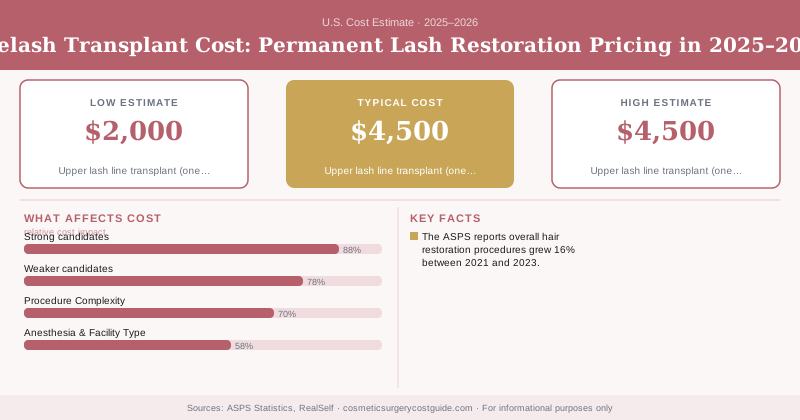
| Upper lash line transplant (one eye) | $2,000–$4,500 |
| Both upper lash lines | $3,000–$8,000 |
| Lower lash transplant (both eyes) | $1,500–$3,500 |
| Full upper + lower lash restoration | $4,500–$10,000 |
| Touch-up session for additional density | $1,000–$3,000 |
The total number of grafts planted determines cost more than almost any other factor. A natural upper eyelash has 90–160 lashes; most transplant patients receive 50–120 grafts per upper lid depending on desired density and donor availability. At $25–$50 per graft (the standard FUE cost model), graft count drives the surgeon’s fee significantly.
Facility and anesthesia fees add $500–$1,500 for most outpatient cases.
How the Procedure Works
Eyelash transplantation uses the same FUE (follicular unit extraction) technique used for scalp hair transplants. Individual follicular units — most commonly fine hairs from the nape of the neck, temple, or leg — are extracted one by one and transplanted into the eyelid margin under magnification.
The procedure takes 3–6 hours depending on the number of grafts. Local anesthesia is applied to both the donor site and the eyelids. The eyelids are particularly sensitive, so sedation (oral or IV) is commonly offered.
Most surgeons choose donor hairs from the nape of the neck specifically because those hairs tend to be finer, softer, and have a natural slight curl compared to crown hairs — producing a result that more closely mimics natural lashes.
According to the American Academy of Ophthalmology (AAO), eyelash loss (madarosis) affects millions of Americans due to causes including alopecia areata, trichotillomania, chemotherapy, thyroid conditions, and chronic lash extension use. A 2023 survey by the International Society of Hair Restoration Surgery (ISHRS) identified eyelash restoration as the fastest-growing niche within hair transplant surgery, with 34% of member surgeons reporting increased requests year-over-year. The ASPS reports overall hair restoration procedures grew 16% between 2021 and 2023.
The Trimming Reality
This is the non-negotiable fact that candidates must accept: transplanted lashes are scalp follicles. They grow at the scalp hair rate — approximately 1–1.5cm per month — rather than the natural lash growth cycle that self-limits at a set length and sheds on its own timeline.
What this means practically: transplanted lashes will grow past the ideal lash length and curl down against the eye if not trimmed. Most patients trim every 2–3 weeks. Some adapt quickly; others find this maintenance burdensome. A few patients also find curling with a lash curler becomes part of their routine since scalp hairs don’t have the same natural upward curve as natural lashes.
Patients with alopecia or medical lash loss conditions often accept this trade-off readily — having to trim lashes is dramatically preferable to having none. Patients seeking purely cosmetic enhancement for already-adequate lashes may find the maintenance surprises them.
Who’s an Ideal Candidate
Strong candidates:
- Patients with alopecia totalis, alopecia areata affecting lashes, or other medical causes of lash loss
- Chemotherapy patients who experienced permanent lash loss
- Patients with trichotillomania (hair-pulling) who’ve addressed the underlying condition
- Individuals with sparse, thin lashes due to genetics rather than cosmetic use
- Patients with adequate scalp or body donor hair
Weaker candidates:
- Patients with adequate natural lashes seeking thicker or longer lashes (Latisse, lash serum, or extensions serve this goal with lower risk)
- Patients unwilling to commit to regular trimming maintenance
- Patients with active eyelid conditions (blepharitis, meibomian gland dysfunction) — these must be treated and stable first
Eyelash Transplant vs. Alternatives
| Option | Cost | Maintenance | Duration |
|---|---|---|---|
| Lash extensions (full set) | $150–$300/fill (every 3–4 wk) | High | Ongoing |
| Latisse prescription | $150–$250/month | Daily application | Ongoing (reverses when stopped) |
| Lash lift + tint | $75–$150/session (every 6–8 wk) | Low | 6–8 weeks |
| Strip lash implants (non-surgical) | $50–$150 | Daily wear/removal | Single use |
| Eyelash transplant | $3,000–$8,000 once | Trimming 2–3x/month | Permanent |
For patients with significant medical lash loss, the transplant is often the best long-term option economically and practically. For those with cosmetic goals and existing lashes, lower-risk alternatives are more appropriate first steps.
Finding a Qualified Surgeon
Eyelash transplantation requires microsurgical skill — the eyelid margin is millimeters from the globe, and placement angle and depth are critical. Seek:
- Board-certified plastic surgeons or oculoplastic surgeons with documented eyelash transplant experience
- Hair restoration surgeons certified by ISHRS with specific lash transplant case volume
- Providers who can show before/after photos at 12+ months (enough time to assess long-term density and natural appearance)
Medical spas do not perform this procedure. It requires a physician surgeon with the appropriate training.
Be very cautious about budget pricing for eyelash transplants. This procedure is performed in the immediate proximity of the eye. Complications including infection, misdirected hair growth scratching the cornea, or poorly angled grafts that curl inward can cause vision-related problems. The eyelid margin tolerates no margin for error. A skilled oculoplastic surgeon charging $6,000+ is worth the investment. A discounted provider with minimal lash-specific experience is not. Always verify the surgeon’s specific eyelash transplant case volume before booking — not just general hair transplant experience.
Financing and Insurance
Cosmetic eyelash transplants are not covered by insurance. For patients with documented medical lash loss (alopecia areata, chemotherapy-induced, trichotillomania), a letter of medical necessity may support partial coverage under some plans — but this is unusual and should be verified in advance.
CareCredit and Alphaeon Credit are accepted at most surgical facilities offering this procedure.
The Bottom Line
Eyelash transplantation is a legitimate, permanent solution for lash loss — particularly for patients with medical causes. Budget $3,000–$8,000 for upper lash restoration by a qualified surgeon. Understand the maintenance commitment (regular trimming) before committing. For purely cosmetic goals, Latisse, lash lifts, or professional extensions offer lower-risk paths. For patients dealing with medical lash loss, the procedure can be genuinely life-changing — and over a 5-year horizon, it’s often more cost-effective than ongoing extension or medication maintenance.
Frequently Asked Questions
Eyelash transplants typically cost $3,000–$8,000 for a single procedure. This is a one-time expense, unlike lash extensions which cost $150–$300 every 3–4 weeks and total $2,700–$6,500 over three years.
No, eyelash transplants are considered cosmetic procedures and are not covered by health insurance plans. You will pay the full $3,000–$8,000 cost out-of-pocket, though some surgical centers may offer financing options to spread payments over time.
Yes, because transplanted eyelashes are actually scalp hairs, they grow continuously and require regular trimming—unlike natural eyelashes or extensions. This ongoing maintenance is an important factor to consider before choosing an eyelash transplant over temporary alternatives like extensions.