Sarah, 58, got her first facelift eight years ago and loved it for years. But when she looked in the mirror last spring, something felt off — not aged, exactly, but pulled tight in a way that didn’t look like her anymore. Her consultation for a revision came back at $14,000, nearly double what she remembered paying the first time. She’s not alone; facelift revision is one of the more expensive corrective procedures in cosmetic surgery, and there’s a real reason why.
Facelift revision addresses a range of concerns: an overly tight or “wind-tunnel” look from aggressive skin removal, visible or widened scars, asymmetry, or a face that has continued to age and needs a secondary lift years later.
What facelift revision costs
| Revision Type | Cost Range |
|---|---|
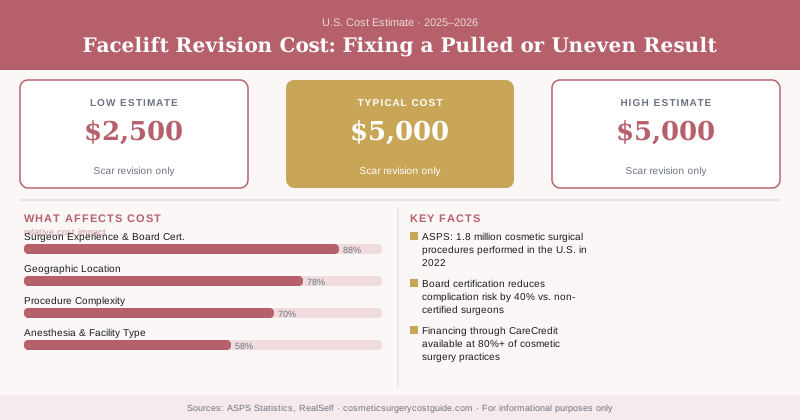
| Scar revision only | $2,500–$5,000 |
| Minor asymmetry correction | $5,000–$9,000 |
| Full surgical revision (SMAS/deep plane) | $10,000–$20,000 |
| Secondary facelift (years later, natural aging) | $8,000–$16,000 |
| Combined with eyelid or neck revision | $12,000–$22,000 |
Why revision surgery costs so much
A revision facelift is technically more demanding than a first-time procedure. Scar tissue from the original surgery obscures the natural tissue planes surgeons rely on, making dissection slower and riskier — nerves that control facial movement sit closer to altered anatomy after a prior lift, raising both the skill requirement and the time needed in the OR. Surgeons performing revisions also often need to correct, not just repeat, the previous technique — releasing over-tightened tissue, redistributing skin more naturally, or addressing a facial nerve issue from the original procedure.
That combination — more OR time, higher skill requirement, and greater complexity — is reflected directly in the higher price relative to most primary facelifts.
The 12-month rule
Reputable surgeons generally won’t perform a full revision within the first 12 months of an original facelift. Swelling, tissue settling, and scar maturation take that long to fully resolve, and revising too early means operating on tissue that hasn’t finished its healing process — which can compromise, rather than improve, the outcome. If a surgeon offers to revise your results at 8 weeks post-op because you’re unhappy with lingering swelling, that’s often premature; ask for a longer follow-up window before committing to a second surgery.
A meaningful share of patients who think they need a facelift revision are actually still within the normal healing timeline. Swelling can persist in subtle ways for 6-12 months, and results often continue to soften and look more natural well past the point patients expect “final” results. Before booking a revision consultation, ask your original surgeon (or a second opinion surgeon) whether you’re evaluating a truly final result or one that’s still resolving.
What separates a good revision candidate from a routine touch-up
Minor scar revision — smoothing a widened or raised scar along the hairline or ear — is a comparatively simple, lower-cost procedure, often done under local anesthesia. Full surgical revision addressing structural over-tightening, deep asymmetry, or facial nerve involvement is an entirely different scale of surgery, typically requiring general anesthesia and the same OR infrastructure as the original procedure.
Related reading: for patients considering their second facelift simply due to continued natural aging (not correcting a problem), see how long a facelift lasts and revision facelift cost for technique-specific detail.
Finding the right revision surgeon
Not every facelift surgeon takes on revision cases, and for good reason — revision work requires specific comfort operating around altered anatomy and scar tissue. Look specifically for a surgeon who performs revision facelifts regularly, ask to see revision-specific before-and-after results, and confirm they use deep-plane or SMAS-level techniques rather than a superficial skin-only approach, which tends to produce less durable results and a higher revision likelihood in the first place.
An “over-pulled” or unnatural-looking facelift is often harder and more expensive to correct than to have gotten right from the start, because releasing overly tight tissue without creating new laxity requires real surgical judgment. If your original consultation heavily emphasized dramatic tightening over natural-looking results, treat that as a signal to seek a second opinion before booking your revision with the same surgeon.
Bottom line
Facelift revision costs $2,500 for a minor scar touch-up up to $20,000+ for a full surgical correction — often exceeding the price of the original surgery due to the added complexity of working around scar tissue and altered anatomy. Wait the full 12 months before assuming you need one, and choose a surgeon with specific revision experience when you do.
Frequently Asked Questions
Facelift revision surgery typically costs $8,000–$20,000, depending on whether the correction addresses minor scarring, an over-pulled or unnatural appearance, or a more complex reconstructive issue like nerve damage or asymmetry. Minor touch-ups under local anesthesia can cost less, while full surgical revisions under general anesthesia land at the higher end.
Most surgeons recommend waiting at least 12 months after the original facelift before considering revision surgery, since swelling and scar tissue take that long to fully settle and final results to become apparent. Revising too early risks operating on tissue that hasn't finished healing, which can worsen the outcome rather than improve it.
Common reasons for facelift revision include an overly tight or 'wind-tunnel' appearance from excessive skin removal, visible or widened scars, asymmetry between the two sides, or results that simply didn't hold up over time due to the specific lifting technique used. Choosing a surgeon with deep-plane or SMAS-specific facelift experience, rather than a simpler skin-only lift, is associated with more durable, natural-looking long-term results.