Most cosmetic surgery uses foreign materials — implants, fillers, synthetic threads. Fat grafting flips that entirely: your surgeon removes fat from one part of your body, purifies it, and reinjects it exactly where you want more volume. No implants. No synthetic filler. Just your own tissue, relocated.
That biological approach is part of why fat transfer has seen significant growth. ASPS data shows fat grafting to the face and body among the fastest-growing procedure categories in recent years, with hundreds of thousands of procedures performed annually across the U.S. And RealSelf data consistently shows high patient satisfaction ratings — typically above 80% “Worth It” — for facial fat grafting specifically.
Fat Transfer Cost by Treatment Area
| Treatment Area | Low Estimate | Typical Cost | High Estimate |
|---|---|---|---|
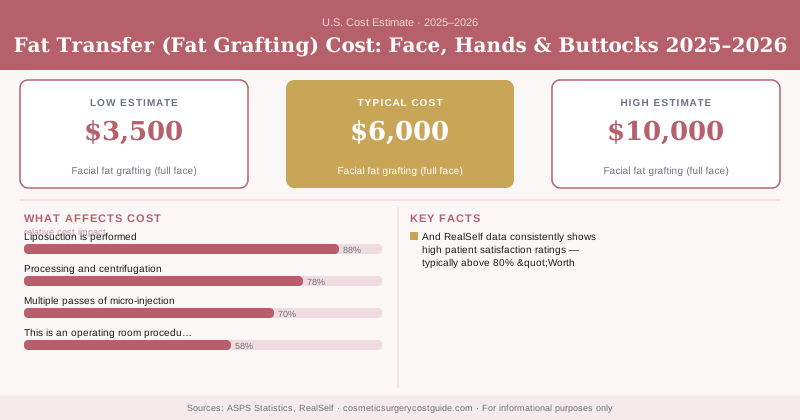
| Facial fat grafting (full face) | $3,500 | $6,000 | $10,000 |
| Under-eye hollows only | $2,500 | $4,000 | $7,000 |
| Cheeks / midface volume | $3,000 | $5,000 | $8,500 |
| Hand rejuvenation (fat) | $2,500 | $4,500 | $7,500 |
| Buttock augmentation (fat) | $5,000 | $9,000 | $15,000 |
| Breast augmentation (fat only) | $6,000 | $10,000 | $16,000 |
| Combined (face + hands) | $5,500 | $8,500 | $13,000 |
These estimates include surgeon fee, anesthesia, and facility. The donor-site liposuction (where the fat is harvested) is factored into these all-in prices.
Why Fat Grafting Costs More Than Filler
The price gap between fat grafting and injectable fillers is real — and justified. Consider what’s actually happening:
- Liposuction is performed to harvest the fat, usually from the abdomen, flanks, or inner thighs
- Processing and centrifugation purify the fat to maximize survival rates
- Multiple passes of micro-injection place the fat in tiny aliquots to ensure blood supply and longevity
- This is an operating room procedure — you need anesthesia, a sterile facility, and a surgeon monitoring the entire process
A syringe of Juvederm costs $600–$800 and takes 20 minutes. Fat grafting to the same area costs $4,000–$8,000 and takes 2–3 hours. But the results from fat grafting can last 5–10+ years (sometimes permanently), versus 9–18 months for hyaluronic acid fillers.
What Drives Cost Variation
Surgeon experience with fat grafting — Not every plastic surgeon has mastered fat grafting technique. The percentage of fat that “takes” (survives the transfer) varies enormously based on harvesting technique, processing method, and injection precision. Surgeons who specialize in structural fat grafting, particularly for the face, often charge premium rates — and deliver meaningfully better survival rates (60–80% vs. 30–40% with less experienced providers).
Number of treatment areas — A single area (like under-eye hollows) costs significantly less than a full-face fat grafting session. Combining facial fat transfer with hand rejuvenation in one operating session is more efficient than staging them separately.
Donor site complexity — Harvesting from the abdomen is straightforward. Patients with limited donor fat or previous liposuction in common donor areas may require more surgical time and effort.
Geographic location — Urban coastal practices in New York, LA, and Miami run 30–50% above Midwest or Southeast practices. The technique matters more than location for outcome quality, so don’t automatically assume coastal practices are better.
Revision transfers — Fat grafting sometimes requires a touch-up procedure 6–12 months after the initial transfer, once the volume has stabilized. Budget $1,500–$3,500 for a touch-up if needed. Reputable surgeons discuss this upfront.
Not all transferred fat survives. Industry estimates suggest 30–70% of injected volume persists long-term, depending heavily on technique. This means your surgeon typically over-fills by 20–30% intentionally. Ask your surgeon: “What fat survival rate do you typically see with your technique, and how do you process the fat?” Their answer reveals their expertise level.
Facial Fat Grafting in Detail
The face loses volume predictably with age — cheeks flatten, temples hollow, tear troughs deepen, and the midface descends. Fillers address this temporarily; fat grafting addresses it more permanently.
Common facial fat grafting areas:
- Cheeks and midface — restoring the apple-cheek fullness lost with age
- Tear troughs / under eyes — one of the most requested areas; delicate technique required
- Temples — hollowing temples age the face significantly; fat restores the youthful convexity
- Lips and perioral area — subtle volume restoration around the mouth
- Nasolabial folds — fat under the skin softens deep folds
Facial fat grafting is often combined with a facelift or brow lift — adding $2,000–$4,000 to the combined procedure cost but delivering significantly more comprehensive rejuvenation than either alone.
Fat Transfer for Hands
Hands are an often-overlooked area that betrays age — tendons become visible, veins protrude, and the skin grows thin as subcutaneous fat disappears. Fat grafting to the hands restores the soft fullness of younger hands.
For hand rejuvenation, fat grafting runs $2,500–$7,500 all-in and delivers results that last years. Radiesse filler ($600–$1,200 per session) is a non-surgical alternative for mild cases, but fat grafting produces more natural and durable results for patients with significant volume loss.
Fat Transfer vs. Brazilian Butt Lift (BBL)
The Brazilian butt lift is specifically fat transfer to the buttocks for augmentation and reshaping — it’s the same fat grafting technique, applied to a different area. The BBL’s cost ($5,000–$15,000) reflects a larger harvesting area and greater fat volumes transferred.
The safety profile of gluteal fat grafting has evolved significantly. ASPS has issued guidelines on injection plane (avoiding deep muscle injection) that have dramatically reduced the serious complication rate. Ensure any surgeon performing BBL is current with these guidelines.
Recovery Costs and Timeline
Fat grafting recovery is moderate — less than a major body lift, more than filler injections.
- Compression garments (donor site) — $80–$200; worn 2–4 weeks
- Bruising/swelling — expect 2–4 weeks of visible swelling, especially on the face
- Time off work — facial fat grafting: 7–14 days; hand fat grafting: 3–5 days; buttock: 2–3 weeks
- Sleep positioning — post-BBL patients can’t sit or lie on their buttocks for 2–3 weeks; affects daily life significantly
- Medications — $50–$150 for antibiotics and pain management
Budget 30–40% on top of the surgical fee for total out-of-pocket costs when you include recovery, medications, and potential follow-up procedures.
Avoid discount fat grafting. Low survival rates, lumpy results, and oil cysts are the most common complications from poorly-executed fat grafting — and they’re extremely difficult to correct. This is one procedure where an experienced, board-certified surgeon who specializes in fat grafting is worth the premium.
Combining Fat Grafting with Other Procedures
Fat grafting pairs naturally with:
- Facelift — adds volume while lifting; more complete rejuvenation
- Eyelid surgery (blepharoplasty) — removal of excess skin plus fat restoration for under-eye hollows
- Liposuction — if you’re already having lipo, the harvested fat can be repurposed rather than discarded
- Breast augmentation — fat-only breast augmentation avoids implants, though it’s limited in the volume increase achievable (~1 cup size maximum)
Bundling procedures saves money on anesthesia and facility fees. Ask your surgeon what makes sense to combine given your goals.
Financing Fat Grafting
Most practices accept CareCredit and Alphaeon Credit. For a $6,000–$10,000 facial fat grafting procedure, 18–24 month financing brings monthly payments to $250–$560. See the cosmetic surgery financing guide for how to structure payment plans without falling into deferred-interest traps.
Frequently Asked Questions
Facial fat grafting typically costs $3,000–$8,000, depending on the number of areas treated and the surgeon's experience level. Smaller, single-area procedures (like under-eye hollows) may start around $3,000, while comprehensive facial rejuvenation involving multiple zones can reach $8,000 or more.
Most insurance plans classify fat transfer as elective cosmetic surgery and do not cover it. You can expect to pay the full cost out-of-pocket, though some surgeons offer payment plans or financing options through medical credit companies like CareCredit to spread payments over 6–24 months.
Initial results appear within 2–4 weeks as swelling subsides, with final results visible at 3–6 months post-procedure. Typically 40–80% of transferred fat survives permanently; your surgeon may overgraft slightly to account for absorption and ensure lasting volume enhancement.