Most non-surgical facelift devices work from the outside in — ultrasound, RF, or lasers targeting skin and fascia through the surface. Fotona 4D doesn’t stop there. One of its four treatment modes goes inside the mouth.
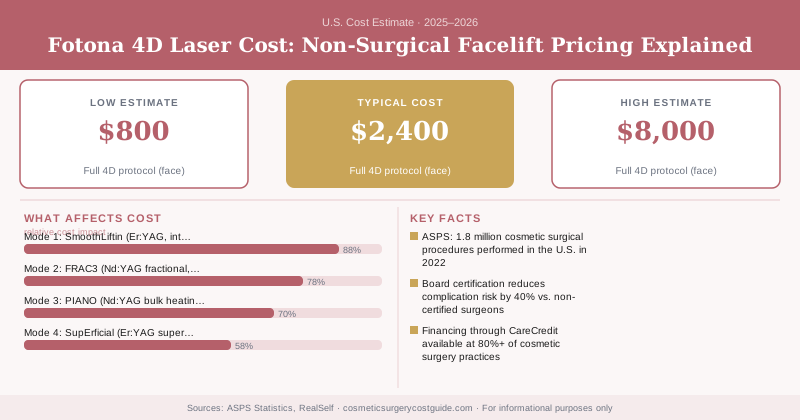
That sounds alarming. It isn’t. But it does explain why Fotona 4D sits in a genuinely different category from Ultherapy, Morpheus8, or any other non-surgical lifting device, and why its $800–$2,000 per-session pricing is worth evaluating carefully against what it actually does.
The “4D” name refers to four sequential laser modes, each targeting a different tissue depth and concern in the same session. Together they address skin surface quality, subsurface structure, deep volumetric tightening, and immediate superficial refinement. That’s the concept. Here’s the clinical reality.
Fotona 4D Pricing
| Treatment | Cost Per Session | Sessions Recommended | Total Estimate |
|---|---|---|---|
| Full 4D protocol (face) | $800–$2,000 | 3–4 | $2,400–$8,000 |
| Full 4D + neck | $1,200–$2,500 | 3–4 | $3,600–$10,000 |
| SmoothLiftin only (intraoral) | $400–$800 | 3–4 | $1,200–$3,200 |
| FRAC3 only (skin rejuvenation) | $400–$700 | 3–4 | $1,200–$2,800 |
| Maintenance session (full 4D) | $600–$1,500 | Every 6–12 months | Ongoing |
| Eyes/lower eyelids add-on | $200–$500 | 3–4 | $600–$2,000 |
Pricing varies significantly by market. Practices in Beverly Hills, NYC, and Miami routinely charge at the upper end; dermatology practices in the Southeast, Midwest, and Southwest are typically 25–40% lower. The provider’s training matters here more than with some devices — the intraoral component requires specific technique and the ability to sequence all four modes safely.
The Four Modes: What Each One Does
Understanding what you’re paying for requires understanding the four components, because “Fotona 4D” without context is just a marketing name.
Mode 1: SmoothLiftin (Er:YAG, intraoral) Performed inside the mouth using a specialized handpiece. The Er:YAG wavelength (2940nm) heats the mucosal tissue from the inside of the cheeks, tightening the underlying fascial structures that support the nasolabial folds and lower face. This is the most distinctive and clinically differentiated mode. External lasers can’t replicate this mechanism because they can’t access the inside of the fascial sleeve that creates midface support. The session is warm and mildly uncomfortable, not painful, and takes 10–15 minutes.
Mode 2: FRAC3 (Nd:YAG fractional, external) Fractional Nd:YAG laser energy applied externally. This targets deeper skin imperfections — pigmentation, vascular lesions, and texture — without ablating the surface. It’s similar in effect to non-ablative fractional treatment.
Mode 3: PIANO (Nd:YAG bulk heating, external) A scanning handpiece delivers rapid Nd:YAG pulses to heat the deeper dermal and sub-dermal structures, producing bulk volumetric heating that triggers collagen contraction and remodeling. This is the mechanism most responsible for the lifting and tightening effect. The sensation is consistent warmth — providers monitor skin surface temperature with a thermal camera in real time.
Mode 4: SupErficial (Er:YAG superficial ablation, external) A final light ablative pass with Er:YAG at very low depth to polish the skin surface — removing superficial pigmentation, refining texture, and creating the immediate “glow” effect patients notice right after treatment.
Every external non-surgical tightening device — Ultherapy, Thermage, RF microneedling, even Morpheus8’s deepest settings — works from the outside through the skin. The nasolabial fold deepens partly because the fascial envelope beneath the midface loses its structural integrity over time. Accessing that structure from the inside through SmoothLiftin treats it from a direction external energy literally cannot reach.
This doesn’t mean Fotona 4D is universally superior to Ultherapy or Morpheus8 — those devices have their own strengths. But for patients whose primary concern is nasolabial fold depth and midface descent, the intraoral component offers a clinically distinct mechanism.
How Fotona 4D Compares to Alternatives
| Treatment | Mechanism | Best For | Cost/Session | Downtime |
|---|---|---|---|---|
| Fotona 4D | 4-mode laser (internal + external) | Nasolabial folds, overall laxity, skin quality | $800–$2,000 | Minimal (1–2 days redness) |
| Ultherapy | Focused ultrasound (HIFU) | Brow lift, jowls, neck | $1,500–$4,000 | Minimal (swelling 2–5 days) |
| Morpheus8 | Deep RF microneedling | Jowls, body laxity, deep tissue | $800–$1,500 | 3–5 days |
| Thermage FLX | Monopolar RF bulk heating | Skin tightening, mild laxity | $2,000–$5,000 | Minimal |
| Surgical facelift | Structural repositioning + excision | Significant laxity | $8,000–$20,000+ | 2–4 weeks |
| Mini facelift | Limited surgical lifting | Early laxity, jowls | $4,000–$10,000 | 1–2 weeks |
Ultherapy focuses ultrasound energy to the SMAS layer — the same layer a surgeon lifts during a facelift — which produces genuine structural tightening, particularly for brow lift and jowl reduction. A single Ultherapy session runs $1,500–$4,000 but typically requires only one treatment (with results improving over 3–6 months), while Fotona 4D requires a series. For patients whose primary concern is upper face and brow position, Ultherapy is often the stronger choice. For patients with nasolabial fold depth and midface concerns, Fotona 4D’s intraoral component addresses a gap that Ultherapy doesn’t reach.
Thermage delivers monopolar RF bulk heating across the entire dermis and subdermis — an approach that produces diffuse, gradual tightening over 2–6 months after a single session. It’s particularly strong for jawline and cheek laxity in patients who can’t tolerate any recovery time. At $2,000–$5,000 per session (one session typically), it’s expensive but offers single-treatment convenience that Fotona 4D’s multi-session protocol doesn’t.
What Results Actually Look Like
Fotona 4D results are real but modest by surgical standards. Published clinical outcomes typically show 15–30% improvement in objective skin laxity measurements at 3 months post-treatment course. Patients and clinicians consistently report the most meaningful improvements in nasolabial fold depth, midface firmness, and skin surface quality.
What you won’t see from Fotona 4D: repositioning of descended facial fat pads, correction of significant jowls, or removal of excess skin. Those results require surgical intervention. The patient who gets the best value from Fotona 4D is typically 40s to 60s, has mild to moderate laxity (not significant sagging), and wants to delay or avoid surgery — not someone who would otherwise be a clear facelift candidate.
Results develop progressively. You’ll notice skin quality improvement within a week. The structural tightening from the SmoothLiftin and PIANO modes takes 2–3 months to fully express as collagen matures. Most patients who do 3–4 sessions report their best results around months 4–6 after their final treatment.
Fotona 4D is not a substitute for treatment of active skin conditions. Active rosacea, eczema, or any infection in the treatment area should be resolved before scheduling. The intraoral component specifically is contraindicated in patients with active oral infections, dental implants in the target area, or dental hardware that could affect laser energy distribution — discuss your full dental and medical history with your provider at consultation.
Finding a Qualified Provider
Fotona is a Slovenian laser manufacturer with a loyal specialty following, but it’s not as widely distributed as InMode (Morpheus8) or Solta (Fraxel). Not every market has a Fotona provider; in some cities your options may be limited to one or two practices.
When evaluating providers:
- Ask specifically how many full 4D protocols (not just Fotona procedures) they perform monthly
- Request before-and-after photos specifically for nasolabial fold and midface improvement, not just skin texture
- Confirm the practice performs all four modes in sequence, not a modified subset sold as “4D”
- Verify the provider is performing SmoothLiftin with proper intraoral technique, not just external modes
The full 4D protocol takes 60–90 minutes. Be skeptical of a “4D treatment” quoted at 30 minutes — either the modes are being rushed or the intraoral component isn’t being included.
Frequently Asked Questions
Fotona 4D treatments typically cost $800–$2,000 per full session, depending on provider location, experience, and whether the complete 4D protocol or a subset of modes is performed. Most providers recommend 3–4 initial sessions spaced 2–4 weeks apart, bringing total investment to $2,400–$8,000 for a complete protocol. Maintenance sessions are usually done every 6–12 months.
SmoothLiftin is one of four treatment modes in the Fotona 4D protocol. It's performed inside the mouth, using an Er:YAG laser to heat the mucosal tissue from the inside of the cheeks. This intraoral heat tightens the nasolabial folds and lower face from the inside out — a mechanism no external laser device replicates. It addresses the fascial structures supporting the midface without requiring incisions. The sensation is warm but generally well-tolerated.
No — and anyone marketing it that way is overpromising. Fotona 4D produces real, measurable tightening and lifting for patients with mild to moderate laxity, and the results are more significant than many comparable non-surgical options. But it cannot replicate the structural repositioning of a surgical facelift. Think of it as a tool for delaying surgery, improving results in patients who aren't facelift candidates, or maintaining post-surgical results — not replacing the procedure.