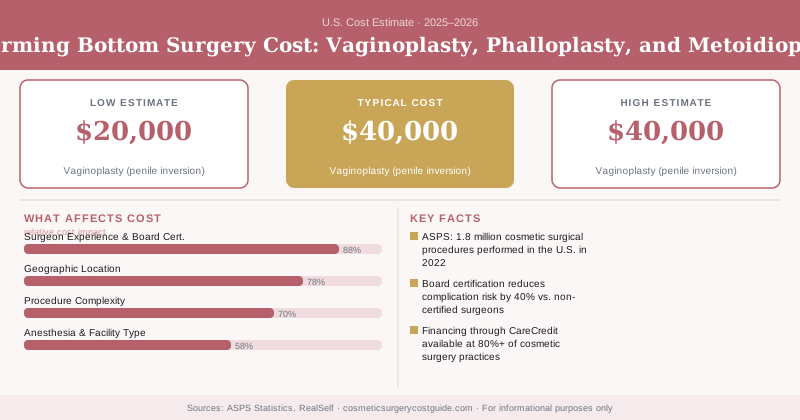
The price gap between the least and most expensive gender-affirming bottom surgery options is larger than almost any other category of surgery in medicine — from roughly $10,000 for a single-stage metoidioplasty to well over $150,000 for a multi-stage phalloplasty. Understanding why that gap exists matters as much as the numbers themselves.
Bottom surgery cost by procedure
| Procedure | Typical Cost |
|---|---|
| Vaginoplasty (penile inversion) | $20,000–$40,000 |
| Vaginoplasty (peritoneal/colon-based) | $30,000–$50,000 |
| Metoidioplasty (single stage) | $10,000–$25,000 |
| Metoidioplasty (with urethral lengthening) | $20,000–$50,000 |
| Phalloplasty (single stage) | $30,000–$70,000 |
| Phalloplasty (full staged, with urethral lengthening) | $75,000–$150,000+ |
Why phalloplasty costs so much more than metoidioplasty
Metoidioplasty works with existing genital tissue, enhanced by testosterone therapy, in a single procedure that typically takes a few hours. Phalloplasty, by contrast, constructs new tissue using a free flap harvested from the forearm, thigh, or back, requiring microsurgical reconnection of blood vessels and nerves under an operating microscope — a fundamentally more complex surgery that can run 6–10 hours for the initial stage alone.
Many phalloplasty patients also pursue additional staged procedures over the following 6 to 18 months: urethral lengthening (allowing standing urination), scrotoplasty with testicular implants, and glansplasty for a more defined tip. Each stage has its own surgical and facility fees, which is why full staged phalloplasty costs can exceed $100,000 by the time every stage is complete.
Vaginoplasty technique affects both cost and recovery
Penile inversion, the most established and widely available technique, uses existing penile and scrotal tissue to construct the vaginal canal and typically costs $20,000–$40,000. Peritoneal or colon-based techniques, sometimes needed for patients with limited tissue (often due to prior hormone therapy duration or anatomy), use abdominal tissue and require a more involved procedure, generally landing at $30,000–$50,000.
Under WPATH Standards of Care Version 8, both vaginoplasty and phalloplasty are recognized as medically necessary treatments for gender dysphoria in appropriate candidates. A growing majority of large private insurers and many state Medicaid programs now provide coverage, typically requiring documentation from mental health providers and evidence of hormone therapy duration where applicable. When approved, out-of-pocket cost often drops to your plan’s deductible and coinsurance — commonly $1,000–$5,000 rather than the full cash price.
Why the wait times matter for cost planning
Surgeons performing these procedures at high volume, particularly at academic medical centers with dedicated gender-affirming surgery programs, often have wait lists of 12–24 months. Some patients choose to pay a premium to see a surgeon with a shorter wait, while others plan their finances around the extended timeline — which does have one upside: it gives more time to navigate insurance authorization and save for any uncovered portions.
Revision surgery is a real budget line item
Complication and revision rates for bottom surgery are meaningful, particularly for phalloplasty’s urethral lengthening stage, where fistula formation is a known risk requiring additional surgical repair. Budget for the possibility of a revision procedure, which can run $5,000–$20,000 if not covered by insurance as part of the original authorization.
Choose a surgeon with high-volume, specific experience in the exact procedure you’re considering — bottom surgery techniques vary enough between surgeons that outcomes and complication rates differ meaningfully based on experience. Ask directly about the surgeon’s case volume per year and their specific complication and revision rates, not just their overall reputation.
Bottom line
Gender-affirming bottom surgery ranges from $10,000 for single-stage metoidioplasty to well over $150,000 for full staged phalloplasty, with vaginoplasty typically falling between $20,000 and $50,000 depending on technique. Insurance coverage has expanded substantially under updated WPATH standards, often reducing out-of-pocket cost to a few thousand dollars when approved — get prior authorization in writing and budget separately for the possibility of revision surgery.
Frequently Asked Questions
Vaginoplasty typically costs $20,000–$50,000 without insurance, depending on the surgical technique (penile inversion versus peritoneal or colon-based approaches) and whether it's performed in one or two stages. With insurance coverage, out-of-pocket cost often drops to the plan's deductible and coinsurance, commonly $1,000–$5,000.
Phalloplasty costs $30,000–$150,000+ because it involves harvesting tissue from another part of the body (commonly the forearm or thigh), microsurgical nerve and vessel reconnection, and often multiple staged surgeries over 6–18 months for urethral lengthening and additional procedures. Metoidioplasty, which enhances existing genital tissue rather than constructing new tissue, is a shorter, less complex single-stage procedure costing $10,000–$50,000.
A growing majority of large private insurers and many state Medicaid programs now cover gender-affirming bottom surgery when documented as medically necessary under WPATH Standards of Care, typically requiring letters from mental health providers and, for some procedures, evidence of a period of hormone therapy. Coverage requirements and included procedures vary significantly by plan and state.